Seed-saving is a form of resistance, intergenerational knowledge that survives because of Palestinian commitment to their land
Jadu’i watermelon seedlings, flourishing in California, over 7,000 miles away from Palestine, are a living testament to Palestinian resilience
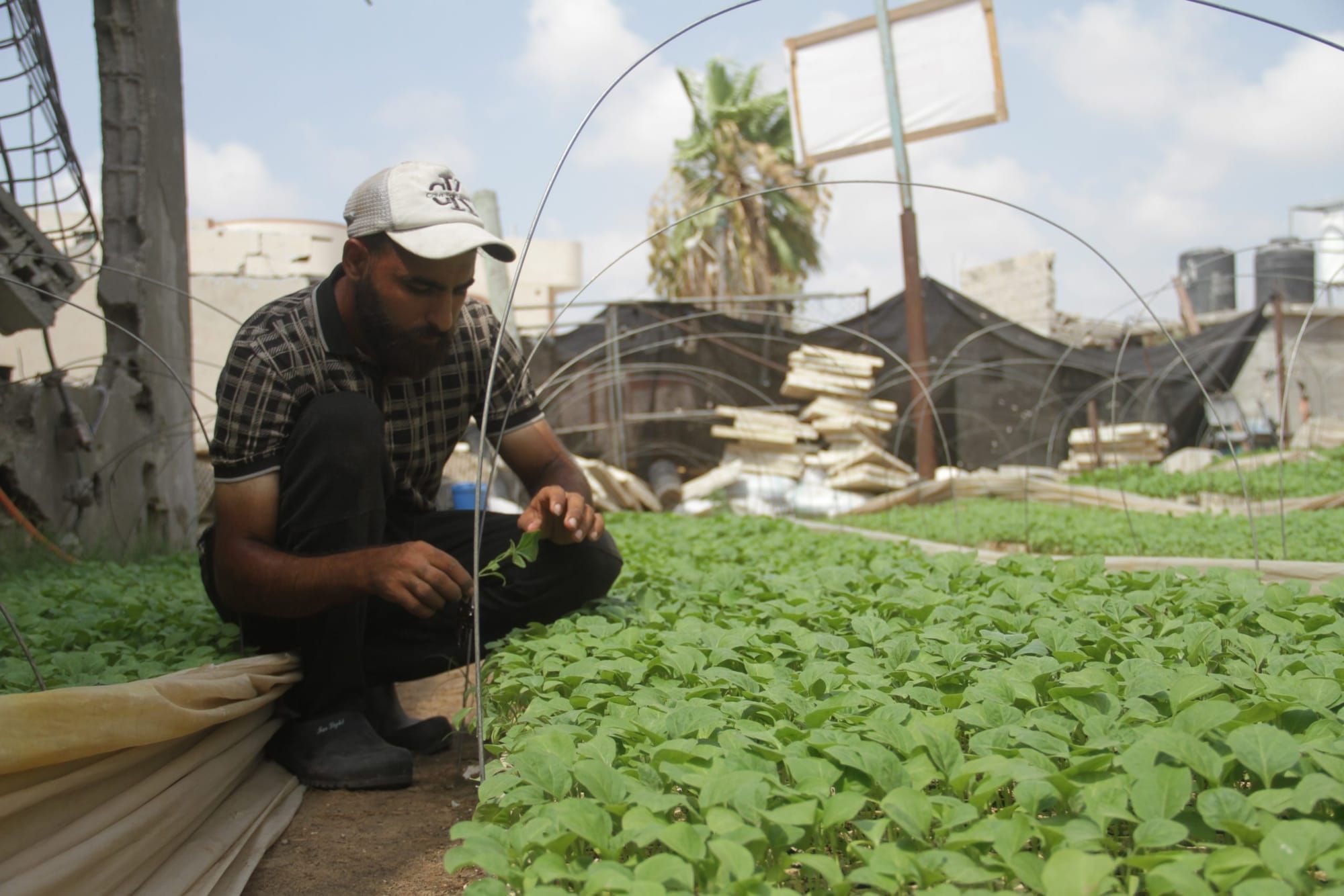
Jadu’i watermelons are not afraid of the unforgiving heat. The sweet melon was once a prized export famed throughout Palestine, finding its way to markets in Jordan, Lebanon, and Syria. This fall, the watermelons will find themselves in Los Angeles.
In five community gardens throughout the city, a handful of Jadu’i watermelon seedlings are unfurling tiny shoots and taking root. They might seem out of place being so far from home, but they have an important job to do: survive, grow, and fruit.
Seed-saving preserves heirloom varieties of plants, vegetables, and fruits like the Jadu’i watermelon—regionally specific cultivars that carry a local community’s traditions, folk history, and agricultural methods within them. For decades, Israeli occupation sought to “modernize” local agriculture, taking possession of land from Palestinian farmers and replacing traditionally grown native crops with industrial hybrids. Israel’s ongoing genocide in Palestine now threatens to eradicate both the people and the land that historically nurtured these seeds. Decades of occupation and dispossession have also sought to estrange Palestinians from their ancestral roots. Jadu’i watermelon seedlings, flourishing in California, over 7,000 miles away from Palestine, are a living refutation of that erasure and alienation.
For Chris Jadallah, an assistant professor of environmental justice in education at the University of California, Los Angeles, the seedlings are a conduit for the natural and cultural history of Palestine—a shared history that has sustained Palestinians for thousands of years.
“The knowledge and practices that have allowed us to survive in the past…will allow us to survive in the future,” Jadallah said.
For many diasporic Palestinians like Jadallah, seed-saving is an act of connection, a means of maintaining their relationship with Palestine even if they cannot physically be there.
“Our connection with the land is really strong,” Jadallah said. The professor comes from a long line of falaheen, or agricultural peasants, who tended the olive groves of Ramallah for generations.
Jadallah obtains his seeds from friends and family, and from the Palestine Heirloom Seed Library in the West Bank village of Battir, founded by artist and agriculturalist Vivien Sansour. The library preserves heirloom seed varieties and their histories, turning these seeds into living archives of Palestinian heritage.
The Jadu’i watermelon was once grown and ripened in the arid summers of Jenin, a city in the northern West Bank that derives its name from the Arabic word for garden. Over 40 years ago, watermelons flourished on the fertile plains across thousands of dunams—a measurement of land, one dunam is equivalent to 1,000 square meters. Estimates from 2021 now count Jenin’s arable land where watermelons can thrive in the tens of dunams, a mere fraction of what used to be a significant economic export.
In 1948, the newly formed Israeli military captured over 75% of historic Palestine and permanently displaced over half of the Palestinian population during the Nakba. The expansion of the occupation took an increasing toll on Palestinian agriculture. Before Israel occupied Gaza and the West Bank in 1967, agriculture was over half of the region’s gross domestic product. In 2012, it accounted for 6%. Palestinian land has existed for decades in relation to occupation, making the fertile soil an object to be claimed, so reviving the historical relationship between the land and its people is significant. Seed-saving is a form of resistance, intergenerational knowledge that survives because of the commitment of Palestinians to their land.
Preserving this connection to the land underlies Jadallah’s work, as it does for many other seed-savers. This includes Nadia Barhoum, the founder of the seed-saving and land-stewardship project Thurraya Seeds. Thurraya is the Arabic name for the star cluster Pleiades.
“For me, so much of [what it means to be Palestinian] is about our relationship to our land, [and] being in the right relationship with our land,” Barhoum said.
Barhoum started working on the Planting Justice Mother Farm in El Sobrante, California, in 2020 and chose the name Thurraya to invoke the millennia-long histories and cosmologies of the Palestinian people that occupation and displacement has tried to erase, she said. Her grandmother’s family lived in a village in Jerusalem called al-Malha until they were expelled by Israeli authorities in 1948.
“They were able to find a place in Bethlehem. It was a single room for a family of nine,” Barhoum said. “But they could grow plants and sell vegetables at the market.”
Eventually, the family had to move again, this time to an apartment with no land for growing.
“My father described it to me as…part of my grandmother dying that day.”
The political dimensions of seed-saving are inextricable from Israel’s decades-long forced displacement of Palestinians from the land they have lived on and with for centuries. The Jadu’i watermelon was very nearly a casualty of this history. During the first Intifada in 1987, Jenin was occupied by Israeli forces. A strict curfew was placed on the city, preventing farmers from tending their fields. Indigenous crops, including the Jadu’i watermelon, were left to wither and die. For decades, the fruit was thought to be lost.
But the Jadu’i watermelon survived—as seeds. In 2016, Sansour found a handful of Jadu’i seeds in a farmer’s tool shed in Beit Jala, a small town just west of Bethlehem. The farmer had the seeds stashed away in a drawer for seven years.
Growing heritage varieties is an endangered practice in the already-precarious landscape for Palestinian farmers in the West Bank. Local markets are regularly flooded with cheap Israeli produce, undercutting domestic producers. As a result, Palestinian farmers are displaced from their lands, and Palestinians are left increasingly dependent on Israeli imports. But to Sansour, these hostile circumstances were why planting the Jadu’i watermelon seeds was so important. Despite being stored among screwdrivers and hammers, the seeds grew and bore fruit, and by 2018, Sansour distributed over 3,000 seedlings to farmers in Palestine. By 2019, the Palestine Heirloom Seed Library was sending seeds to growers worldwide. The seedlings that now grow in California come from this lineage of survivors.
This history isn’t lost on Barhoum and Jadallah.
The relationship between Palestinian people and plants, said Jadallah, “poses an explicit threat to settler state building.” Israel’s acts of ecological destruction are, in a sense, a tacit acknowledgment of the cultural significance of Indigenous Palestinian plants. Olive trees, which have grown in Palestine for thousands of years, often signify sumud, the Palestinian cultural value of being steadfast and persistent in the face of displacement and occupation. If you cut down a prickly pear cactus, it will grow anew from cuttings, exemplifying its Arabic name sabr, or patience. The watermelon, with its red flesh and white and green rind, has famously represented the Palestinian flag since 1967, when Israeli police gained the power to remove anything that was a threat to “public order.” In January 2023, the Israeli government outright banned the flag from public spaces.
The communal ties nurtured by seed-saving extend beyond Palestine. Li’i Furumoto, an educational consultant and parent of two children attending New Horizon School in Pasadena, California, happened to attend a Zoom workshop taught by Jadallah. When Jadallah mentioned that he had Jadu’i seeds to distribute to community gardens willing to plant them, Furumoto, who is on the committee that oversees the school’s community garden, saw the opportunity to organize Seeds of Hope, an event aimed at helping to protect and celebrate Indigenous traditions from Palestine to North America.
“We wanted to make this a healing event,” Furumoto said. “[Our school community] had a lot of people whose families were killed, and many of them were previously expelled from their homeland.”
Furumoto, who is of Yacqui descent, also wanted Seeds of Hope to draw broader connections between the shared history and experiences of Palestinian and the Indigenous peoples of Southern California and their shared beliefs of being stewards and caretakers of the land.
“As a person of Native descent, we have gone through the same experience of genocide and cultural eradication, and the decimation of the environment we lived in,” Furumoto said. “But we are in a state of revival, of trying to bring back our traditions…and we believe that for the Palestinian people, there will come a point in time where they will also be able to live freely.”
Because of Furumoto’s connections to community gardens throughout Los Angeles, the Jadu’i seeds were distributed to Arlington Garden and El Sereno Community Garden, as well as gardens at Occidental College and Woodrow Wilson High School.
Alice Zhang, a volunteer at Arlington Garden in Pasadena, said the planting was accompanied by poetry and shared food—watermelon with fresh mint and soft Nabulsi cheese.
“I [remember] the voices of people,” Zhang said. “People were getting their hands into soil, digging holes, moving mulch, [and] putting in oyas,” or clay pots buried underground for irrigation. The volunteer told Prism “there were a lot of hands” at the event, and it felt like a special moment “for everyone who did it.”
This spirit of solidarity and community is fundamental to seed-saving, something Jadallah experienced when he began seed-saving at the Cultural Roots Nursery in Winters, California, which cultivates culturally significant heritage plants. There, he received physical infrastructure, land, and practical mentorship from other agriculturalists, many of whom are from diaspora communities, too. With their support, Palestinian watermelons flourished on Californian soil, interacting with the local ecology.
“I’d see native bees visiting their flowers, a little sweat bee or mining bee,” Jadallah said. The watermelon was pollinated by the bees, and in turn the bees received nectar and pollen from the watermelon, each sustaining the other. “It’s this beautiful reciprocal relationship,” he said.
In the nursery, Jadu’i watermelons grew next to Taiwanese bitter melons, their vines tightly intertwined. To Jadallah, this is what solidarity looks like—not inevitably borne of shared circumstance but actively grown and cultivated.
This solidarity between plant communities can even grow resilience to climate change. Many Palestinian plants are adapted to drought, with little need for irrigation. As California faces increasingly hot, dry, and drought-prone conditions, the resilience of these varieties could prove vital to food production.
Nearly three months from when they were first planted, the Jadu’i watermelons at Arlington Garden were beginning to fruit. They grew from delicate seedlings into robust plants, their vines too long to be contained within the beds they were planted in. Even as heat waves brought weeks of temperatures over 100F°, they were resilient to the Californian summer as their ancestors were in Jenin.
Historically, the Jadu’i watermelon was a ba’al, or rainfed crop. It was planted at the end of the rainy season, and the still-damp soil provided all the water the fruit would need for months. The rainfed crops are named for the Canaanite deity Ba’al, the god of fertility and destruction—not as opposites, but as part of a cycle of renewal.
To mimic the traditional planting method, the volunteers at Arlington Garden used a garden hose to flood troughs dug around each seedling, suffusing the earth with moisture. Water rushed into the grooves, a steady pulse flowing through the dirt like blood through a vein.
Planting seeds is a practice of care and solidarity and moving toward a vision of the world Jadallah wishes to bring into being.
“When Palestine is free, what are we going to live like?” Jadallah said. “What communities are we going to build? I see planting seeds now as starting…to build [that] future.”
Author
Sign up for Prism newsletters.
Stay up to date with curated collection of our top stories.