Legal threat to long-standing disability law sets precedent for future civil rights attacks, advocates warn
Texas v. Becerra targets Section 504 of the Rehabilitation Act after the Biden administration included gender dysphoria as a protected disability

A coalition of 16 states joined Texas in a lawsuit claiming that a federal rule that prohibits discriminating against disabled people is unconstitutional. The lawsuit is sparking fear among disability advocates, who say it sets a precedent for future attacks on civil rights protections.
The lawsuit, Texas v. Becerra, was filed in September by Texas Attorney General Ken Paxton after the Biden administration updated Section 504 of the Rehabilitation Act last year to include gender dysphoria as a protected disability. On Feb. 20, Texas, along with the other GOP-led states, submitted a new court filing clarifying their stance in the lawsuit following backlash nationwide from disability advocates, who urged state attorneys general to back out of the lawsuit.
“The Biden Administration is once again abusing executive action to sidestep federal law and force unscientific, unfounded gender ideology onto the public,” Paxton said in a press release in September. “Texas is suing because [the U.S. Department of Health and Human Services] has no authority to unilaterally rewrite statutory definitions and classify ‘gender dysphoria’ as a disability.”
Section 504 became federal law in 1973 as part of the Rehabilitation Act to prohibit disability discrimination by the federal government and federally funded entities within health care, education, employment, and more. It also prohibits the segregation and institutionalization of disabled people and requires services to be provided in the least restrictive settings possible. Institutions that fail to comply with Section 504 risk losing their federal funding.
The coalition of conservative states trying to overturn the Biden administration’s change argues that Section 504 is unconstitutional and wrongly leverages federal funding, according to Britt Dorton, a law student at the University of Michigan who focuses on disability rights. Dorton told Prism that these states are trying to remove the 2024 rule because they want to keep discriminating against people with body dysphoria without the risk of losing funding.
The lawsuit also addresses the 1999 Supreme Court decision Olmstead v. L.C., claiming that it’s unreasonable and costly to ask states to make every space and service accessible to disabled people.
“Part of me wonders if the attorneys general just don’t understand the implications of Olmstead, that they’re trying to argue that they should be able to provide separate but equal facilities for people with disabilities,” Dorton said.
On Feb. 19, the 17 states filed a joint status report clarifying that they are not trying to eliminate Section 504, but rather challenge a specific rule within it.
“From the beginning our lawsuit challenging the Biden administration’s rule categorizing gender dysphoria as a disability was about just that: challenging that specific rule,” Arkansas Attorney General Tim Griffin said in a press release. “Threatening Section 504 of the Rehabilitation Act of 1973 in its entirety was never our goal nor was it something we sought, despite what some have said in the media and online.”
Similarly, Nebraska Attorney General Mike Hilgers said in a statement that his state joined the lawsuit because the regulation update “hijacks Section 504 for political purposes and threatens the way Nebraska provides mental health services.” He added that his office would “reevaluate Nebraska’s involvement or take other appropriate action if the legal protection and funding provided by Section 504 becomes threatened.”
But disability experts point out that no states have dropped out of the lawsuit and nothing in the complaint has changed; it still explicitly states that Section 504 is unconstitutional, which could eliminate the law entirely and have far-reaching consequences for the disability community.
Threats to disability and transgender rights
The lawsuit not only threatens protections for trans people, but it also sets a precedent for future attacks on disability law and the entire disability community, advocates say. For disabled people nationwide, this lawsuit could threaten accommodations at schools, workplaces, and health care spaces.
During the 2020-2021 school year, 1.6 million disabled students had 504 plans, according to the U.S. Department of Education. Among that demographic was Mercy Botchway, 21, who used a 504 plan to access her education as a Deaf student with executive dysfunction when she started high school in 2018. Her accommodations included sitting at the front of the classroom, receiving class notes from the teacher, and using a device that connects the teacher’s voice to her hearing aid.
“If I didn’t have that, I’d always have to be accommodating myself,” she said.
Without a 504 plan, Botchway said it would have been impossible for her to attend school and emphasized how important it is for these rights to be protected by federal law.
“It’s better to have legal backing when asking for accommodations because sometimes, unfortunately, the threat of legal challenges causes a school to take them seriously,” she explained.
The Department of Education did not respond to requests for comment on the lawsuit.
How the case could eliminate Section 504
The lawsuit was filed in a Northern District of Texas federal court, and if it goes to trial, the losing party can appeal to the 5th Circuit Court of Appeals. The 5th Circuit Court has a reputation for being one of the most conservative courts in the country, often going against legal precedent.
“I think the 5th Circuit is very much a court that would … go above and beyond and say, ‘No, all of 504 should be thrown out,’” Dorton said.
The legal proceedings for Texas v. Becerra are paused as the Department of Health and Human Services reevaluates its position following President Donald Trump’s executive order encouraging agencies to stop promoting “gender ideology,” Stateline reported. According to KSL News, Utah’s former Attorney General Sean Reyes believes that the regulation in Section 504 would be withdrawn, and therefore, Section 504 will be safe.
Dom Kelly, president of New Disabled South, a disability rights organization operating in 14 southern states, said that the lawsuit “is not just about gender dysphoria.” Instead, it could also hurt people with intellectual or developmental disabilities.
Disabled people are pushing back
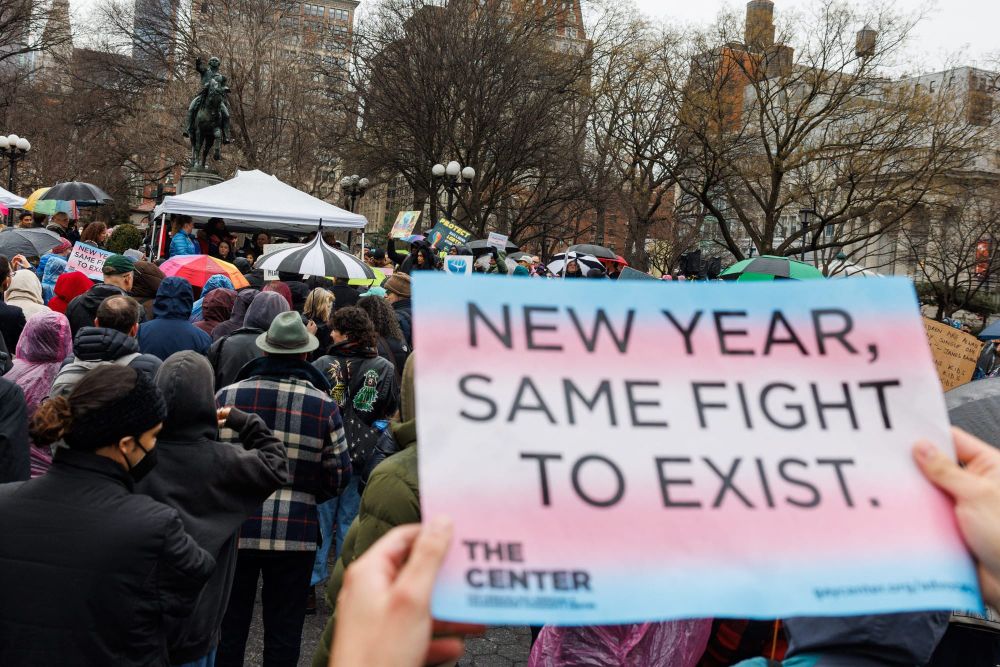
Disabled people and allies are organizing rallies nationwide to urge state attorneys general to back out of the lawsuit. In Atlanta, about 50 parents, advocates, and educators attended a rally last month to protest the lawsuit. Some attendees spoke alongside state elected officials, said Kelly, who attended the event.
Although legal proceedings are paused, no states have backed out of the lawsuit, igniting fears among Kelly and others of more attacks against disability rights in the future. Kelly predicted that the lawsuit could likely be a “springboard for doing away with the Americans with Disabilities Act,” since Section 504 was the precursor to the federal disability law.
Kelly said he hopes more people will show up and demand that the lawsuit go away.
“[The attorneys general are] motivated by transphobia,” he said. “But this will also be detrimental to the disability community.”
Editorial Team:
Sahar Fatima, Lead Editor
Carolyn Copeland, Top Editor
Rashmee Kumar, Copy Editor
Author

Shruti Rajkumar is a freelance journalist with a focus on disability reporting. Previously, they were a breaking news reporter at HuffPost. Rajkumar earned a Bachelor's degree from Emerson College and
Sign up for Prism newsletters.
Stay up to date with curated collection of our top stories.