Supreme Court rules that bans on public encampments are permissible and do not violate Eighth Amendment protections
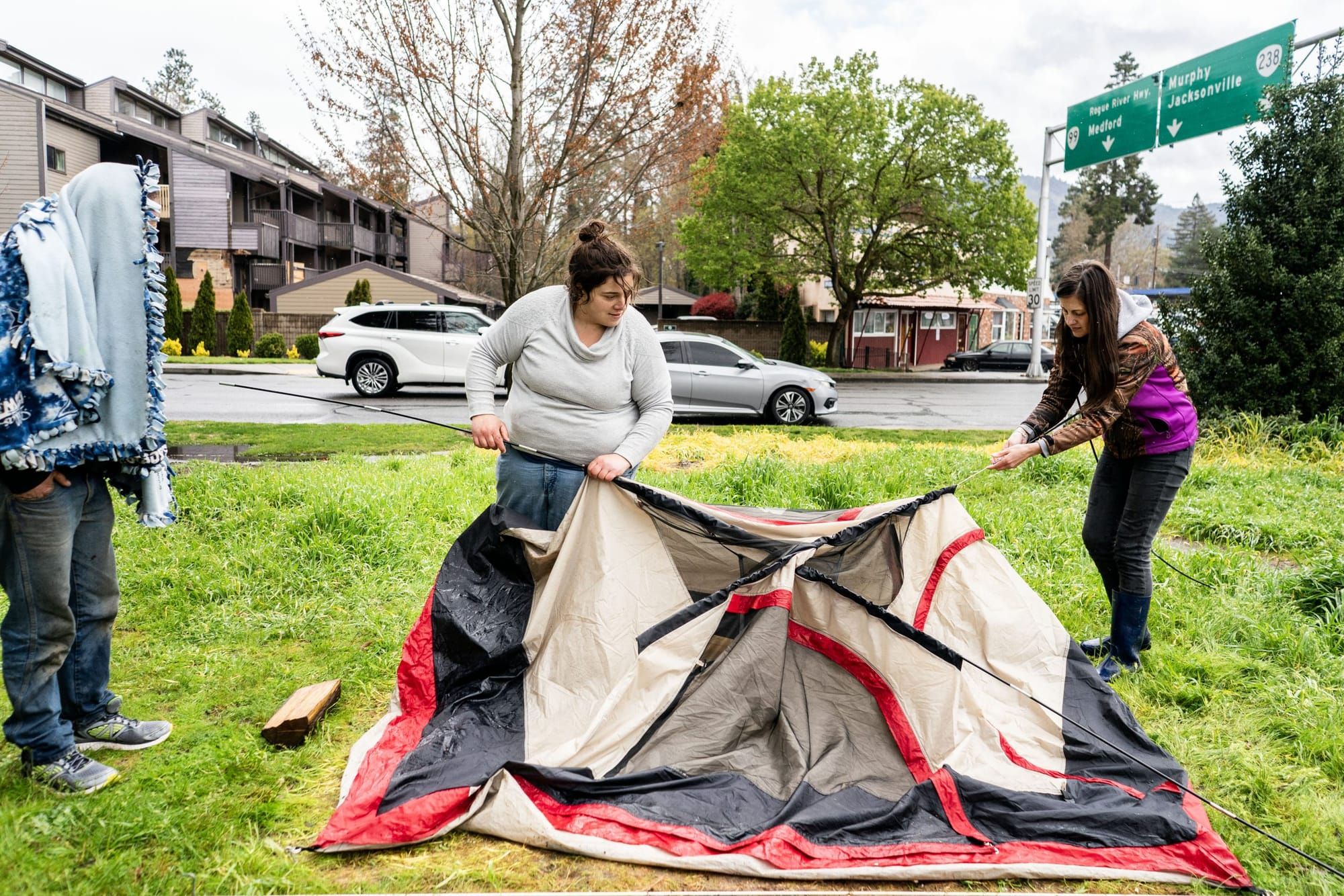
The Supreme Court on Friday, June 28, ruled on what many consider to be one of the most significant cases involving the rights of those experiencing homelessness in recent decades. In City of Grants Pass v. Johnson, the Supreme Court ruled in a 6-3 decision that cities have the right to enforce bans on people sleeping outdoors or in public encampments, reversing a lower court’s ruling against the policy.
Advocates for unhoused people widely condemned the ruling. “At a time when elected officials need to be focused on long-term, sustainable solutions that are grounded in evidence—including funding the affordable housing and supportive services that their constituents need—this ruling allows leaders to shift the burden to law enforcement,” said Ann Oliva, CEO of the National Alliance to End Homelessness, in a press release. “This tactic has consistently failed to reduce homelessness in the past, and it will assuredly fail to reduce homelessness in the future.”
In 2018, a group of involuntarily unhoused citizens of Grants Pass, Oregon, filed a suit against the city for a policy concerning public encampments. The ordinance bans sleeping and camping in public places and levies high fines and fees for those who sleep in public encampments.
Plaintiffs in the case argued that the policy criminalizes homelessness and makes anyone experiencing housing insecurity vulnerable to prosecution or saddles them with fines. Fines under the ordinance start at $295. One of the lead plaintiffs in the case, Debra Blake, accrued more than $5,000 in fines before her death in 2021.
In 2022, the 9th Circuit Court of Appeals ruled in favor of the plaintiffs, finding that the ordinance criminalizes housing insecurity without providing alternate shelter options. In doing so, the policy violates the Eighth Amendment protections against the use of “cruel and unusual punishment.”
Grants Pass currently has a homeless population of about 600, yet the city’s shelter system can only accommodate roughly 130 people. In a 2013 community roundtable on “vagrancy problems” throughout Grants Pass, then-City Council President Lily Morgan said, “The point is to make it uncomfortable enough … in our city so [they] will want to move on down the road.”
Plaintiffs and their supporters have sought to highlight how the policy exacerbates the economic precarity of people already experiencing homelessness while also funneling them into the larger criminal legal system. They argue that penalizing homelessness turns housing insecurity into a “status crime.” The 1962 case Robinson v. California led to the Supreme Court ruling that it is unconstitutional to criminalize a state of being or punish an individual for an “involuntary status” such as being dependent on substances such as alcohol or, in this case, experiencing homelessness and not having access to shelter.
Advocates for the City of Grants Pass argue that the 9th Circuit Court ruling encroaches upon the city’s leadership and restricts what municipalities can do to manage issues involving vagrancy and public encampments. They also have argued that the Eighth Amendment should be interpreted within the context of the time it was written, stating that the Constitution is not a living document but rather one with fixed, immutable meaning and thus cannot be applied to this case.
This debate about viewing the Constitution through the lens of its original intent versus allowing its meaning to evolve is central to why this recent ruling is so significant and could have ripple effects beyond housing policy. In addition to setting a precedent for other states to criminalize homelessness, the decision not to uphold the 9th Circuit Court ruling may mark a turning point around the rights of incarcerated people.
Decades of wins for those imprisoned across the country have come via successful lawsuits that interpreted the Eighth Amendment under contemporary understandings of what constitutes cruelty. These victories came from recognizing that there are “evolving standards of decency” to which the Constitution must be applied. For example, defining poor prison conditions or mistreatment of those in the criminal legal system as cruel and unusual punishment has helped formerly incarcerated people gain access to the right to vote and has been the basis of cases related to imprisoned people seeking access to better health care, gender-affirming surgery, as well as policy changes regarding solitary confinement.
While the impact of the Supreme Court’s decision on these issues is yet to be seen, the effect on those experiencing homelessness nationwide may come soon with certain communities at greater risk. LGBTQIA+ individuals are unhoused at highly disproportionate rates, and this is particularly true for young people. While LGBTQIA+ youth make up less than 10% of the U.S. population, they make up 40% of unhoused youth and 65% of youth enduring chronic homelessness, according to the Center for Constitutional Rights (CCR). In April, CCR filed an amicus brief on behalf of 46 groups detailing the impact the SCOTUS ruling could have on LGBTQIA+ youth.
“The Supreme Court, a historically reactionary institution, is growing ever more hostile to the needs of low-income Americans and other marginalized groups,” the group said in a statement released on Friday following the ruling.
Similar concerns have been raised by and about domestic violence survivors who also experience homelessness at disproportionate rates. In fact, studies have shown that 57% of houseless women cite domestic violence as the immediate cause of their homelessness.
In a statement to the Associated Press, Grants Pass Mayor Sara Bristol shared that the city council will first need to review the decision to determine its next steps. However, she shared relief “that Grants Pass will be able to reclaim our city parks for recreation. Homelessness is a complex issue, and our community has been trying to find solutions.”
Meanwhile, legislators outside of Oregon have weighed in on the decision and what it may mean for their communities. Both California Gov. Gavin Newsom as well as San Francisco Mayor London Breed have praised the decision.
“This decision removes the legal ambiguities that have tied the hands of local officials for years and limited their ability to deliver on common-sense measures to protect the safety and well-being of our communities,” said Newsom in a public statement.
However, advocates for unhoused people resisted the idea that local and state leaders have been trying to find meaningful solutions or “common-sense measures.”
Members of the National Alliance to End Homelessness, for example, have emphasized investment in affordable housing and the U.S. Department of Housing and Urban Development’s Homeless Assistance programs as more significant efforts that could address housing insecurity without criminalizing those who are experiencing it.
Advocates in Portland, Oregon, also highlighted how the ruling will create new burdens for themselves and those they seek to serve.
“This decision really does make our work more difficult,” said Liz Starke, the development director for Rose Haven, a community center and day shelter, to KOIN 6 News. “Because when people have additional fines or jail time, that’s ultimately getting them further and further away from their goals and sustainability.”
Author

Tamar Sarai is a writer, journalist, and historian in training. Her work focuses on race, culture, and the criminal legal system. She is currently pursing her PhD in History at Temple University where
Sign up for Prism newsletters.
Stay up to date with curated collection of our top stories.