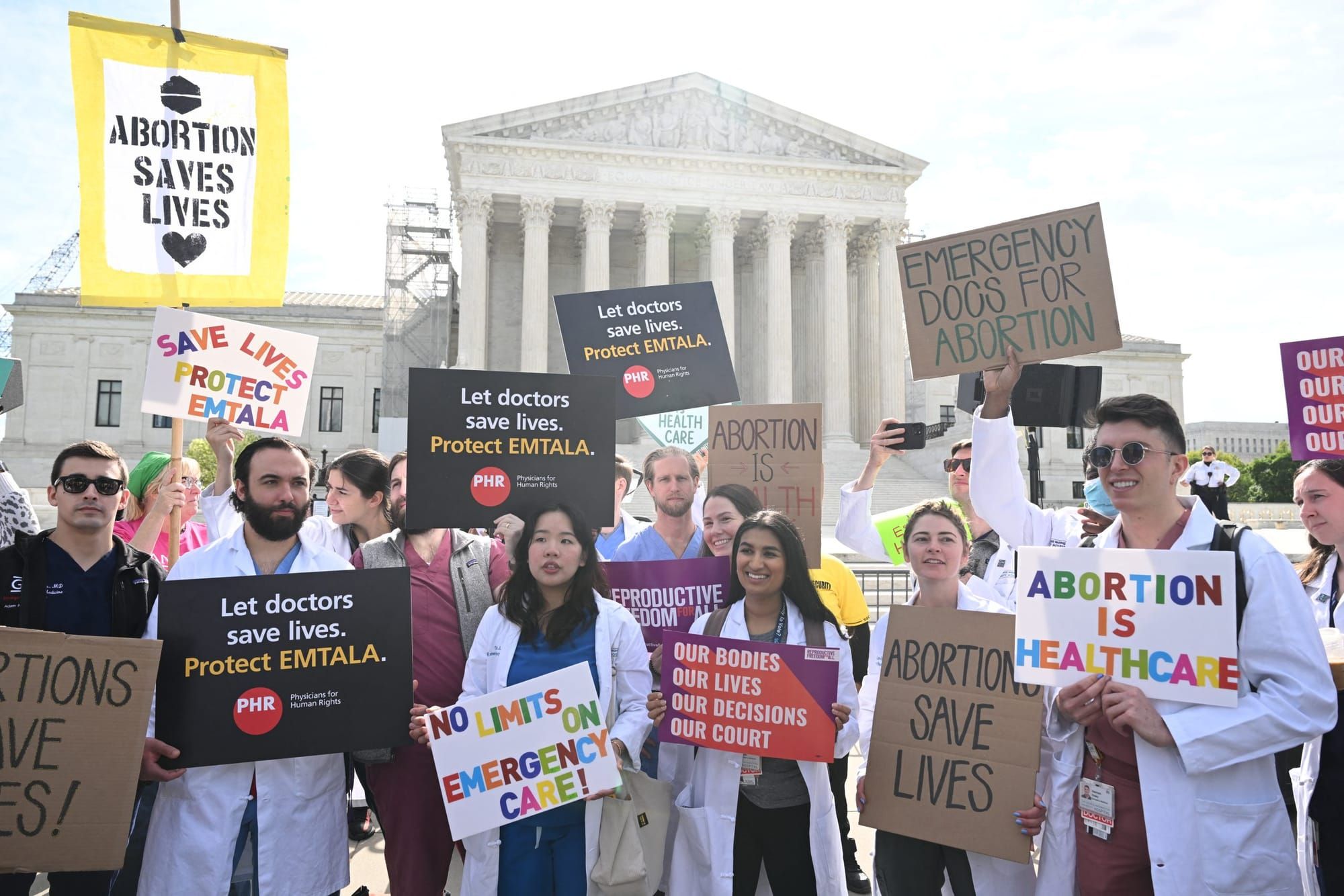
In a pivotal decision, the Supreme Court dismissed the Idaho emergency abortion case, safeguarding access to abortion care in emergency situations in the state. The 6-3 ruling, which comes amid a landscape of escalating challenges to reproductive freedom, marks a temporary victory for advocates and communities disproportionately affected by restrictive laws.
“To be clear: Today’s decision is not a victory for pregnant patients in Idaho. It is delay,” wrote Justice Ketanji Brown Jackson in an opinion that partially concurred and partially dissented. “While this Court dawdles and the country waits, pregnant people experiencing emergency medical conditions remain in a precarious position, as their doctors are kept in the dark about what the law requires. This Court had a chance to bring clarity and certainty to this tragic situation, and we have squandered it. And for as long as we refuse to declare what the law requires, pregnant patients in Idaho, Texas, and elsewhere will be paying the price. Because we owe them—and the Nation—an answer to the straightforward pre-emption question presented in these cases, I respectfully dissent.”
In Idaho and Moyle v. United States, SCOTUS decided whether the court should uphold its stay on a lower court’s decision to prevent the state of Idaho from enforcing the Defense of Life Act, which prohibits abortion except to save the life of a pregnant person. When SCOTUS implemented the stay in January, it allowed the state to disregard the federal Emergency Medical Treatment and Labor Act (EMTALA) and refuse to provide emergency abortions under state laws. While vacating the stay restores the lower court’s injunction, temporarily protecting abortion rights in the state, the courts did not resolve the question at the heart of the case about how state abortion bans and federal directives on emergency health care relate. Lower courts will continue to decide on that question, and abortions as emergency care will continue in Idaho as it plays out, but the dismissal has no bearing on other states with bans.
“Today the court took the politically convenient route by temporarily upholding federal protections for pregnant people five months before an election where abortion will be the key defining issue,” said Nourbese Flint, President of All* In Action Fund. “Let’s be clear—the bar is in hell.”
Since Roe v. Wade was overturned two years ago this month, experts say the maternal mortality rate has increased, especially for pregnant people of color. The ruling comes at a critical moment, with reproductive rights advocates expressing deep concern over the erosion of access to essential health care services.
“This case should never have been taken up by the courts in the first place,” said Flint. “Dismissing the case has everything to do with politics and little to do with protecting people’s health and safety. Anti-abortion politicians are putting people’s lives, health, and future fertility on the line to further their political agenda. It is important for us who believe in freedom, autonomy over our bodies, and a functioning democracy to understand that the majority MAGA justices are still in pursuit of power, even if it is delayed. Our communities deserve better.”
Regina Davis Moss, the president and CEO of In Our Own Voice and a leading voice in the fight for reproductive justice, underscored the impact of restrictive policies on marginalized communities, particularly Black women who face disproportionate risks and barriers to care.
“We have to back up to talk about what’s happened in the last two years since Dobbs,” said Moss. “The research predicted that we were going to see an increase in maternal mortality rates; we’ve seen that now Black women at childbearing age are thinking about, should I even get pregnant? Should I be living in the state where I currently am?”
Moreover, the emergence of so-called “abortion deserts,” regions where access to abortion care is severely restricted or nonexistent, has added further urgency to the situation. The implications are far-reaching, placing undue burdens on patients and exacerbating existing disparities in health care access.
“Today’s Supreme Court decision preserves the right to emergency care—including abortion care—for now, but makes clear why the courts have no place making medical decisions,” said Daniel Grossman, director of Advancing New Standards in Reproductive Health (ANSIRH), an abortion and reproductive health research program based at the University of California San Francisco. “Patients and providers cannot operate under the constant threat of criminalization and fear hanging over them. Any future action by the courts to restrict emergency care will tie the hands of providers who are providing care in life-threatening situations, making pregnancy more dangerous for patients.”
Post-Roe research from ANSIRH shows that even with EMTALA protections in place, doctors feel their hands are tied, leading to harmful health outcomes for patients and possible legal consequences for providers.
“Medicine is not black and white, and every pregnancy is different,” said Grossman. “Health care providers must be able to practice medicine without political interference—the health and well-being of patients depend on it.”
According to Moss, Black women are “the canary in the coal mine” in terms of what is to come. In 2021, the maternal mortality rate for non-Hispanic Black women was 69.9 deaths per 100,000 live births, 2.6 times the rate for non-Hispanic White women. According to data, 43% of Black women of childbearing age are in Texas, Georgia, and Florida, where some of the toughest laws exist. Now, these pregnant people will not even be protected in cases of emergencies.
“Imagine having to travel to the South. That’s not a two-hour trip, you know, that’s days away,” said Moss. “And then there’s recovery. People just can’t afford to turn right back around and come back to work. If you’re looking at people who have already made the decision because it could push them further into economic distress, it really just perpetuates the cycle.”
In response to these challenges, Moss emphasized the need for comprehensive solutions that extend beyond legal protections. Access to health care, robust sex education, and policies rooted in reproductive justice are essential to safeguarding reproductive rights.
“What we know is that certain communities that have historically been disenfranchised are going to feel the impact of these things in a very magnified way,” Moss said. “It’s very disheartening that we are in the state because the reality is, people are going to lose their lives.”
Author

Alexandra is a Cuban-American writer based in Miami, with an interest in immigration, the economy, gender justice, and the environment. Her work has appeared in CNN, Vice, and Catapult Magazine, among
Sign up for Prism newsletters.
Stay up to date with curated collection of our top stories.