Breaking: SCOTUS rules against affirmative action
Chief Justice John Roberts penned the majority opinion that race-conscious admissions policies violate the equal-protection clause of the U.S. Constitution

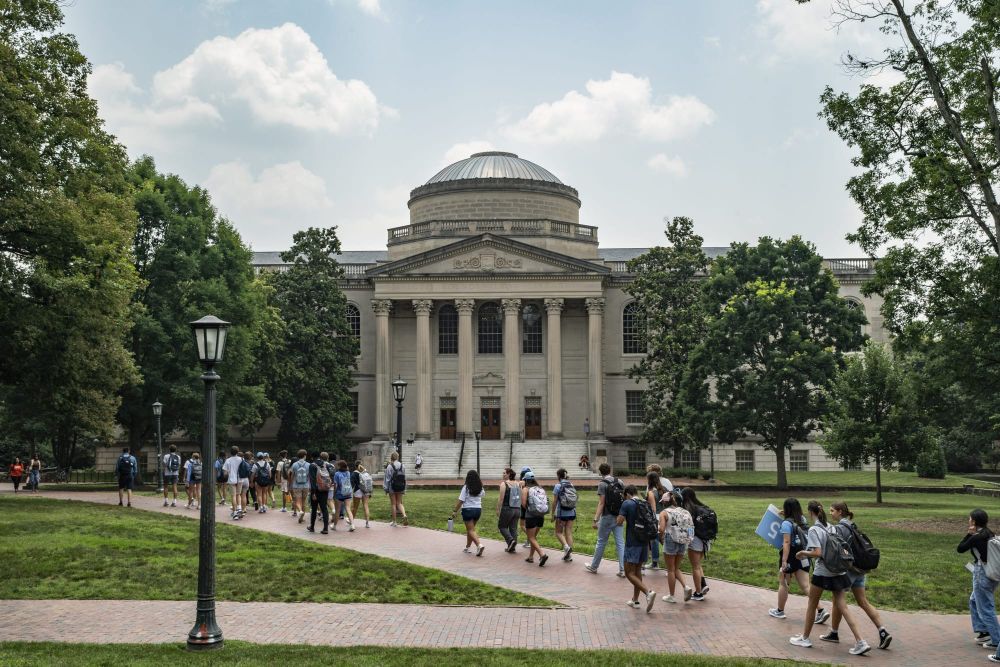
The U.S. Supreme Court has ruled that race-conscious admissions policies at Harvard University, a private institution, and the University of North Carolina, the nation’s oldest public university, violate the equal-protection clause under the U.S. Constitution. The court’s conservative majority was poised to undo the decades-long affirmative action policy, which was enacted via executive order in 1961 by former President John F. Kennedy. The decision now jeopardizes affirmative action at colleges across the nation and is expected to decrease the number of Black and Latinx students.
“We have disparities in people of color in the upper echelons of corporate America, nonprofits, corporate at large companies,” said Errol Pierre, co-author of “The Way Up: Climbing the Corporate Mountain as a Professional of Color.” “And that stems from systematic bias that has happened in the country’s history.”
Affirmative action was introduced in the early 1960s as a way to combat racial discrimination in the hiring process. Since then, the policy has been aimed at creating more diverse student bodies by factoring in students’ racial backgrounds during the admissions process. The consideration is taken in tandem with applicants’ test scores, grades, and extracurricular activities. Advocates of the policy say it has been successful in relatively increasing representation of students of color, even though they are still underrepresented in higher education. In 1965, only 4.8% of all undergraduates were Black. Between 1965 and 2001, that percentage more than doubled.
“By unraveling the program now, all the work that has been done since 1964 … will just immediately stop,” Pierre said. “Schools won’t be able to figure out how to have diverse classrooms if we’re not allowed to use race at all.”
Pierre says the ripple effect will be far reaching.
“You will have people of color just decide not to even apply to what we call their stretch schools or dream schools because they’ll say, ‘I don’t even have a chance,’” Pierre said. “So you are actually going to have a double hit, which then turns into less income, less generational wealth, fewer job opportunities. So just the ripple effects are just uncanny.”
Affirmative action opponents have challenged the law before. Prior to the SCOTUS decision, the policy was outlawed in nine states, including California and Florida. According to SCOTUSPoll data, 69% of people surveyed believe private colleges and universities should not be able to use race as a factor in admissions, while 74% think public colleges and universities should not be able to use race as a factor in admissions. Politically, both Democrats and Republicans alike favor not taking race into account.
The court previously upheld affirmative action programs as recently as 2016, saying that educational diversity is a compelling interest. Now, the group Students for Fair Admissions’ argument that considering race as a factor amounts to racial discrimination, particularly against Asian Americans, will completely reshape the college admissions process for students across the country.
Author

Alexandra is a Cuban-American writer based in Miami, with an interest in immigration, the economy, gender justice, and the environment. Her work has appeared in CNN, Vice, and Catapult Magazine, among
Sign up for Prism newsletters.
Stay up to date with curated collection of our top stories.