A farm in rural North Carolina provides a refuge and radical new possibilities for formerly incarcerated women
Alamance County’s Benevolence Farm provides housing, job skills, and community connections to women leaving prison
The 13 acres of farmland nestled in North Carolina’s Alamance County that comprise Benevolence Farm serve many different purposes: an active body care business harvesting herbs for natural soaps and soy wax candles, a hub for social advocacy about issues impacting formerly incarcerated women across the state, and a home and a refuge for a handful of those very women.
As both a small business enterprise and a reentry community, Benevolence Farm provides formerly incarcerated women a place to reside and tend to the farmland, with the women living in one of two shared homes for a time period between six months to two years. Benevolence Farm also plans to build tiny homes as an independent living option for women who still desire peer support but want to experience living alone. In addition to receiving supportive services that help aid in their transition out of incarceration, residents work on the 13-acre farm, tending to general farm chores, including planting, harvesting, and drying herbs and flowers, making body care products, packing online orders, and even creating new products. The farm enterprise helps women earn a living wage, acquire job readiness skills, and earn a pre-apprenticeship certificate from the Department of Labor certifying their training for jobs in the green economy.
With over 2,500 women returning home from North Carolina state prisons annually, Benevolence Farm fills a crucial gap by providing services that speak to the unique needs of formerly incarcerated women—many of whom are also the primary caretakers for their families. Unlike countless other reentry programs, Benevolence Farm doesn’t deny entry based on certain past convictions, meaning that even women with Class A felonies or histories of substance dependence can apply. However, the farm’s size and commitment to “scale up at the speed of trust,” as described by Executive Director Kristen Powers, means that it cannot possibly meet the needs of every woman returning home across the state. Thus, the farm is a dream realized for some and, ideally, a model to be replicated by others.
Prism spoke with Powers by phone about Benevolence Farm’s “individualized system,” the housing crisis facing incarcerated women, and the importance of using a trauma-informed lens.
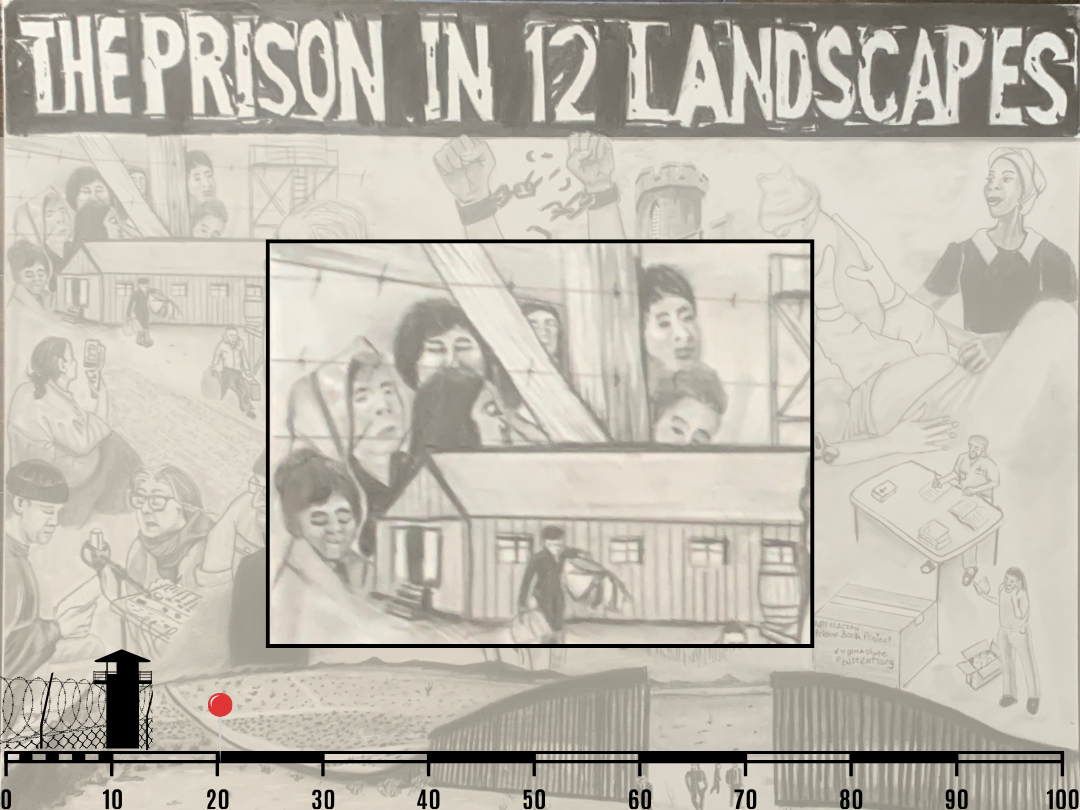
This Q&A is part of a series, Prison in 12 Landscapes, featuring companion pieces from Ray Levy Uyeda and Tamar Sarai. The series runs through September and is organized to introduce readers to subjects beginning with the most—and easing into the least—proximate to prisons’ material form. You can read through the series here.
This conversation has been edited for length and clarity.
Tamar Sarai: I’d love to start by learning a little bit about your background and what brought you to this work.
Kristen Powers: I grew up in a family with a mom who had a mental health disorder that was often policed by her neighbors, whether that literally meant calling the police or child services. It kind of left a mark on me as a young kid, watching how instead of being in community with one another, people used the police to resolve things that were inconvenient to them or that worried them. My mom unfortunately passed away from Huntington’s Disease, which is the disease that caused both her mental health and neurological health to decline.
So when I went to college, I was thinking about all of that when [in 2014] Mike Brown was murdered by the police. That was the moment where I was like, “I’m a white woman who had a dad and an uncle who are both former police officers, and I have this tension between my mom’s experience and what I’m seeing and what I’ve been told.” That led me to analyze what I wanted to do with my career, and I ended up graduating, returning to the South, and working for the Southern Coalition for Social Justice, which is where I met a bunch of amazing formerly incarcerated organizers who taught me what I should be doing—especially as a white ally. During that time, I also got connected to this place called Benevolence Farm, and I was intrigued by it because I was someone who had moved to a farm, and it changed my life. The intersection of women and incarceration was also compelling to me.
Sarai: I always love hearing how people arrive at their work. Can you share a little bit about Benevolence Farm, its origin story, and what it offers to the women working and living on the farm?
Powers: We’ve gone through our own evolution since 2007, which is when our founder Tanya Jisa—who was a social worker—worked with a lot of people affected by incarceration. She was struck by how there was this rising rate of incarceration for women and not anywhere near the level of investment in their return home [or] resources that were gender and trauma-informed. Women kept saying to her, “When I come home, I need to find housing and employment. That’s what they say will keep me safe and in the community, but I can’t find that when I get out.”
So [Jisa] started to do interviews with formerly incarcerated women [to see] what Benevolence Farm could look like, and eventually, she kind of came upon this opportunity to use agriculture and permaculture to [create] the antithesis of prison, which is nature, open skies, open lands, and no concrete bars—a place for people to breathe and heal from their experience of incarceration and receive the services and support they needed.
When we started, that meant providing housing immediately upon release and a dual employment program where people get paid immediately to farm. Eventually, that turned into a body care and social enterprise. Now, I would say it’s evolved to where we’re still doing those core services, but we’re also now pivoting to investing in more of the structural interruption of the criminal legal system by sharpening and supporting the leadership of formerly incarcerated women into advocacy and pushing for system-level change.
Sarai: So are women who are living on the farm given the option to pivot towards advocacy rather than working on the farm?
Powers: So it’s a pretty individualized system, and that’s really important to us. Sometimes we get pushback that we seem to only serve a small amount of people at a time, but for us, we’re only here to scale up at the speed of trust. People coming out have no reason to trust a lot of systems, so at first, we’re just trying to build the community. Everyone who comes is a part of our core programming, which is the farm. People earn an income through the farm and social enterprise, and then as opportunities present, and as their interests indicate, we connect them. [For example] yesterday our partners put out a call to action against a problematic bill that’s trying to repeal automatic expungement for dismissed charges, and we [announced that] we are looking for folks who are from these certain communities across the state to contact their state legislators because of the power analysis we did. It’s the same with if there’s a professional career opportunity or training or a peer support class or things like that. Once their core needs are met, we really center it on what their goals are as an individual and not so much what we think they should like.
Sarai: One thing I was curious about is how you address the second transition that women will go through from the farm to whatever permanent housing they find afterward. My understanding is their families aren’t living with them when they’re on the farm, but can they visit? How can they continue to foster relationships?
Powers: Probably one of the top two questions we get from people when they’re interviewing with us is: Can I have a phone, and can I see my family? It makes me a little emotional that programs are not letting people talk to their families. They just came out of incarceration where they had to pay to speak to their family on the phone or tablets and now they’re out, but they go into programs that still restrict their communication, despite evidence that family ties keep people safe. So for us, what that looks like is day one, they’re getting a cell phone. We pay for the first 30 days and then help them transition to a plan. We have pretty flexible visits with family, and [we] coordinate family options, like going to the movies or a park. After the first four weeks, they can do overnight trips and be with their family on weekends.
Last year, we launched our Housing First Fund to help formerly incarcerated women across the state who know they want to return to North Carolina and are looking for permanent housing, but the upfront cost is a major barrier. Like most of the U.S., we too are also going through a housing affordability crisis. If you’re someone with a record, you usually spend money on applications they’re going to deny you, and they’re going to double your security deposit for the perceived risk or lack of credit or financial status. So, the Housing First Fund pays the security deposit so that people can get into the housing they choose. The hope with the fund is that it shows state and local governments that this is stuff they should be doing because it is expensive.
Sarai: I noticed that the proposal for the tiny home community mentioned that the homes won’t have lofted beds because of how similar they may feel to prison bunk beds. Are there other design considerations—either in the existing residences or just throughout the farm itself—that were made in light of the fact that the residents are women who were incarcerated?
Powers: Our two current houses kind of fell into our lap, and we’re very thankful for it. But one thing we’ve learned is that while people benefit from peer-based housing to a degree, when it begins to replicate the feeling of prison or jail—where you’re bunking with a lot of people in a room or putting people with complex trauma in situations where they don’t have their own space—then you’re just defeating the purpose of peer-led housing. The tiny home community was sparked by someone who experienced 27 years of incarceration and said when she came to the shared housing initially that’s what she needed: having people that she could just knock on their door and ask [for help] was great. But she also said she’s never lived alone or practiced living alone. So, she initiated a brainstorming conversation in 2020 and 2021 that led to the design of these tiny homes. They’ll still be in nature—facing trees and water features—and [residents] won’t be required to bunk but will have the ability to knock on a neighbor’s door.
We’ve had donors say it’s more efficient to build another shared house, and sure, it’s more efficient, but that doesn’t mean it’s more effective. It’s also really not centering the needs of people who are going through this experience. No one told us, “We want to live in another shared house with 10 other women for another two years.” I think COVID made us hopefully more empathetic to the fact that even when you’re living with someone you love dearly, you need a space sometimes to just step back and reset. That’s even more imperative for people who’ve been forced to be around people for however many years.
Sarai: What’s an overarching takeaway you want readers to know or understand about Benevolence Farm?
Powers: I think what we really [understand] at Benevolence Farm is that a part of the human experience is harm, whether it’s causing it or receiving it. As of now, here in the U.S., we don’t respond to harm equitably or compassionately or with a trauma-informed lens, and that’s leading in part to mass incarceration.
I think at our core, we’re not only supporting people after prison, but we’re also trying to interrogate and complicate why people go to prison in the first place. We really believe that at Benevolence Farm, we’re innovating and trying things out. I think that’s part of what Mariame Kaba talks about [when she says] we need one million experiments. We need people trying things every day to create the world that we want. We’re trying to do that at Benevolence Farm and to various degrees of success. But I’m pretty excited with what we’ve discovered so far and where we’re going.
Author

Tamar Sarai is a writer, journalist, and historian in training. Her work focuses on race, culture, and the criminal legal system. She is currently pursing her PhD in History at Temple University where
Sign up for Prism newsletters.
Stay up to date with curated collection of our top stories.