India’s largest far-right Hindu organization ends congressional lobbying campaign in U.S.
Squire Patton Boggs, the firm that lobbied on behalf of the Rashtriya Swayamsevak Sangh last year, terminated the campaign weeks after a Prism investigation detailed the RSS’s lobbying activities
Real journalists wrote and edited this (not AI)—independent, community-driven journalism survives because you back it. Donate to sustain Prism’s mission and the humans behind it.
India’s largest Hindu far-right organization, the Rashtriya Swayamsevak Sangh (RSS), is no longer working with lobbyists in the U.S. after launching its first known lobbying campaign targeting members of Congress last January.
Squire Patton Boggs, the firm that lobbied on behalf of the RSS, terminated the campaign weeks after a Prism investigation detailed the RSS’s lobbying activities, according to public disclosures.
The firm also filed several amendments to its lobbying registration and quarterly reports that retroactively changed details about its client. Previous reports show the client as State Street Strategies doing business as the lobbying firm One+ Strategies on behalf of the RSS. The amended documents, which were filed on Dec. 23 and 29, replace the RSS with an individual named Vivek Sharma.
Sharma, who is based in Acton, Massachusetts, is the executive chair of Cohance Lifesciences, a drug manufacturer with major operations in India and the U.S. He had been listed in Squire Patton Boggs’ original lobbying registration as “an entity other than the client that contributes more than $5,000 to the lobbying activities in a quarterly period” and either participates in or supervises the registrant’s lobbying activities.
Sharma, the RSS, Squire Patton Boggs, and One+ Strategies did not respond to Prism’s requests for comment by publication time.
On Nov. 12, Prism reported that Squire Patton Boggs received $330,000 in the first three quarters of 2025 to lobby officials in the U.S. Senate and House of Representatives on behalf of the RSS. Public records indicate this was the first time the RSS hired lobbyists in the U.S.
A review of congressional disclosure documents by Prism found that the RSS had not been identified as a foreign entity, despite the organization being based in India. Multiple experts on foreign influence operations interviewed by Prism also raised concerns that Squire Patton Boggs did not register its RSS lobbying under the Foreign Agents Registration Act (FARA), a 1938 law that requires transparency from representatives of foreign interests.
The day after Prism published its report, an RSS spokesperson denied that the RSS was working with lobbyists in the U.S. A week later, an RSS publication appeared to contradict the spokesperson, claiming that the RSS’s activities were fully disclosed under the Lobbying Disclosure Act of 1995 (LDA), a transparency law for activities to influence the federal government.
The Prism report prompted political and media backlash in India, including from leaders of the country’s largest opposition party who criticized the lobbying efforts. Indian news outlets published editorials questioning the RSS’s campaign and described it as “alarming and potentially harmful to Indian interests, democracy and credibility.”
In September, the RSS marked 100 years since its founding in 1925. Its followers have been accused of targeting Muslims and other minorities with discrimination, harassment, and violence. Indian Prime Minister Narendra Modi’s political party emerged from the RSS, and Modi himself was once a worker for the organization.
The RSS is not registered as a legal entity in India. Critics say this setup enables a lack of financial transparency and accountability. In November, in response to such criticisms, RSS chief Mohan Bhagwat said, “We are categorized as a body of individuals, and we are a recognized organization.”
“The RSS is used to operating in opaque and nontransparent ways in India and appears to have assumed it could do the same in the U.S. by lobbying quietly and flying under the radar,” said Raqib Hameed Naik, founder and executive director of the Center for the Study of Organized Hate, a Washington, D.C.,-based think tank that researches political extremism. “That does not work here.”
Retroactive amendments
Squire Patton Boggs began working for the RSS on Jan. 16, 2025, according to its lobbying registration. The original registration lists its client as One+ Strategies on behalf of the RSS. However, the amended registration and quarterly reports in December removed the RSS from the client name and replaced it with Sharma’s.
Prism’s investigation described a Jan. 16 email from one of Squire Patton Boggs’ lobbyists to a U.S.-based scholar on the Hindu right, in which he details the relationship between the firm and the RSS.
“Our team was recently retained by Rashtriya Swayamsevak Sangh (RSS) to educate lawmakers about RSS’s mission and impact, as the organization marks its centenary. This effort calls for us to develop a comprehensive understanding of RSS’s history, including historical controversies associated with the group,” Squire Patton Boggs lobbyist Bradford Ellison wrote to Rutgers University–Newark history professor Audrey Truschke in an email asking to meet with her.
Experts on foreign influence operations also raised concerns that the disclosures do not list the RSS as a foreign entity.
“This is clearly, just unquestionably, a foreign entity as far as the LDA is concerned,” Ben Freeman, director of the Democratizing Foreign Policy program at the Quincy Institute for Responsible Statecraft, told Prism for its November report. “They should have checked ‘yes’ in that foreign entities box.”
“What matters is who the ultimate client is,” Freeman added. “And the ultimate client here, according to this document, is the RSS, which is a foreign entity.”
According to the amended reports, the “ultimate client” is now listed as Sharma, who is based in Massachusetts.
Squire Patton Boggs did not alter the issues it lobbied about. On the amended registration form, the lobbying issue remains “U.S.-India bilateral relations,” and the specific lobbying issue on all three amended quarterly reports is still listed as “Introduce the Rashtriya Swayamsevak Sangh (RSS) to U.S. officials.” It is not clear why amendments to the first- and second-quarter reports were filed twice, on Dec. 23 and 29.
The third-quarter report was amended to be a termination report. Though the termination date is listed as Sept. 30, the last day of the third quarter, the document was signed and filed on Dec. 29.
Though the RSS’s lobbying efforts in the U.S. appear to have ended, critics still have questions about how the organization engaged Squire Patton Boggs.
“The larger question remains unanswered: What conduit was used to pay the firm in the U.S.?” said Naik. “The RSS claims it has no bank account and is not a registered entity, so who provided the money and how?”
Political and media reaction
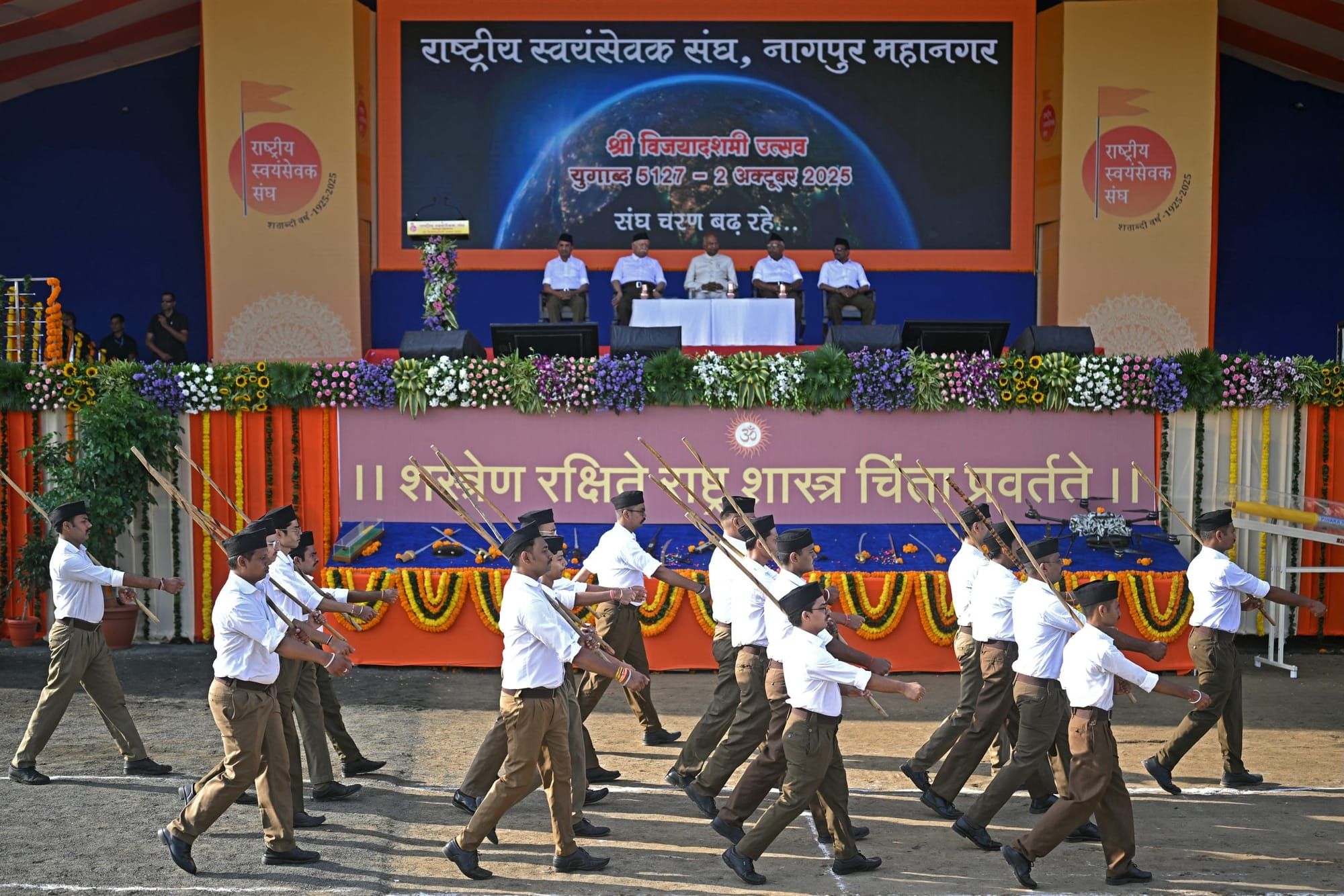
Last year, the RSS celebrated its 100-year anniversary. Over the past century, the organization has grown from a small volunteer paramilitary group into what scholars and analysts describe as the most influential right-wing Hindu organization in India. The early leaders of the all-male organization praised Nazi Germany and fascist Italy, and a member of the RSS assassinated Mahatma Gandhi in 1948.
The RSS serves as the ideological fountainhead of the broader Sangh Parivar, a network of Hindu right-wing organizations encompassing education, social services, and labor. An offshoot of the Sangh’s political wing eventually became the Bharatiya Janata Party, through which Modi rose through the ranks to become prime minister.
“The RSS might have become a mainstream force in Indian politics, but globally, it is still seen as a fascist paramilitary group,” Naik told Prism in its November report. He said that the RSS was trying to invest in changing the perception abroad.
The day after Prism published its report, the RSS denied working with lobbyists in the U.S. “Rashtriya Swayamsevak Sangh works in Bharat and has not engaged any lobbying firm in United States of America,” said RSS spokesperson Sunil Ambekar, using the Hindi word for India.
A week later, however, the RSS publication Organiser published an article that acknowledged the group’s lobbying efforts. “RSS’s outreach is fully disclosed under LDA and mirrors the engagement model used by countless cultural and faith-based organisations,” the article claimed.
The Organiser article was later taken down after one of the reporters of the Prism investigation pointed out the contradictory statements.
In India, media and political scrutiny mounted against the RSS and its U.S. influence operation.
A member of India’s largest opposition party drew attention to the RSS’s status as an unregistered entity in India and scrutinized the amount of money it spent lobbying in the U.S. A retired senior bureaucrat and former secretary to the government of India wrote to officials demanding an investigation into the RSS’s lobbying expenses.
Critics also pointed out that last year, Squire Patton Boggs was simultaneously lobbying on behalf of the Pakistani government, which they described as especially sensitive given ongoing military tensions between India and Pakistan.
In the U.S., a petition called for the Department of Justice to investigate potential FARA violations related to the influence campaign.
Weeks later, the RSS’s congressional influence campaign in the U.S. was terminated.
“This latest move looks like damage control after the reporting triggered a political storm in India,” Naik said.
Editorial Team:
Rashmee Kumar, Lead Editor
Carolyn Copeland, Top Editor
Kyubin Kim, Copy Editor
Authors

Biplob Kumar Das is an investigative reporter based in New York City. His reporting focuses on politics and business. He graduated from Columbia Journalism School with a Master's in Journalism in May

Meghnad Bose is an award-winning investigative journalist based in the U.S. He is a professor of journalism at The University of Memphis, where he heads the MA program in Open Source Investigative Rep
Sign up for Prism newsletters.
Stay up to date with curated collection of our top stories.