The right-wing pipeline for Gen Z teen girls is subtle, insidious, and hidden in wellness trends
It wasn’t just organizations like Charlie Kirk’s Turning Point USA that prompted young women to become right-wing influencers. Their paths were first paved by “clean girl” morning routines and “what I eat in a day” vlogs
Real journalists wrote and edited this (not AI)—independent, community-driven journalism survives because you back it. Donate to sustain Prism’s mission and the humans behind it.
When Faith Merrill moved back to Alabama’s Troy University in August, days before her 19th birthday, she didn’t anticipate student protests. She certainly didn’t think they’d be protesting her.
“Three days into me moving back into my apartment … my phone’s blowing up,” she recalled. “[The texts] were like, ‘Oh my gosh, they are protesting you on campus.’”
Merrill, an aspiring right-wing social media influencer, said that the backlash isn’t new. She’s been dealing with it since she was 16, back when she first joined far-right pundit Charlie Kirk’s Turning Point USA and began posting her beliefs online: There are only two genders, the white race is at risk, and abortion is murder.
Kirk was assassinated on a Utah college campus earlier this month, turning the transphobic and xenophobic podcaster into a “martyr” on the right. The beliefs Turning Point USA first ignited in Merrill still hold for her three years later. Merrill told Prism that she still believes feminism is liberal propaganda. But at a “left-leaning” college, the teen acknowledged that some of her opinions don’t land well.
“I went out yesterday to this protest, and it was five angry students who just stood there and screamed at me,” she said in August.
Merrill is part of a growing cohort of young conservatives who were born and raised in the social media landscape. Merrill “knew nothing about” politics when she first started watching right-wing figures such as Candace Owens on YouTube, but soon, platforms such as TikTok pulled her deeper into the “#tradwife” pipeline. There, she found influencers like Nara Smith romanticizing domesticity, including homesteading, baking from scratch, and tending to multiple children.
These videos are deeply intertwined with viral, even subtler, wellness clips such as “clean girl” morning routines and “what I eat in a day” vlogs that applaud restraint. Though they appear apolitical, researchers say that many train viewers to equate goodness and success with discipline, thinness, and purity.
Merrill said she’s drawn to influencers who “fall back on traditions” and champion conventional womanhood. Much like actress Sydney Sweeney’s “great genes,” a number of right-wing men believe the ideal conservative woman looks slim, attractive, and compliant. And through something as simple as a raw food “cook with me” clip, young women enter a soft-entry pipeline from wellness to extremism.
“I mean, obviously, I’m a teenager,” Merrill said. “All of us are on social media 24/7, and I think social media is one of the easiest and most efficient [ways to reach people].”
Merrill sees herself and her followers as tired of contemporary life. The demands of 21st century womanhood seem like chores: Don’t be a housewife. Don’t get married. Work.
“Go live life, go hook up with people, go party,” she ticked off. “I honestly feel like we’re just tired of that. It’s not fulfilling in any way possible.”
The fantasy of the tradwife
Sarah Brouillette, a Carleton University professor in Canada who has long studied traditional wife, or “tradwife,” dynamics, said that the idea of tradwives is rooted in nostalgia—much like President Donald Trump’s “Make America Great Again” movement. According to Brouillette, lower- and middle-income women, who find themselves both working jobs and raising children, believe that the promise of feminism was never realized and that tradwives offer an exit route from the burden of a life that’s materially constrained.
She explained that this feeling of weariness among young girls has skyrocketed in recent years. In 2020, United Kingdom-based extremism researcher Julia Ebner found that at least 30,000 women identified as tradwives. Today, Brouillette and her colleagues fear this has only grown and started seeping into the algorithms of younger tweens—some as young as 12.
“If I just become a housewife … and if we just have more babies, then everything will be fine,” Brouillette said.
In some ways, the oversaturation of overtly political messaging has only pushed more girls deeper into traditional homemaking.
“A big appeal for younger people is the opportunity to fantasize about a simpler life and a simpler future where they don’t have to be petrified with worry—about economic crises, climate collapse, the ‘am I a bad person because I’m white?’” Brouillette said.
This sense of comfort derived from right-wing content allows young women to offset burdens and instead blame an intangible “other”: feminists, communists, immigrants, and public sector workers who intervene in the “American Project.”
“It is an exit from history and from reality,” Brouillette said. “It’s a kind of fantasy structure of a world in which you can play pretend.”
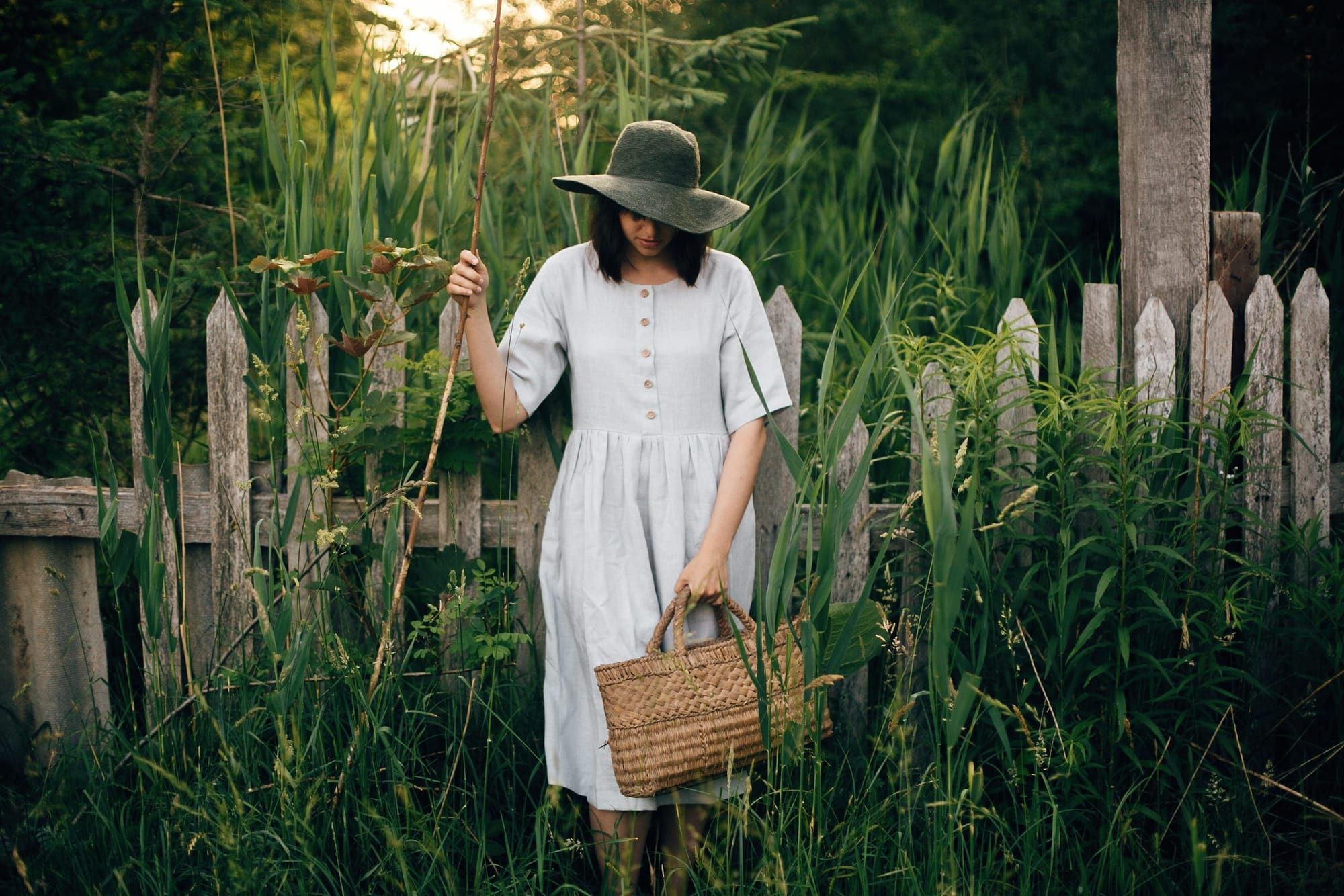
In the world of social media, homesteaders also fixate on their online presence. The term “body fascism” describes discrimination based on someone’s appearance or weight. It’s associated with the emergence of extreme exercise regimes, typically for women, to keep them presentable in heteronormative societies. Body fascism circulates rapidly on social media, and simple wellness routine videos become insidious ways for influencers to uphold ideals of thinness and domestic femininity.
For example, on some tradwife accounts, even fridge restocking videos become Trojan horses, normalizing a worldview in which deviation from organization and health is seen as disorder.
Women who question these kinds of beliefs are still susceptible to falling down the social media rabbit hole. Brouillette said that it is easy to become siloed in an algorithm that replays content repeatedly.
This content’s theme is often subliminal. Some videos appear to offer an aesthetic respite from the grind of a “Severance”-esque society: Instead of grinding through a 9-to-5, women are kneading bread, baking cookies, and trying on modest dresses. For some, this imagery calls up memories of childhood. For others, it’s a way to celebrate a “pioneer”-like era, when the only challenge conservatives faced was Western expansion or the push for Christian supremacy.
Covert extremism
Researchers say this right-wing ideology, veiled through a pro-wellness exterior, is far from benign. Instead, it triggers subconscious conservative beliefs, according to Brouillette, making some believe that tradwives are the keys to safeguarding humanity.
Many progressives today value the rejection of norms: childbirth, the nuclear family, gender roles, and non-normative ways of presenting themselves as a typical “human being,” Brouillette told Prism. But to right-wing influencers, abandoning these beliefs is a “dramatic threat to existence itself.”
Some conservatives fear that “unnatural” ways of living weaken their families or even dilute their race. In an attempt to protect humanity, tradwives promote purity culture to safeguard the body of a Christian woman and also the body of the nation.
Here’s the irony: Most Christians believe that their families have the strongest foundations. Yet many still feel threatened by anyone who isn’t heterosexual, cisgender, white, and religious. They view this “other” as an encroaching group that threatens to erode their principles and influence their children. This paranoia has seeped into everything from politics to school boards.
“[They think] we’re not going to have a society anymore,” Brouillette said. “We’re going to be bred out of existence unless we fight back.”
Since Trump took office, Republican lawmakers, influencers, and talking heads have openly pushed pro-natalist beliefs as the key to national revival. This argument, often rooted in eugenics, is then recycled by tradwife influencers who translate the rhetoric into lifestyle content. In their videos, cycle-tracking is framed as religious destiny, fertility becomes a woman’s highest calling, and beauty or health regimens are preparation for domestic life.
Anything that these tradwives view as a risk to their survival and continuance—from vaccines to birth control to Western medicine—is treated with not just skepticism but fear.
Merrill told Prism that she fears her race and community are disappearing, especially as modern-day society loses the “definition of women.”
“We all need to get married young,” Merrill said. “We need to start having kids because, I mean, they’re the next generation. Charlie Kirk [said] this all the time, ‘We’re just going to outpopulate them.’”
“A good wife”
The perils of modern dating also push some women to seek out a different kind of certainty. The term “heteropessimism” refers to the performative disaffiliation from heterosexuality, or the notion that it is a curse to like men. Even as a joke, the theory reflects the dating “minefield” for young women, said Brouillette.
Isabella Simone, 21, whose right-wing TikTok account has amassed nearly 20,000 followers, said that America’s flawed dating culture prompts young women to seek these online spaces out.
“I’ve seen a lot of conservative influencers saying to be a good wife,” she said. “A young person sees this is how I can get a man to stay with me, if I cook and clean with them. If they see that, they are encouraged to feel like they can get a man.”
With the economy on the brink of collapse, many young girls feel their future is perilous. It’s especially stressful when they’re responsible for their own material well-being. And although this reliance on men is not a new phenomenon, researchers say that over the last five years, the influence of social media has funneled more young women into tradwife spaces.
Simone, who emphasized the importance of family values, told Prism that she’s found an “escape” on the internet with a number of other young people, lending to the feeling that she’s “not alone.”
She added that one extreme might prioritize traditional family roles, while the left literally “lights things on fire.”
“The left posts things that are way too extreme,” said Simone, referring to individuals lighting ex-special government employee Elon Musk’s Teslas on fire. “There’s constant violence with them.”
But critics say that the right turns the other cheek when their fellow conservatives commit acts of violence. Kirk’s death has gotten far more coverage than when the deeply religious and conservative Vance Boelter allegedly killed Democratic Minnesota state Rep. Melissa Hortman and her husband Mark in June.
Over half of mass shooters are white, and over 95% are male. Tyler Robinson, Kirk’s accused killer, comes from a family of Republicans (although he is not affiliated with one political party). Right-wing extremist violence is responsible for the overwhelming majority of deadly political violence in the U.S., amounting to approximately 75% to 80% of U.S. domestic terrorism deaths since 2001, PBS reported.
According to Time Magazine, in the last five years, 81 people have been killed by political violence in the U.S., and right-wing terrorists account for over half of these murders.
Search for control
Arie Perliger, a University of Massachusetts Lowell professor who studies extremist misogyny, said that conservative, family-friendly mirages disguise a different kind of violence.
“This is an expanding phenomenon,” he said. “I’ve seen more and more convergence between far-right extremist online communities and misogynist communities … and we do see increasing levels of violence [by members of misogynist communities].”
There’s been a substantial increase in users flocking to “female-dominant misogynist” influencers, he said, and tradwives that introduce young people to the “entire ecosystem of far-right online extremism.”
These channels are so effective because the messages are so covert. The feminine, soft appearance is comforting and not excessively political.
“It’s much more subtle,” he said. “They use language and they use visualizations that provide an environment of calm and certainty.”
Higher education, the online dating world, and the job market can all feel like a “competitive endeavor” that simply increases anxiety and stress for young people. But tradwife content provides a sense of security and safety, and a way to “disconnect” from an endless “game,” according to Perliger.
But it’s an illusion, he said. While successful influencers endorse submission and compliance, they’re often the ones leading mass business ventures: high-earning TikTok accounts or podcasts, for example. Others are born into wealth or marry rich.
Women in lower socioeconomic brackets are tempted by an empty promise. They cannot afford to stay home and bake bread every day. But right-wing influencers create “unrealistic expectations,” Perliger added.
These expectations include extreme rituals of beauty and wellness, such as nighttime routines filled with expensive products and even high-tech sleep masks that go on the market for hundreds of dollars. Other routines include only eating whole foods—often grown in one’s own garden. Influencers present this lifestyle as proof of discipline and control over one’s body, suggesting that clean eating and a perfected appearance can optimize not just the individual but America—or the white race—as a whole.
This kind of content, growing more popular by the day, makes Perliger fear for younger generations who often do not understand the way that algorithms funnel them toward these seemingly innocuous videos.
“They are the first generation that actually grew up through social media, where social media was ingrained in their life, and now we see the consequences of that,” he said.
With fewer in-person interactions, declining sexual relationships, and the dominance of screens, young people are growing more isolated and lonely. Certainty is scarce. Social skills atrophy.
“Young women are looking for some way to restore their sense of control,” Perliger said. “[And to do so], many of them are gravitating towards those kinds of extremist communities.”
Editorial Team:
Tina Vasquez, Lead Editor
Carolyn Copeland, Top Editor
Stephanie Harris, Copy Editor
Author

Kenneal Patterson is a Brooklyn-based reporter covering breaking news for The Daily Beast and New York culture for WNYC/Gothamist. As a prolific freelance journalist, she has written for more than a d
Sign up for Prism newsletters.
Stay up to date with curated collection of our top stories.