Our work toward reparations will not end under the Trump administration
As the administration unfurls wide-ranging attacks on racial justice, leaders in the reparations movement are considering different strategies to ensure the longevity of their work
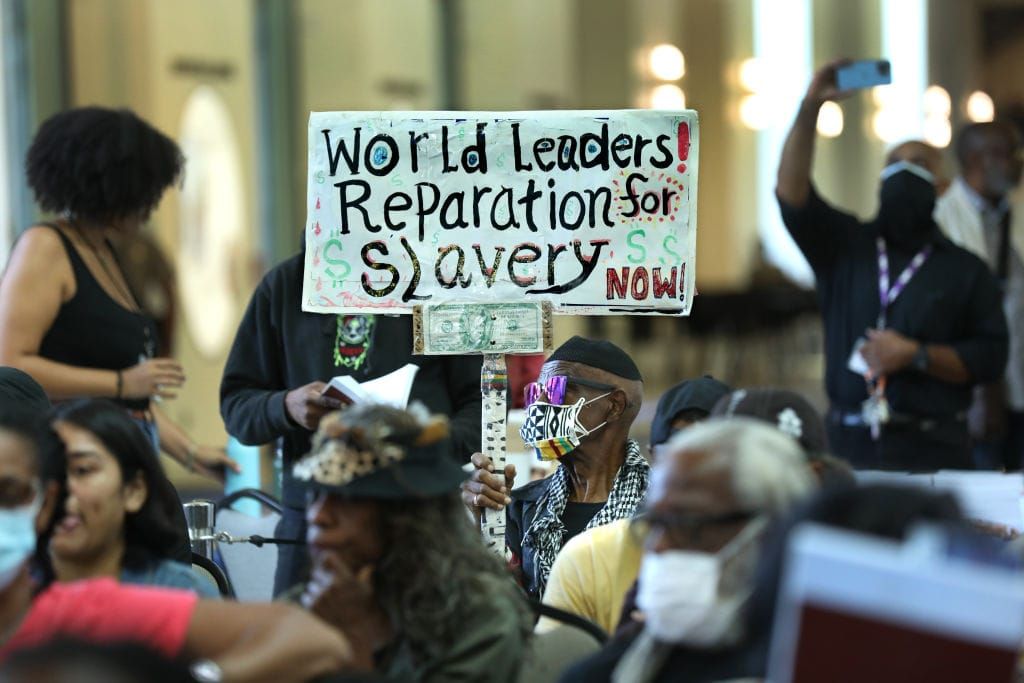
On the heels of emancipation in January 1865, Union leaders called upon Black ministers to advocate for thousands of freed slaves. The Baptist and Methodist clergymen convened with Union Army General William T. Sherman and the Lincoln administration’s Secretary of War Edwin M. Stanton to answer the question: What do you want for your people?
Led by Baptist minister Garrison Frazier, 20 ministers clearly and precisely described what was necessary for self-determination. Frazier, who emancipated himself and his wife four years before the start of the Civil War, asserted, “The way we can best take care of ourselves is to have land, and turn it and till it by our own labor … We want to be placed on land until we are able to buy it and make it our own.” The men, many of whom were considered property less than a decade prior, knew the sites of their profound trauma were also the key to their economic and personal freedom. General Sherman signed Special Field Order No. 15 four days later, a land redistribution plan granting African American families 40 acres and a mule.
An estimated 40,000 freedmen eventually settled on plots of seized Confederate farmland from Charleston, South Carolina, to Florida’s Saint Johns River, where they built homes, tilled the land, established their own governments, and defied expectations. However, this glimpse into an alternate, more bountiful future was short-lived. After President Lincoln’s assassination, any pretense of care for the formerly enslaved fell. President Johnson, who historians have called a segregationist, rescinded the order.
A century and a half later, Frazier’s dream for his people remains largely unrealized.
A pivotal moment
The question of reparations has been in the ether since Black clergy members met with Union leaders to set the terms of our autonomy. How can we begin to nurse the centuries-long wounds that constant assaults on our liberties and personhood have inflicted?
It depends on who you ask.
At Where Is My Land (WIML), an organization created to help Black Americans reclaim stolen land and secure restitution, the answer is similar to Frazier’s and those who catalyzed 40 acres and a mule. Owning land is—and always has been—a pathway to self-determination, allowing us to build our communities, grow food, and define ourselves outside the shadow of whiteness.
“The cornerstone of this nation’s wealth is land,” said Milana Davis, WIML advocacy and policy lead. In 2020, our CEO and founder, Kavon Ward, helped spark the Black Land Back Movement when she orchestrated the return of Bruce’s Beach, the first Black land return in U.S. history.
From 2014 to 2020, the killings of Black children and adults at the hands of police forces galvanized uprisings and protests decrying the racism deeply embedded in our policing systems and reinvigorated mainstream conversations surrounding racial equity and repair. Legacies of enslavement, which for too long had mainly gone unaddressed and unexamined, re-entered the mainstream. Reparations, while unrealized on the federal level, are rapidly progressing locally across the country. However, for many activists, a second Trump administration is a pivotal moment that will undoubtedly reshape how we conceptualize racial equity in our country—and for trailblazers in the reparations movement, there will be new strategies to ensure the longevity of their work.
President Donald Trump’s second term is undoubtedly going to accelerate our country’s plunge into despotism, but for Black communities, there’s nothing new under the sun. Fascism has been a defining feature of our American experience from captives to the present. While Trump’s second term quickly revealed itself to be a coup, Robin Rue Simmons told Prism today’s challenges have always been here, lying dormant, waiting for an opportune moment to arise.
Rue Simmons is the founder and executive director of First Repair, an organization that advances local reparations policies. As a former alderwoman from Evanston, Illinois, she helped materialize what many thought was impossible: the nation’s first government-funded reparations program. Evanston has disbursed nearly $6 million to victims of redlining and discriminatory housing practices. In 2024—three years after the program’s launch—the conservative legal group Judicial Watch filed a class-action lawsuit against the city of Evanston, claiming race was used as “a proxy for experiencing discrimination between 1919 and 1969.” While the legal group claims to “promote transparency, accountability, and integrity in government, politics, and the law,” their agenda aligns with the Trump administration’s, and it is very clear: to dismantle race-based remedies.
In their argument against Evanston’s groundbreaking program, Judicial Watch levied the claim that the reparations program violates the Equal Protection Clause of the 14th Amendment, which grants citizenship to all people born in the U.S. and provides them equal protection and due process. It’s a sobering reality that adversaries of racial equity can weaponize the avenues of protection put in place to ensure our enslaved ancestors were considered whole human beings under the law.
Judicial Watch’s argument against Evanston’s program stated, “Remedying discrimination from 55 to 105 years ago or remedying discrimination experienced at any time by an individual’s parents, grandparents, or great-grandparents has not been recognized as a compelling governmental interest…” The goal is to create distance from the discrimination so that bad actors are absolved of their transgressions. The harms that private and public actors inflicted—whether 55 or 105 years ago—did not occur in a vacuum and fueled vicious cycles of injustice that continue to impact every facet of Black life. Political education and grounding ourselves in history are critical tools in combating the distancing attempts and the active erasure of history.
Beyond symbolic gestures
One Missouri organization takes political education very seriously. Each month, the Kansas City Reparations Coalition (KCRC) dedicated to ensuring local reparations, hosts education meetings to spur community engagement with their local reparative justice process. KCRC chair, Janay Reliford said education is the “secret sauce” in building political will. The grassroots organization is now a watchdog over the citywide Reparations Commission launched in 2023. Reliford said that if the commission didn’t have the coalition backing it and helping push it along, there likely would not have been much progress. In 2023, the city council approved the ordinance that launched the commission and also declared the city’s intent to make amends to Black citizens of Kansas City for its participation in enslavement and the enforcement of segregation and other discriminatory practices.
WIML functions similarly, holding government entities and private actors accountable for their role in dispossessing Black land owners—and, more importantly, pushing them past symbolic gestures of repair.
State and local reparations task forces and commissions are proliferating, and serious funds are being poured into harm reports and research, but only a handful are currently in the policy implementation phase. Less than 50 days into Trump’s second term, many institutions have started to renege on their commitments to race-based repair. This may not bode well for the reparations movement. At WIML, we’ve witnessed cities spend months or even years grappling with the historical question of reparations, a stalling tactic that often feels intentional and performative. With Trump in office, municipalities may decide to prioritize their bottom lines over repair, setting the movement back even further.
As one example, WIML client, the Russell City Descendants for Restorative Justice, has fought tooth and nail with California’s Alameda County and Hayward City for redress.
Incorporated in 1853, Russell City, California, was once a beacon of Black independence and self-determination. The town was a haven for Black folks and other residents of color relegated to the area due to redlining and restrictive covenants. In 1963, Hayward City and Alameda County declared Russell City a “blight,” condemned it, and evicted all its residents, burning down their properties. Fast forward to 2022, the city of Hayward formed the Russell City Reparative Justice Project Steering Committee to research and prepare restitution recommendations. The committee’s deadline to return with the next steps on proposals quietly came and went last November. These bureaucratic and legislative hurdles prompt those in the reparations movement to consider which avenue of redress is most effective: court-based or direct political action.
In July 2024, KCRC decided to explore legal avenues with the help of attorney Nick Cummings, founder of Osiris Professional Services, which helps entities “prepare constitutionally sound reparative justice arguments and programs.” Cummings asserts that First Repair’s work in Evanston is replicable. While courts have never been kind to race-based legal claims, Cummings is helping to carve out a space that safeguards reparative justice programs from those who seek to upend them. Partnering with legal consultants with a vested interest in repair will be a key strategy under the Trump administration as assaults on repair escalate in the courts and legislatively.
In June 2023, Rep. Brian Babin, R-TX, introduced HR 4321, the No Bailouts for Reparations Act. The bill would prohibit the federal government from providing bailouts or other financial assistance to any state or local government that offers reparations for chattel slavery or any other purposes. The bill has 13 Republican co-sponsors, including Texas Reps. Troy Nehls and Ronny Jackson, Rep. Burgess Owens, R-UT, and Rep. Scott Franklin, R-FL. After the bill’s introduction, an emboldened Babin told Fox News, “American taxpayers shouldn’t be forced to pay for radical, race-based reparation payments to please the woke left.”
Another hurdle, HR 9495, or The Stop Terror-Financing and Tax Penalties on American Hostages Act, was passed by the House of Representatives last November. The bill would empower the Treasury Department to eliminate the tax-exempt status of any nonprofit it alleges supports “terrorism.” While the bill was interpreted as directly targeting pro-Palestine advocacy, it is emblematic of the challenges ahead for all activists. This McCarthy-like attack on advocacy groups foreshadows a dark era of repression and, perhaps, funder retreats. According to leaders in the reparations movement, external attacks on the movement highlight the need for more profound intra-communal healing.
According to Marcus Coleman, founder of grassroots social justice organization Save OurSelves and vice chair of Fulton County, Georgia’s Reparations Taskforce, some of our biggest challenges are internal. When he entered this work five and a half years ago, he expected opposition from the white community. However, he was unprepared for “the resistance of my own people.” Rue Simmons agreed, “I didn’t have to fight the man. I had to fight through my own block to get repair.”
Our multitudes as Black folks extend to our opinions on how racial healing can be achieved, and according to Coleman, rather than creating an echo chamber, it’s essential to invite different voices to the table to succeed. However, differing opinions can create friction that is difficult to wade through. Leaders must hold space for everything, including how our people process their trauma. The reparations movement seeks to make all whole again, which means it’s “emotional work,” Rue Simmons explained.
Reparations must begin with community engagement, and in Rue Simmons’ experience, “whether they came cussing and screaming or with flowers and hugs,” it all informed First Repair’s process. The psychological wounds we have amassed after being regarded as chattel and living under an apartheid system must be exhumed and remedied. While these wounds are not self-imposed, the onus falls on us to heal because the defense mechanisms we’ve developed to protect ourselves can stifle progress.
In Coleman’s view, unlearning individualism would help us achieve “collective victory.” He believes that leaders’ personal interests and egos have clouded his local task forces’ process.
“We have not met as a task force since September of last year.. because we are in the final stages of preparing our final report. But… the truth is that we have a number of members that are actually in fear of coming before the public. We have a number of members that feel like they are in the position to be able to make all the decisions that will affect all of our community,” Coleman said.
These paternalistic attitudes are symptomatic of the programming that white supremacy and capitalism have ingrained in us. According to leaders in the reparations movement, collectivism will be our ultimate salvation.
Sankofa, a Twi word from the Akan Tribe of Ghana, is central to Reliford’s ideology. “That means go back and fetch it, go back and get those things that you need for the journey ahead.” Our forebears created roadmaps that we can and should follow, Reliford explained. As corporations walk back the empty commitments they made in 2020, divesting from these companies and participating in cooperative economics will help us reshape our communities as we fight for repair. While boycotts have proven to be a powerful tool, unity and resolve drive their effectiveness.
Simmons believes that activist, author, professor, and creator of the African American holiday Kwanzaa, Maulana Karenga, first developed operational unity as a solution to developing unity amongst the different factions of the Civil Rights Movement. The concept honors “unity over uniformity,” which is the answer to strategic unification. Operational unity honors the “diversity of Black people through dialogue, mutual respect, and collaboration.” Reparations leader and scholar Kamm Howard has “fetched” the strategy and is leveraging the ideology to help push the movement forward.
Black folk’s existence has been politicized since our ancestors were forced to build the empire we now see crumbling before us. In the wake of the Civil War, the prevailing sentiment surrounding repair for the formerly enslaved was that second-tiered freedom should be enough–and it was presented as a gift and not a human right. Since 1989, when the Commission to Study and Develop Reparation Proposals for African Americans Act was first introduced, it has only advanced past a House Committee once. Naturally, it is a tall order to convince descendants of enslavers and their sympathizers to repay a multi-billion dollar debt. While the law recognizes Black people as full humans, those who craft and enact it do not.
Trump’s presidency will undoubtedly impact the movement, but his loud and proud racism is something many people have quietly nursed and hidden inside of policy and dog whistles. A profound reckoning that goes beyond financial compensation is necessary, or we will continue to oscillate between periods of white rage and social progress.
Disclosure: Hannah Greene is the communications lead at the organization Where Is My Land.
Editorial Team:
Tina Vasquez, Lead Editor
Carolyn Copeland, Top Editor
Lara Witt, Copy Editor
Author
Hannah Greene is a New Haven-raised and based Yale College graduate. With a B.A. in African American Studies, Greene is no stranger to questions about her degree's utility. As a young Black woman, she
Sign up for Prism newsletters.
Stay up to date with curated collection of our top stories.