Stanley Howard’s entire life changed in November 1984 when he was arrested and tortured in Illinois by former Chicago Police Commander Jon Burge and his “Midnight Crew.”
“I was 21 years old, scared half to death, and actually believed that they were trying to kill me by suffocation,” Howard told Prism.
Across Chicago between 1972 and 1991, Burge and other officers terrorized more than 120 people—mostly Black men—kidnapping and torturing them using military tactics that Burge honed while serving in the Vietnam War. Burge and his crew suffocated, electrocuted, beat, and hurled racial epithets at innocent civilians to produce false confessions. While the sentences levied against Burge’s victims varied, Howard, along with at least nine other survivors, were sentenced to capital punishment. While on death row, Howard began a campaign fighting for their freedom. In 2003, Howard was successfully granted a pardon. Due to other unrelated convictions, Howard didn’t return home until November 2023.
After 39 years inside, Howard continues to fight on behalf of other torture survivors through his work as a paralegal prison advocate at Chicago’s Uptown People’s Law Center, by sharing his story through his book, “Tortured by Blue,” and by supporting the implementation of a large-scale reparations ordinance for all of the known Burge survivors.
In 2015, after years of waging a grassroots campaign demanding redress for and acknowledgment of Burge’s reign of terror—Chicago organizers won the first city reparations package for victims of racially motivated police violence. The package included $5.5 million in financial compensation to the collective of survivors, a formal apology from the Chicago City Council, free tuition to Chicago City Colleges for survivors and their families, the establishment of the Chicago Torture Justice Center that provides mental health and clinical support to survivors of police brutality, a requirement that Chicago’s history of police torture be incorporated into Chicago Public School’s eighth- and 10th-grade curriculum, and finally, the creation of a public memorial for the Burge torture survivors.
The public memorial is the only element of this package that has yet to be realized, though the design and location have been finalized and construction will begin next year. Designed by Chicago-based artist Patricia Nguyen and landscape architect John Lee, the memorial is called “Breath, Form, and Freedom” and spans 1,600 square feet. The design features include an open ceiling and winding hallway displaying the names of the more than 120 survivors of Burge’s regime.
“I believe that it’s really important not to forget history, and I believe that it’s really sad that a lot of people, especially here in Chicago, do not know what actually happened under the Jon Burge torture scandal.” Howard said. “We have many people in this city that know about the Central Park Five case but don’t even know what occurred here in [their] own backyard, so to be able to have the memorial to stand as a testament for what happened and use it as an educational tool? I’m very excited about that.”
In addition to Howard, for this Q&A Prism spoke with Jennifer Ash, executive director of the Chicago Torture Justice Memorial (CTJM) Foundation, to learn more about how the memorial was conceived, the role of memorials in preserving history and shaping public memory, and the space memorials allow for us to meditate on histories of violence.
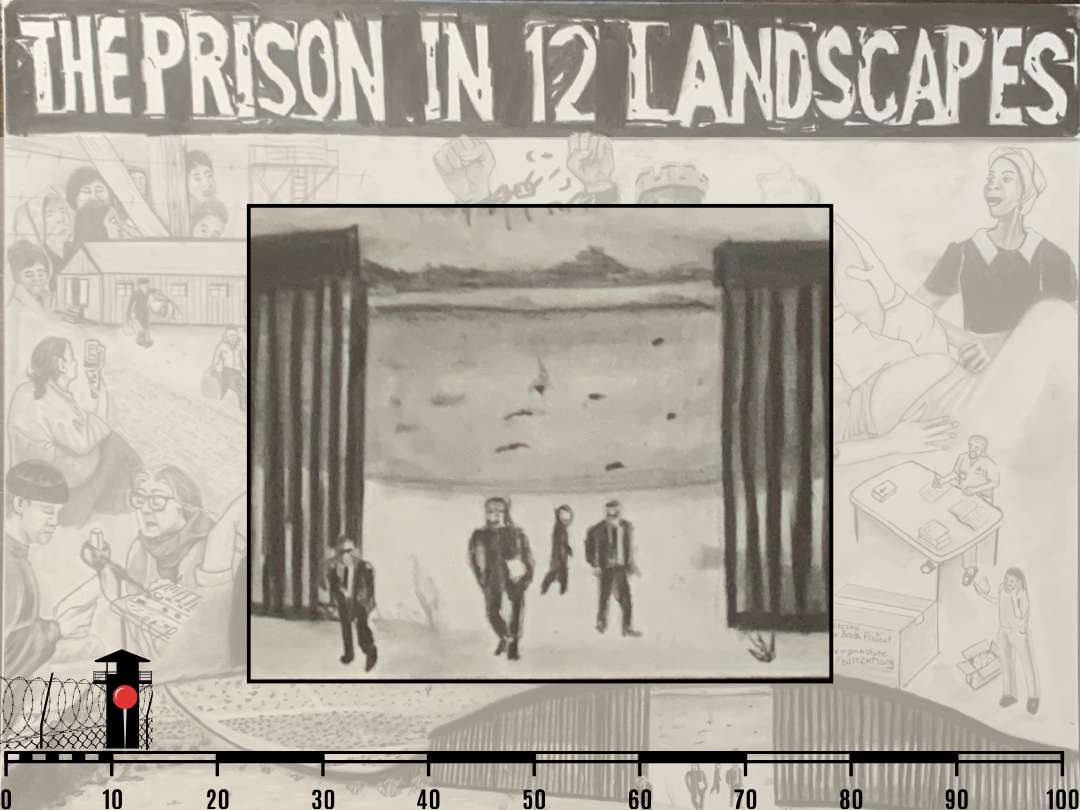
This Q&A is part of a series, Prison in 12 Landscapes, featuring companion pieces from Ray Levy Uyeda and Tamar Sarai, running through September and organized to introduce readers to subjects beginning with the most—and easing into the least—proximate to prisons’ material form. You can read through the full series here.
This conversation has been edited for clarity and brevity.
Tamar Sarai: How did you come to this work and first become involved with the campaign for reparations?
Jennifer Ash: I’m not originally from Chicago. I’m from North Carolina, and I moved here to go to graduate school for a Ph.D. in history. When I got here, I wanted to connect to movement-building [since] my research as a historian was all about movements, and I was very active in movement-building where I came from. So, connecting with people that were doing important work locally was important to me. I made friends with people who were connected to the campaign for reparations, and I was intrigued by this idea. Using the word “reparations” can be very controversial in this country because of the connotations the word takes; it’s often just automatically rejected as something that’s not feasible or possible. But the fact that people were saying reparations—and that Black folks in Chicago have been saying reparations for a really long time around these cases—was really inspiring to me. It pushed the envelope in a way that I had not thought of. I was really excited about how the reparations were framed and that it wasn’t focused on punishment or any kind of use of the criminal legal system because that had failed people, but [rather] it was focused on a more holistic approach to repair. The legislation was [also] constructed in a way that I felt was really smart and gave a long-lasting impact on the communities that have been affected directly by these instances of police torture.
Sarai: In fighting for reparations, why was it important that a public memorial be a part of that package? What function can these kinds of public memorials play in allowing us to meditate upon histories of violence?
Ash: Since 2020 especially, there’s been a lot of public dialogue about memorials and monuments as either liberatory spaces in the landscape or representing oppressive structures of anti-Blackness and colonialism and all the -isms. This memorial was dreamed up a long time before 2020, so it’s important to keep pushing that conversation. I think this memorial is particularly important because it, as we say over and over, inscribes what happened onto the landscape of Chicago. It doesn’t allow our city to forget what happened, and it’s also a place where organizing can take place for the present and the future. So it’s not just about historical remembrance, which is very important. I’m a historian, and I believe that it’s very important to remember what has happened, but it’s also important to use that information to move forward and to demand better, and I think that [with] this memorial in particular, that is the focus. It’s also very important specifically to survivors to have this space that honors them and their families and what they went through, but it’s not just about the torture either. It’s a place where healing can happen and where joy can be expressed and shared; I think that that is also what makes this place unique. It doesn’t always focus on the terrible things that happened and the injustices. We are trying to create a place where healing can happen and people can have happy moments and share communal experiences.
Sarai: What were the initial planning stages of the memorial, and what did you have to consider to get the idea off the ground?
Ash: There was a very intentional jury selection process where Black, Indigenous, and people of color artists who had a history of also being connected to movement work in Chicago were asked to submit proposals for memorials. Back when CTJM started in 2011, it was right after Burge was sentenced for perjury, and because no healing happened based on what the criminal legal system doled out, people got together and asked for speculative memorials. More than 70 people submitted them. There’s this history of memorials as speculative artistic pieces, and so that was sort of built into the legislation. The ordinance that was originally crafted to include the memorial, the center, and all the other things that were promised back in 2015 was actually one of the speculative memorials that was submitted. So that’s the origin of that legislation.
Fast forward to 2015, after reparations passed, a committee of people who were supportive of the memorial, had connections in the art community, and were cultural workers, got together and pulled survivors and family members in to create this panel that called for BIPOC social justice minded artists to submit [designs]. This was around 2018-19, and the one that was selected was called “Breath, Form, and Freedom,” by Patricia and John, who are still active in CTJM. They created the original design, and then the collective got to work on making it actually happen.
Sarai: Have there been any challenges working with the city to bring the memorial to fruition?
Ash: We’ve [gone] back and forth with the city for more than nine years trying to find a piece of land for the memorial. We’ve located one that works in the 20th Ward in Washington Park. It took a while because there was no political will on the parts of the Emanuel or Lightfoot administrations to make this happen, [but] since the new Johnson administration has come in, there’s financial backing and the political will to make it happen. Since late 2022, as we were heading into election season, we started really pushing, and it paid off. Last year, they publicly announced that they were finally going to fund it. We’re in the design development phase right now, taking the original design and working with our architectural and landscape team. We hired Black-owned architectural firm Nia Architects to finalize the design, and we’re also working with Site Design Group for the landscape architecture. We expect to start construction in 2025.
Sarai: I’ve seen a rendering of “Breath, Form, and Freedom.” It’s really beautiful. Talk to me about the design elements that stood out to you and what elements seemed to speak to what survivors and their families wanted to see in the memorial.
Ash: One of the things that was so brilliant was this concept of the panopticon, which is part of prison design. Also, [we’re] envisioning it as a space where you’ll see the design circle around, and at the end of telling the story about what happened, it opens up into this communal space. I think that is so brilliant and important because, again, survivors have expressed this need to have a place where they can all come and be together and support each other and have real community in the neighborhood.
Sarai: When you mentioned the longstanding lack of political will around the memorial, I thought about a 2020 ProPublica piece about former Mayor Lori Lightfoot’s administration being unclear on whether they were committed to building a memorial for survivors of police injustice broadly or for just the Burge survivors specifically. What’s the importance of the specificity of this memorial? Do you have any hopes or expectations for the memorial to push visitors to think about contemporary police violence beyond those who were directly impacted by Burge?
Ash: One thousand percent. Because of the work of the Chicago Torture Justice Center, our community of survivors extends beyond people who were directly tortured by Burge or people directly under his [leadership]. Burge tortured folks between 1972 and 1991, but we see the memorial as a space where healing happens—not just for survivors of police torture, but for anyone who’s been affected by state violence or domestic torture. I think that’s another brilliant aspect of what has come out of this: the ripple effect. It has not just impacted the people who received financial reparations in 2015. Many people were not only tortured by Burge, but were tortured by other police detectives or were affected by state violence in other ways. All of those people can benefit from—and have benefited from—the work of the center and this memorial.
I don’t believe in looking at history as a blueprint, per se, because things change, and we have to develop new strategies all the time to combat injustice. But I think this memorial can serve as an example to other places around the world to say, “This is what survivors and attorneys and journalists and artists and educators and family members did here. What can other places learn about this, and what can they implement in their location? In Chicago, what can we learn from these cases that will prevent future systemic harm from happening?” It’s not just the Burge cases. The Burge cases are critical because there was a very particular pattern and practice of torture that happened, and it’s critical to acknowledge that, but our community is even larger than that.
Author
Tamar Sarai is a writer, journalist, and historian in training. Her work focuses on race, culture, and the criminal legal system. She is currently pursing her PhD in History at Temple University where
Sign up for Prism newsletters.
Stay up to date with curated collection of our top stories.