Never eat the candy on your pillow: Freedom demands
While I may feel like I’m stumbling through life on the outside, I know my commitment to growth makes all the difference—especially now that I feel more free to be myself

Dear Reader,
Few things are more unsettling than uncertainty, especially when being released from prison after many years of incarceration, with no job or serious prospects.
I found myself facing freedom without a clear path forward, and my mind constantly raced with questions: Where will I live? How will I support myself? Where do I start?
These questions don’t just reflect my own personal fears; they reveal a much larger societal need to provide support and assistance to those reentering society after incarceration. Without help, uncertainty can quickly turn into frustration or even desperation—and we don’t always act rationally when we feel desperate.
Preparation can make a significant difference. I saw men come back to my prison after being released, and I vowed that would never be me. Well before I even knew I’d be released, I gathered information about housing, employment opportunities, and community resources. I sought out mentors, counselors, and others who could offer advice on successfully reintegrating. Before my release, I knew it was crucial to seek out information and build a network so I wouldn’t have to face these challenges alone.
I thought I had everything figured out.
What if I told you that I submitted over 60 employment applications and had more than 30 interviews? Would you be surprised to learn that I was rejected by every single employer after they took a look at my background check?
Most interviewers weren’t rude or malicious. Some even apologized for passing me over for the job. Apparently for most companies, there was no good way to hire someone with my criminal convictions. Business is business, right?
Still, even after a steady stream of disappointments, I refused to let rejection define me. Instead, I looked for less conventional employment by exploring temp agencies and looking into gigs as a day laborer. More broadly, I leaned on support groups and stayed connected with others who understood my struggle. Each setback, though frustrating, made me more resilient and pushed me to keep searching for a place where my past wouldn’t automatically disqualify me from having a future.
The road was far from easy, but I learned that persistence and a willingness to adapt could open doors I’d never expected.
In case you didn’t know: Being free is a tremendous amount of work.
It’s been a humbling experience, jumping from dirty job to dirty job. I’ve cleaned people’s houses, mowed lawns, gardened, assembled furniture, and even shoveled mounds of horse manure, just to pay my parole supervision fees and provide for myself. Though certainly not ideal, I saw these jobs as gifts given to me by people who recognized my willingness to work. While this work was hard, it paled in comparison to the emotional work I was doing to adjust to life outside. In case you didn’t know: Being free is a tremendous amount of work.
I’m not a saint. I certainly have bad days. I feel frustrated that I cannot earn a living as a writer, the way that I’d hoped. But every day, I remind myself that each task—no matter how small or strenuous—is a step toward something greater.
But reader, sometimes I feel like the little bit of good I have is robbing someone else of work, support, or care. I know this is a scarcity mindset, but the city I live in is filled with unhoused, jobless, seemingly broken people—many of whom have a criminal background, the same as me. This lends to the feeling that any meager side job I get somehow takes an opportunity away from someone else. Then one day at church while serving breakfast, I got some helpful advice from an unhoused man we’ll call Mitch.
It was one of those days when I was feeling less than stellar about my circumstances. Though grateful for the small jobs I picked up here and there, I obsessed over finding steady employment. Sensing my mood, Mitch struck up a conversation with me, making a joke about his unemployment being the “vacation” he never intended to take.
He explained that he once worked on an assembly line, and when he was laid off, he sought respite in the bottle. I mentioned that I was feeling dejected about my own prospects, explaining all the recent job interviews and rejections. Mitch said something I initially thought was a joke: He told me to look at each job interview as if it were merely “an opportunity to meet new people.” I shouldn’t get so worked up about whether I’d get the job, he said. Instead, I should just be transparent about my situation and see what happens.
The inevitable background check always felt like the ax about to fall on an otherwise good interview. It never occurred to me that I could tell my story on my own terms, in my own words. I thanked Mitch for the advice and offered him what little money I had. He declined, making another joke about how he’s terrible with money because he has so little of it. What he did accept was my promise that I’d be myself at my next job interview.
Putting Mitch’s advice into practice felt like a turning point. It also made me realize that when I worried about taking opportunities from others, the reason was that I didn’t believe I was deserving of the blessings I received. That’s what incarceration does to people; it makes them feel unworthy of life outside.
As I walked into my next interview, I carried Mitch’s words with me, and I reminded myself that the interview process was a chance to connect. Letting go of my anxiety and embracing authenticity, I found myself speaking with genuine openness about my experiences and aspirations. The interviewers responded with curiosity rather than judgment, and for the first time, I felt seen—not only for my past but for my potential.
This newfound perspective shifted my approach entirely, helping me realize that each encounter, whether in a church kitchen or a professional office, could be a step toward building trust and discovering new opportunities. For the first time, I left an interview with hope, grateful for the lessons learned from both the struggle and the kindness of others. For once, I really felt OK with whatever came next.
I am proud to say that I finally received a job offer!
While I know our value isn’t measured by whether we work, the sense of validation I felt was overwhelming. It was as if all of the effort I poured into proving my reliability and determination was finally paying off. Accepting the position marked the beginning of a new chapter, one where hope replaced uncertainty. With gratitude, I am doing my best to embrace whatever challenges lie ahead, knowing that freedom demands continuous effort and a commitment to growth.
I also understand that the path to rebuilding life outside isn’t just about securing employment; it’s about learning, adapting, and building trust each day with the people I’m now in community with.
Several weeks later, I saw Mitch again. He was standing in the breakfast line, drunk and belligerent. Once he had his food, he kept to himself, sitting as far from others as possible.
When he finished eating, Mitch caught me by the arm and asked whether I had gotten a job yet. I nodded, and he gave me a big grin. We sat outside the church together, him smoking cheap cigarettes and me nursing a glass of orange juice. I told him all about the interview. Mitch congratulated me and shared his own big news: He planned to quit drinking. His liver was failing, and he wanted to put his past assembly line experience to use long enough to get health insurance.
I didn’t know how to take Mitch’s revelation; it was both heavy and heartening. I went inside and fixed him a to-go plate. Mitch took the food and smiled. He looked hopeful.
The Right to Write (R2W) project is an editorial initiative where Prism works with incarcerated writers to share their reporting and perspectives across our verticals and coverage areas. Learn more about R2W and how to pitch here.
Editorial Team:
Tina Vasquez, Lead Editor
Carolyn Copeland, Top Editor
Rashmee Kumar, Copy Editor
Author
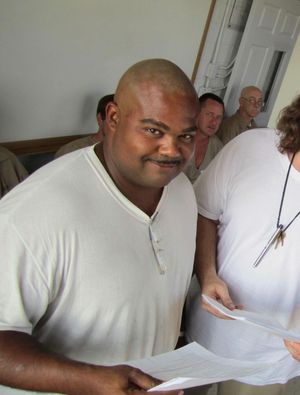
Derek R. Trumbo, Sr., a multiple-time PEN Prison Writing Award winner, is an essayist, playwright, and author whose writing has been featured in "The Sentences That Create Us: Crafting A Writer's Life
Sign up for Prism newsletters.
Stay up to date with curated collection of our top stories.