Redlining shaped the power grid. Communities of color are still paying the price
The clean energy transition is moving forward, but the legacy of segregation leaves many urban neighborhoods locked out

As an ice storm slicked roads across eastern Michigan on Feb. 6, representatives from four houses of worship arrived at the offices of Democratic Sen. Gary Peters.
They wanted Peters to pressure the Trump administration to lift the funding freeze on $20 million in “community change grants” promised by the Environmental Protection Agency (EPA) to houses of worship across Detroit. The goal: to create community resilience hubs powered by renewable energy to provide shelter during weather emergencies and utility outages.
More than three months later, spring has come to Michigan—and yet the expected $2 million in funding for the St. Suzanne Cody Rouge Community Resource Center in Detroit remains on ice.
St. Suzanne Executive Director Steve Wasko says his organization has “received conflicting and sometimes contradictory communication about the grant.” The group pays up to $15,000 a month in the winter for energy as it provides meals, clothing, day care and other programs for residents of this predominantly Black neighborhood.
The funding freeze is just the latest setback for poor communities of color across the United States—including in Detroit, Los Angeles, and Philadelphia—that are being left behind in the transition to cleaner, cheaper power.
Formerly redlined neighborhoods like Cody Rouge suffer from underpowered electrical service, more frequent power outages, shutoffs for nonpayment and high energy bills—a legacy of the once-legal practice of redlining that robbed communities of color of financial and public services, Floodlight found.
Poverty also limits access to renewable energy: Aging roofs can’t support solar panels, outdated wiring can’t handle new heaters, and old electrical infrastructure struggles to accommodate electric vehicle charging and solar arrays.
“It’s now very clear that energy services, ranging from quality of service to price of service, are disproportionately poor if you are a minority, a woman, or of low income,” said Daniel Kammen, professor of energy at the University of California, Berkeley.
Little money, high bills
Across the United States, a quarter of all low-income households—roughly 23 million people—struggle to pay their energy bills. In most major U.S. cities, including Detroit and Philadelphia, these households pay 15% or more of their incomes on average on electricity, cooling, and heat. In LA, this group pays just over 14% of their household income on utility bills.
These energy burdens have persisted for decades despite billions of dollars from federal and state governments subsidizing electricity bills in low-income communities. And now, President Donald Trump has gutted the Low Income Home Energy Assistance Program, which provides heating and cooling subsidies for 6 million U.S. households.
Collective “community solar” efforts capable of bringing cheap renewable power to renters and the urban poor are stymied by utilities or unavailable to folks with lower incomes.
Other policy solutions face significant challenges. Energy subsidy programs suffer from low enrollment. Collective “community solar” efforts capable of bringing cheap renewable power to renters and the urban poor are stymied by utilities or unavailable to folks with lower incomes.
“The current energy system has this imbalance, but if we don’t fix that, we’ll continue down that path, even as we transition to a cleaner, greener energy system,” said Tony Reames, professor of environmental justice at the University of Michigan.
At least 3 million Americans face disconnection each year because they can’t afford utility bills, with Latinx and Black households being four and three times more likely to be disconnected, respectively, according to the Energy Justice Lab, which tracks disconnections.
That number could be much higher, though, since only 28 states require their utilities to disclose disconnections, meaning that no data is available for 44% of the country, according to Selah Goodson Bell, an energy justice campaigner with the Center for Biological Diversity.
The redlined grid
And in certain cities, the inequality extends to the very structure of the grid itself.
In Detroit, advocates and scientists have found that outdated utility infrastructure is concentrated in areas predominantly inhabited by marginalized groups. This barrier may limit those neighborhoods’ ability to access renewable energy technologies such as rooftop solar, battery storage, and electric vehicle charging, which can lower energy costs.
When the lights flicker or go out in Detroit’s poorest neighborhoods, it’s often because of the electrical distribution grid.
Today in Motor City, many low-income residents get their power through DTE Energy’s 4.8-kilovolt (kV) electric system, which struggles to keep up with the changing climate. Whiter, wealthier suburbs of Detroit are serviced by a more modern 13.8-kV grid.
Across the city, power lines and transformers are decades past their intended lifespan, leading to frequent outages and prolonged blackouts. Aging infrastructure, beset by summer heat waves and winter storms, led to almost 45% of customers suffering eight or more hours of service disruptions in 2023. A company spokesperson noted that DTE improved reliability by 70% between 2023 and 2024.
“I know after three days without power, the strands of civilization get tested,” said Jeff Jones, a Detroit resident and executive director of Hope Village Revitalization, a nonprofit community development corporation. “It can get really frightening.”
DTE said it has committed to improving the grid, citing a $1.2 billion investment in downtown Detroit’s infrastructure and a push to prioritize grid upgrades in vulnerable communities.
Lauren Sarnacki, a senior communications strategist at DTE, said the company also helped connect customers to nearly $144 million in energy assistance last year. And the utility runs a pilot program for households earning up to 200% of the federal poverty level, capping their energy costs at 6% of their income.
One Black church in Metro Detroit did not wait for the grid to improve. Last fall, New Mount Hermon Missionary Baptist Church weatherized, upgraded its heating system, and installed solar panels and a battery with the assistance of the nonprofit Michigan Interfaith Power and Light and a state grant.
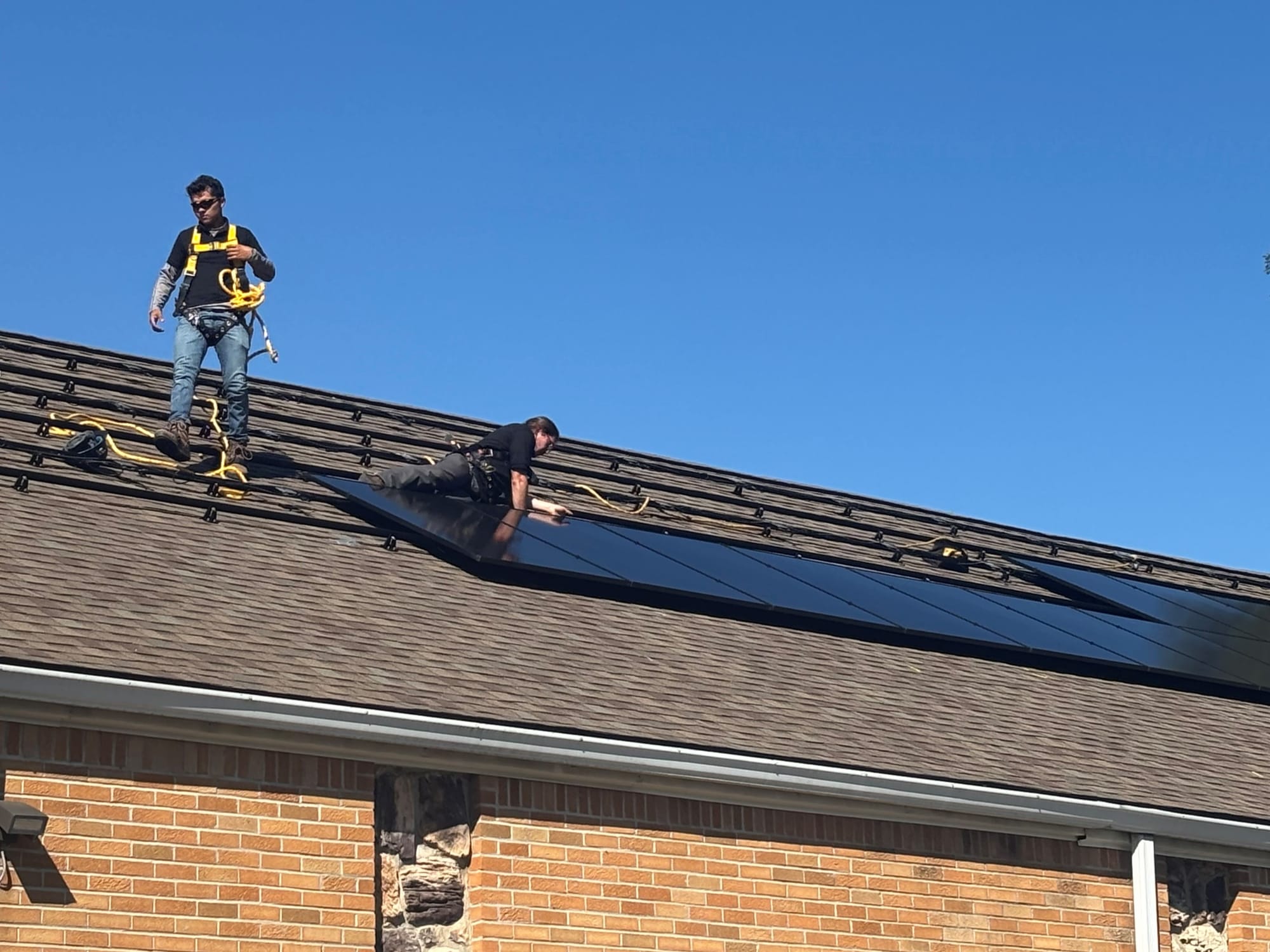
The solar array and battery give community members a chance to warm up or cool down in the building when the power is out in the neighborhood, said the church’s deacon, Wilson Moore.
“For the church itself, we’ve cut costs as far as energy consumption almost 40, 45%—and that’s without even solar panels up,” he said.
The shadow of redlining remains
In addition to a low-powered, 4.8-kV grid in some neighborhoods, old roofs are a major barrier to rooftop solar adoption in some formerly redlined parts of LA, according to Alex Turek, deputy director at GRID Alternatives Greater Los Angeles, a nonprofit that deploys renewable energy in low-income neighborhoods.
“I think 70% or more of our folks who … are ready to move forward can’t then adopt solar because their roofs are old and can’t support the weight,” Turek said.
Floodlight spoke to 18 organizations attempting to deploy renewable energy in low-income communities across the country. All of them said that poor housing stock, which is often concentrated in formerly redlined neighborhoods, was a major barrier to their work.
For renters and apartment dwellers, community solar may be a solution by allowing low-income residents “a way of dividing up an array and sharing it among multiple people,” said Alan Drew, a regional organizer with the Climate Witness project, a faith-based climate nonprofit.
Programs in 24 states and Washington, D.C., support this form of collective solar energy, which generates enough to power more than 8 million homes, according to a yearly survey from the NREL. Most of the locations also offer financial assistance for low-income households.
However, in Michigan and Pennsylvania, investor-owned utilities have stymied the adoption of community solar.
And California has a dearth of community solar—with just 13 installations—but it does have the Solar on Multifamily Housing (SOMAH) program, bringing down costs for residents of some 50,000 affordable apartments.
Solar helps cool city
On sweltering afternoons in Hunting Park, the heat rises in waves from the asphalt, baking the brick rowhouses. The Philadelphia neighborhood’s sparse tree cover offers little relief—only 9% of it is shaded, compared to 20% of the city overall.
With much of its land covered in concrete, brick, and blacktop, temperatures in Hunting Park can soar as much as 22 degrees higher than in other parts of Philadelphia. That difference translates directly into higher electricity bills as residents struggle to cool aging homes never built for such extreme heat.
Charles Lanier, executive director of the Hunting Park Community Revitalization Corp., said some residents pay as much as 40% of their incomes just to heat and cool their homes.
“I’ve seen bills as high as $5,000,” Lanier said. “It’s a problem across the board in marginalized communities here in the city of Philadelphia.”
In Hunting Park and in low-income neighborhoods across the City of Brotherly Love, the Philadelphia Energy Authority has braided together several grant and funding streams to repair, weatherize, electrify, and add solar power to some 200 low-income homes across the city in a state where community solar is not allowed.
The agency also runs Solarize Philly, a program that has helped install solar on some 3,300 homes, including low- to moderate-income households.
“We think low-income solar is the best way to create long-term affordable housing,” said Emily Shapira, CEO of Philadelphia’s Energy Authority.
Lanier has seen the value of adding solar firsthand.
“Here at our office, we have installed rooftop solar panels. Our electric bill has gone from $100,” he added, “to almost zero.”
This story was originally published by Floodlight, a nonprofit newsroom that investigates the powerful interests stalling climate action. Ethan Bakuli reported from Detroit for Planet Detroit, an independent nonprofit local news organization designed to inform residents about the environment and public health in Detroit and Michigan.
This story was supported by a grant from the Fund for Environmental Journalism.
Author
Sign up for Prism newsletters.
Stay up to date with curated collection of our top stories.