Queer people organizing in solidarity with Palestine continues to grow
LGBTQIA+ solidarity with Palestinians has a long, rich history, and it’s growing despite years of Israeli pinkwashing
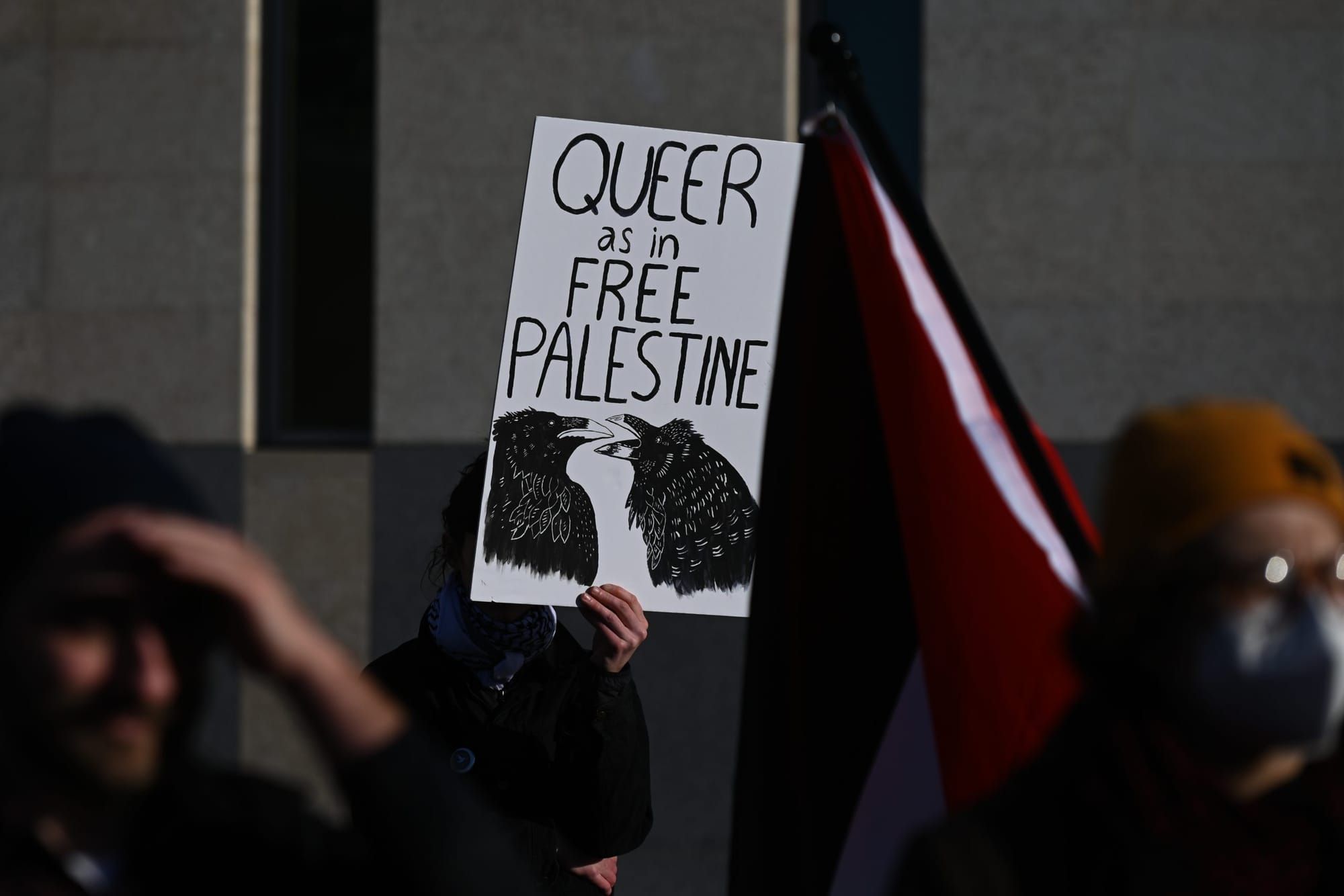
Queer Palestinian people have always been the leaders of their own resistance against Israeli apartheid, and non-Palestinian LGBTQIA+ people around the world have supported the call to end the Israeli occupation of Palestine for decades. On Jan. 6 in Northampton, Massachusetts, at an event called Queers for Palestine, transgender Palestinian poet and activist Yaffa said that Israeli genocide on Gaza has killed every LGBTQIA+ person they knew in Gaza before Oct. 7 and every LGBTQIA+ person in they connected with after Oct. 7, too.
During the event, Yaffa, queer Palestinian-American performance artist Juliet Olivier, and queer Palestinian-American author and activist Hannah Moushabeck spoke about how indigenous peoples around the world were queer before colonists brought homophobia to their societies and warned that bringing up transphobia in Palestine in response to “Free Palestine” is simply a distraction, much like any other answer to “Free Palestine” other than “yes.” They also noted that Palestinians don’t care if their oppressor can live as openly queer or not and that needing to meet basic needs like food, water, and shelter means that Palestinians cannot turn their attention to other needs like working for queer liberation.
“Palestine could be the most homophobic place in the world—which it’s not, it’s literally better than here—but it could be, and does that mean all these people need to be killed?” Yaffa asked. “A third of those are children. The children are the homophobes?”
In a strategy termed “pinkwashing,” Israel promotes itself as a gay utopia and tourist destination and attempts to co-opt queerness as a propaganda tool. Queer people themselves have long organized against being used by Israel as props in a marketing war. Queer Palestinian groups like Aswat and alQaws have been working at a grassroots level to bring visibility and acceptance of LGBTQIA+ identities within Palestinian society and offer “an alternative to Israel’s Pinkwashing practices and Palestinian taboos regarding sexual freedoms and rights.” They say that their main concern isn’t homophobia and transphobia in Palestinian society—systems that exist in every society, including Israeli and American—it’s the Israeli occupation, a system that oppresses and kills LGBTQIA+ people the same as all Palestinian people.
Yaffa, speaking with Prism after the Northampton event, says that solidarity with Palestinians from LGBTQIA+ people in the U.S. and Europe should be framed as accountability instead of white saviorism.
“It’s so important for those groups to be engaged and to actually be doing this because it is those countries that are fueling [the genocide]. They’re the ones who are supplying all the weapons, they’re paying for all of it, so in a sense they’re literally the reason for the genocide,” said Yaffa, who is also the executive director of the Muslim Alliance for Sexual and Gender Diversity. “It’s really really, really important for groups not to internalize that, ‘Oh, we as Americans are doing this good thing in the world,’ and more so of, ‘We as Americans, this is our job because it is our country that is doing this,’ which are two very different things.”
Engagement and solidarity with Palestinians across LGBTQIA+ groups continues to grow. Queer Muslims 4 Palestine and Queers for a Liberated Palestine were two of the several New York City-based groups that organized a jummah prayer for LGBTQIA+ Muslims at the Stonewall National Monument on Dec. 15, 2023.
“We are here to say there is no pride in genocide,” Rafa Kidvai, a queer Pakistani parent from Brooklyn and one of the organizers of the event said in a statement. “That we demand an end to pinkwashing and using our trans/queer bodies, stories, and struggles to fuel Islamophobia and settler colonialism.”
More recently, on Jan. 23, ACT UP NY, the historic coalition against the AIDS epidemic, announced their solidarity with Palestinians and endorsed the Boycott, Divestment, Sanctions (BDS) Movement.
In a press release, ACT UP NY noted: “ACT UP has always been a rainbow coalition fighting in the struggles for queer and trans liberation. We recognize that Israel’s efforts to pinkwash genocide weaponize queerness to indiscriminately brutalize Palestinians of all genders and sexualities. ACT UP NY is proud to be a diverse group of non-partisan individuals united in anger to end HIV/AIDS, with many of our members being part of the LGBTQ community. This is why we join Queers For Liberation to call for an immediate and permanent ceasefire in Gaza.”
A queer solidarity movement rises in response to pinkwashing and Palestinian calls
The history of pinkwashing goes back to the early 2000s when Israel began to use LGBTQIA+ people for propaganda, and some queer people began to organize against being used as tools against their will.
Sarah Schulman, author of “Israel/Palestine and the Queer International” and more than 20 other books and plays and a professor of English at Northwestern University, wrote for The New York Times in 2011 that the Israeli government began a marketing campaign in 2005 called “Brand Israel” with the help of American marketing executives. This campaign eventually expanded to include a multi-million marketing campaign to position Tel Aviv as an international gay tourist destination.
Queer anti-Zionist activists were spurred to speak out for Palestine, specifically as queer people in response to pinkwashing. Groups identifying themselves as queer people in solidarity with Palestine generally appeared in the early 2000s and after.
Queers Undermining Israeli Terrorism (QUIT!), founded in 2000 in the San Francisco Bay Area of California, is one of a handful of queer-specific U.S.-based groups actively working on Palestinian liberation.
“I believe that queer liberation is connected to the liberation of all people,” said Carla Schick, a retired educator in the Bay Area and an organizer with QUIT! “If we’re fighting a white supremacist patriarchy, you can’t just pick and choose your battles. They’re all interconnected.”
Since October, QUIT! members have regularly stood in Harvey Milk Plaza in San Francisco, holding up pictures of what is happening in Gaza. They also go beyond calling for a ceasefire to demand the liberation of Palestine. Throughout their organization’s history, they have projected slideshows about the impact of Israel’s occupation and apartheid against Palestinians, taken actions to pressure the local LGBTQIA+ film festival to stop taking money from the Israeli consulate, and performed street theater to support Boycott Divestment and Sanctions.
Schick says that it’s important for Americans to follow the lead of queer Palestinians. “If we as Westerners try to define what liberation looks like for them, that itself is a very colonizing stance.”
Lucas Claussen is a teacher in Olympia, Washington, who first made connections around how gender and sexuality can play into conflicts when he was an anti-war activist as an undergraduate at The Evergreen State College in Olympia in the time soon after 9/11. Claussen’s queer identity only became an explicit part of his anti-Zionist activism on campus when the pro-Israel group StandWithUs (SWU) came to the Olympia area as part of a pinkwashing tour targeting LGBTQIA+ community centers.
“It wasn’t until we had to push back against [SWU] that it became really front and center,” Claussen said of his queer identity. Hearing SWU’s use of queer rights as a pro-Israeli talking point made him “feel gross, really uncomfortable, and disturbed.”
Schick and Claussen both point out that there are anti-trans and anti-queer violence and laws in the U.S., Israel, and everywhere in the world, and it is hypocritical of pinkwashing messaging to bring up their presence in Palestine as a way to attempt to defend the Israeli occupation or genocide.
Schulman notes the large official organizations dedicated to LGBTQIA+ rights movement have been generally silent on the ongoing genocide issue since Oct. 7.
A newly formed collective named Queers for Liberation has gathered more than 25,000 signatures on a petition calling for LGBTQIA+ organizations like GLAAD, GLSEN, Human Rights Campaign (whose corporate sponsors include Northrop Grumman, which manufactures weapons systems being used by the Israeli military against Palestinians), PFLAG, and The Trevor Project to call for a ceasefire in Gaza. “We firmly denounce the cynical use of queer symbols for colonial propaganda and condemn LGBTQIA2S+ organizations that have remained silent or ‘neutral’ in the face of genocide,” the petition reads. “Our Palestinian LGBTQIA2S+ siblings’ greatest threat to safety and freedom is violence at the hands of the state of Israel. Your organizations have the power to meaningfully influence public discourse and political opinion to end the injustices Palestinians face urgently in Gaza.”
A long history of queer solidarity with Palestine
While many queer people have been mobilizing for Palestine since the genocide began in October, this solidarity is nothing new. Queer solidarity with Palestine has a deep history. Queer writers, professors, poets, and activists in the U.S., like June Jordan, Audre Lorde, James Baldwin, Judith Butler, bell hooks, and Leslie Feinberg, spoke out for Palestinian liberation and being anti-Zionist, while grassroots groups like Queers for Palestine organized on the streets.
“I would say that queer people—openly gay people—in solidarity with Palestine have been welcomed [in Palestine] for almost 60 years,” says Schulman.
Schulman points to French writer Jean Genet visiting Palestinians in Jordanian refugee camps in 1970 and becoming an outspoken advocate for Palestinian resistance and anti-Zionism in the years after. His 1986 book “Prisoner of Love” describes his time among activists in Jordan in 1970 and his visit to the Shatila refugee camp in Lebanon in 1982 directly after an Israeli massacre of hundreds of Palestinians. Schulman says Genet was openly gay, and Palestinians welcomed his advocacy.
American LGBTQIA+ activists also spoke out against Zionism, apartheid, and U.S. backing of the Israeli occupation of Palestine through their writings and speeches.
Lorde’s 1989 commencement speech at Oberlin College included her oft-quoted line, “We are citizens of the most powerful country on earth—we are also citizens of a country that stands upon the wrong side of every liberation struggle on earth.” She mentioned homophobia, AIDS, poverty, police brutality, anti-Black racism, antisemitism, and South African apartheid, along with anti-Palestinian violence.
“Israeli soldiers fire tear gas canisters made in America into Palestinian homes and hospitals, killing babies, the sick, and the elderly. Thousands of Palestinians, some as young as 12, are being detained without trial in barbed-wired detention camps, and even many Jews of conscience opposing these acts have also been arrested and detained,” Lorde told the students. “Encouraging your congresspeople to press for a peaceful solution in the Middle East, and for recognition of the rights of the Palestinian people, is not altruism, it is survival.”
Feinberg, author of “Stone Butch Blues,” used hir minutes on the stage at the 2002 March on Washington against the U.S.’ invasion of Iraq to also mention that “as a Jewish revolutionary, I continue to fight for Palestinian freedom. Zionism is my enemy, too.” In a speech given at a Palestinian queer group’s conference in 2007, ze said, “I am with Palestinian liberation with every breath in my body; every muscle and every sinew.”
LGBTQIA+ celebrities and organizations share their support for Palestinian liberation
Today, visible and prominent members of the LGBTQIA+ community are using their platforms to publicly voice their support of the Palestinian people. More than 3,500 artists signed on to a letter under the title “Queer Artists for Palestine” calling for a permanent ceasefire in Gaza.
“Our queer Palestinian siblings have asked us to stand firmly with them in their call for dignity and self-determination,” the statement reads. “This includes challenging Israel’s whitewashing, or ‘pinkwashing,’ of its brutal military occupation, by exploiting queer performers and voices to cover up decades of right-wing, violent, and racist policies against Palestinians. Now more than ever, we must be clear: queer people are no friends to Israeli apartheid. We use our voices and our platforms to oppose systemic violence and inequality—against Palestinians, and against all people everywhere.”
Signatories include singer-songwriter Phoebe Bridgers, comedian John Early, singer Kehlani, actor Indya Moore, actor Hari Nef, author Ijeoma Oluo, actor Bella Ramsey, actor Angelica Ross, comedian Bowen Yang, and drag artists Shea Couleé, Kandy Muse, and Sasha Velour. The artists pledge not to perform in public events in Israel “until Palestinians are free.”
LGBTQIA+ celebrities, including comedian Margaret Cho, actor Alan Cumming, singer Adam Lambert, singer Janelle Monáe, actor Rosie O’Donnell, actor Sara Ramírez, actor Susan Sarandon, actor Kristen Stewart, and comedian Wanda Sykes signed onto the Artists4Ceasefire letter.
Another notable statement showing queer solidarity with Palestine is A Liberatory Demand from Queers in Palestine, signed by more than 500 organizations from more than 50 countries. The organizations include queer groups of all kinds, from Vegan Rugby Lesbians to Queer Mutual Aid Lebanon and queer Palestine solidarity groups from around the world like the Queer Palestinian Empowerment Network, Los Angeles LGBTQIA+ 4 Palestine, Queer Artists for a Free Palestine, Queer Cinema for Palestine, and Queers for Palestine chapters in the U.S., U.K., Canada, and Germany.
As the movements of queer solidarity with Palestine continue to grow on the foundation of their rich history and a sense of collective liberation of all oppressed people, LGBTQIA+ activists and organizers continue to push for a ceasefire and an end to the Israeli occupation through actions around the country.
“An end to an occupation is what’s needed for everyone. A ceasefire is needed for everyone,” Yaffa said. “Otherwise, we haven’t eliminated any of the things that are fueling a lot of the challenges that queer and trans Palestinians are going to be experiencing.”
Author

Sarah Prager’s writing has appeared in the New York Times, National Geographic, The Atlantic, NBC News, and other national outlets. She is the author of four books on LGBTQ+ history for youth: Queer,
Sign up for Prism newsletters.
Stay up to date with curated collection of our top stories.