Filed Under:
One bite at a time: Losing my religion (and regaining my faith)
I’ve come to believe that mercy is not an abstract idea; sometimes it’s a place being set for you at the table when you thought you no longer belonged anywhere
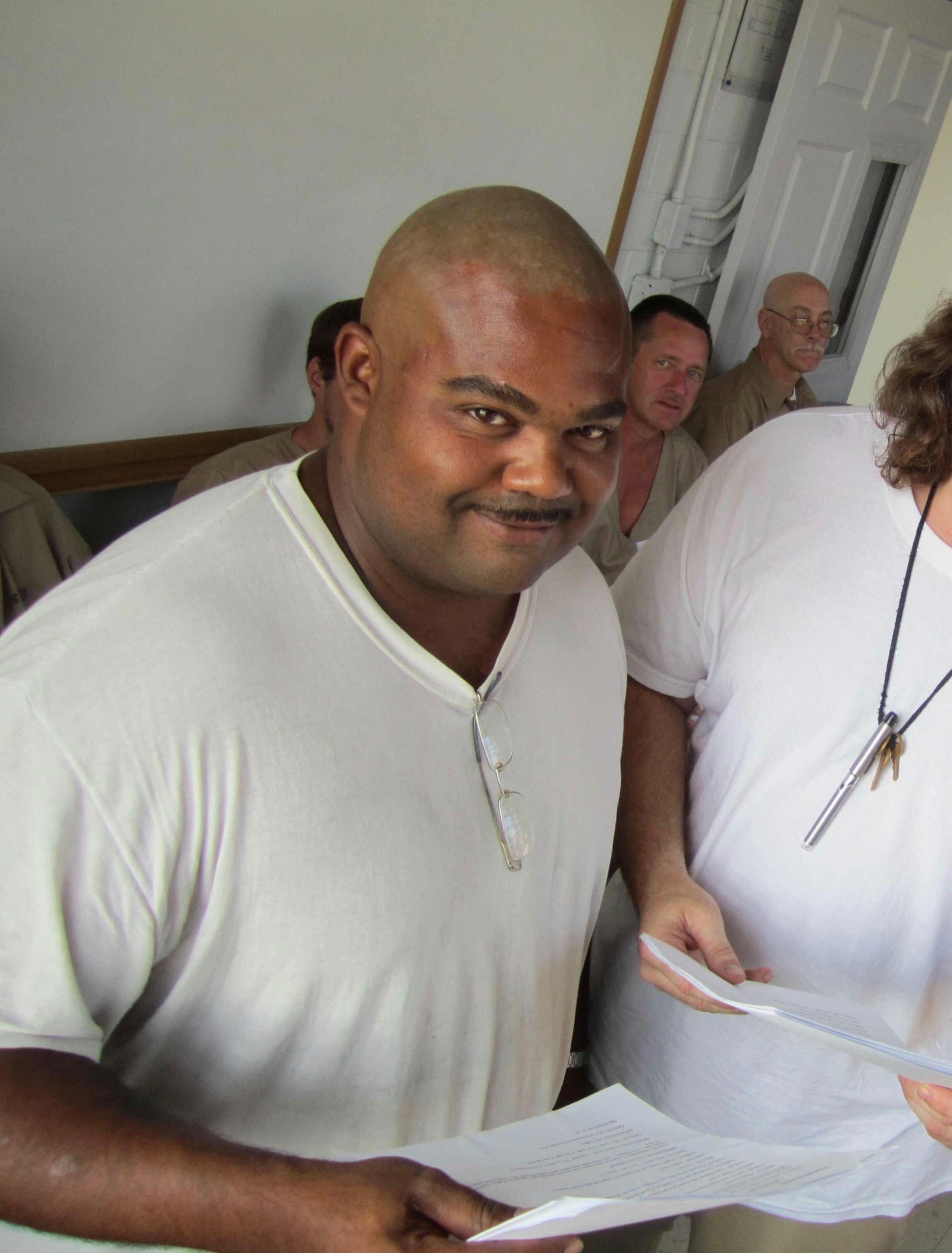
Derek R. Trumbo, Sr.
Real journalists wrote and edited this (not AI). Independent, community-driven journalism survives because you back it. Donate to sustain Prism’s mission and the humans behind it.
Real journalists wrote and edited this (not AI)—independent, community-driven journalism survives because you back it. Donate to sustain Prism’s mission and the humans behind it.
Dear Reader,
Prior to my conviction, I wasn’t a religious person, even though I came from a very religious family. I have aunts, uncles, and a grandfather who are deacons, ministers, and pastors. But early on, I knew that life was not for me.
Somewhere along the line from childhood to incarceration at the age of 24, I lost my way. In 2009, three years into my incarceration at Kentucky’s Northpoint Training Center, there was a massive riot. I can safely report that nothing makes you rethink your life choices quite like standing in the middle of a burning prison …
Prison is hard, but it feels even harder when you have absolutely no sense of direction. After the riot, I began to ponder the meaning of life. Not on a purely philosophical level, though there were times I did exactly that. Mostly, it was on a more personal one: What was the meaning of my life? What was my sense of purpose? What did I have to offer anyone? It bothered me that I didn’t have any answers.
During those early years in prison, I spent weeks speaking to people who were serving far more time than me, asking them where they thought their lives would be if they weren’t incarcerated. They told me stories about their family members, children, and spouses. They were noticeably absent from these narratives. That realization startled me, because I saw that I was also the missing part in my own story.
As I’m sure you’ve picked up from my columns, I aspired to be a writer. It didn’t come easily—I had to study a lot—but I was always a curious person, always asking questions and seeking answers. So, it was only natural for me to sit down with a blank page to organize my thoughts and catalog everything I pondered. I realized my story wasn’t really complete without me in the picture, so I set out to determine what it would look like to take control of my narrative.
A few of the people I spoke to about their lives invited me to church. I thought this could be an interesting first step to figuring myself out. When I first attended, I was stunned by the expansive wooden ceiling, tall oak beams, and neat, clean building that seemed out of place behind prison fences. Church inside is not like church outside. At Northpoint, our prison was called “the inmate religious chapel” to make sure it was inclusive of many faiths. The people who attended and inmates who worked as staff in the chapel all treated the place as sacred. Yet, I struggled with what I saw there. Some people spoke with deep conviction in the chapel, only to return to the dorm and engage in the same destructive behaviors. That bothered me—not because I judged these men, but because I was searching for something real, something that could actually change me.
In time, I began taking Bible study courses and praying on my own. Eventually, I attended Buddhist studies in the chapel, and I met a chaplain who became an important mentor to me. He told me that faith does not depend on appearances or labels, but on what a person truly believes. He admitted that since childhood, he wrestled with his own understanding of Christ. His honesty moved me.
The chaplain once told me that he was kicked out of Sunday school for asking if a person who was never taught about Jesus goes to hell when they die. The sermon of the day had been about accepting Jesus as your personal savior, and he was told that without acceptance, you are surely destined for an eternity in hell. His young mind couldn’t understand how hell figured into the picture if Jesus died for everyone’s sins. Should it matter if a person accepted a savior or not?
My talks with the chaplain showed me that faith can be sincere, thoughtful, and personal—and that it can even grow in a place built to confine you.
When he asked if I was religious, I told him I was “spiritual.” He laughed and said he understood. I confessed that I had an issue with Jesus being depicted as someone other than a person born in Bethlehem, and he advised me to imagine Jesus however I wished because it didn’t change my faith. As someone who did not grow up with many moral role models, these conversations mattered to me a great deal. My talks with the chaplain showed me that faith can be sincere, thoughtful, and personal—and that it can even grow in a place built to confine you.
There were nights in prison when the noise finally died down, and all I could hear were my own thoughts. Those were often the hardest moments of all. In the daytime, a man can hide from himself through routine, conversation, and other distractions. But at night, there was nowhere to go. I had to sit with the reality of what I had been convicted of, what I had become, and how many people I disappointed—including myself. That kind of silence can either hollow you out or force you to honestly face yourself.
For a long time, I carried shame like bricks on my back. I felt the loss of time, the loss of dignity, and the loss of the life I might have had if I made different choices. Yet somewhere inside that grief, I also began to feel the first small stirrings of change. Not all at once, but little by little.
I found myself beginning to believe that broken things are not always beyond repair.
Upon my release from prison last year, I can’t help but feel that in one way or another, many of the people now in my life are connected to that moment when I met the chaplain who taught me that God is in all of us.
Since coming home, I’ve volunteered at the church I attend by preparing and serving food on Sundays and helping set up events. Through these actions, I’ve been welcomed by a community that supports my reentry. These are people who do not judge me. They do not ask more from me than what I am willing or able to give, and their only expectation is that I do what is best for my freedom. As a young man, I never had support, a sense of community, or people around me who encouraged me to seek positive things in life. This lack of direction led me to seek temporary pleasures, easy money, and unhealthy distractions from the poverty that surrounded me. I lacked integrity, morals, and a sense of self. All of this changed after I was confined and forgotten by everyone I’d ever known. I had only myself to rely on, and I wanted to take a different path than the one that led me to prison.
Now, what compels me more than anything is kindness and how this simple act can reach a person who spent their lives expecting rejection. There is a feeling that comes with being seen without condemnation; it’s difficult to put into words.
For so long, I believed that once people knew where I had been, they would only see my worst decisions. I expected distance. I expected suspicion. Instead, I found people willing to shake my hand, share a meal, and ask how I was doing and actually mean it. Those moments probably seemed small to them, but to me they were profound. They have reminded me that mercy is not an abstract idea; sometimes it’s a place being set for you at the table when you thought you no longer belonged anywhere.
Of course, I still carry sorrow with me. There are memories I cannot undo and years I cannot reclaim. There are relationships unlikely to be fully restored and consequences that do not disappear simply because a person is changed. I have had to make peace with all of that. But I have also learned that a meaningful life does not begin when the past is erased—it begins when a person decides not to let the past have the final word. This is now part of my faith too: not pretending I was never lost, but believing that even a life marked by failure can still be used for something honest and good. If my journey can help anyone now, I hope it is through the understanding that healing is slow, dignity can be rebuilt, and purpose can still be found by those who once believed they had thrown theirs away.
Today, my faith is less about claiming a label and more about practicing a way of living. My faith shows up in the choices I make each day: to be patient when I am frustrated, to be honest about my past, to serve where I can, and to keep believing that my life still has purpose.
My faith was tested in prison in ways that I am only now really beginning to understand. There were so many moments when despair, anger, and hopelessness felt stronger than anything holy. But in that darkness, I learned that belief does not have to be loud to be real. Sometimes faith is simply the decision to keep going, to keep growing, and to trust that redemption is possible.
While the church now gives me community, it is my faith that gives me direction. It reminds me that freedom isn’t as simple as being released from prison. It’s about becoming the kind of man who can live with gratitude, responsibility, and hope.
The Right to Write (R2W) project is an editorial initiative where Prism works with incarcerated writers to share their reporting and perspectives across our verticals and coverage areas. Learn more about R2W and how to pitch here.
Editorial Team:
Tina Vasquez, Lead Editor
Lara Witt, Top Editor
Rashmee Kumar, Copy Editor