Never eat the candy on your pillow: Connections that dissolve prison walls
Loneliness drives a great deal of distress in prison, and it also fuels inmate pen pal sites that incarcerated people turn to for friendship and romance

Dear Reader,
How do you meet new people? We often hear that it’s harder to make new friends the older you get, but what if you genuinely can’t connect with others?
It’s probably hard for you to understand just how few opportunities there are for the incarcerated to meet new people. I’m sure this sounds crazy, given what we know about mass incarceration and how many people filter in and out of prisons each day.
Consider this column an SOS or distress signal, if you will.
Loneliness drives a great deal of distress in prison. It also fuels inmate pen pal sites that profit from preying on people’s desire to connect. The U.S. does have more incarcerated people than any other nation in the world, so connection guides are big business. I cannot tell you how many of these guides I’ve come across for inmate pen pals, written by both well-meaning and unscrupulous people.
The average, well-meaning author of a pen pal writing guide encourages the reader to be honest about themselves and open to new experiences, while also reminding them to be patient with their new pen pals. Whereas scammers urge readers to make themselves more appealing by lying, seducing, and manipulating the people who write them as a way of creating the perfect illusion of what their pen pal is looking for in another person.
In this column, you’ll hear about the pen pal experience of someone we’re calling Jerome and how he ultimately learned that the key to connection isn’t mirroring who you think someone wants you to be. It’s about being who you are and making sure you bring something to the table—a lesson that extends beyond these prison walls.
When guys inside asked me my thoughts on meeting new people through pen pal sites, I highly advised against any form of scam, seduction, or manipulation. If you really want to get to know someone new, why wouldn’t you just be yourself?
The subject came up because Jerome was bragging to everyone about how he met his new girlfriend on a pen pal site.
“Real talk: If old girl hadn’t started writing me, man. I don’t know where I’d be right now,” Jerome said. “I’d be sitting in the hole right now, looking stupid, because I didn’t have anything better to do with my time.”
The hole is the prison’s restricted housing unit used for disciplinary purposes, meaning that Jerome would have simply acted out due to boredom. But Rita stopped him from such foolishness.
Jerome met Rita on a paid pen pal site that advertised his profile across major online search engines. According to Jerome, he wasn’t even looking for a relationship. He just wanted someone to talk to. He didn’t even really know how the pen pal site worked when he first joined.
“I had four duds right from the beginning,” Jerome said, describing the unanswered letters he sent out and the letters he received that asked probing questions about prison life that he didn’t feel comfortable answering.
“I wanted to find someone who made these prison walls disappear.”
“I paid $100 for that online ad,” he said. “That’s three months of work for me. I didn’t spend all that cash just to keep my mind cooped up in here, you feel me? I wanted to find someone who made these prison walls disappear.”
After the series of duds, Jerome invested in a pen pal connection guide. He said he wanted to learn what to say to new pen pals so that they would continue writing to him, but some of the guide’s suggestions seemed bogus.
“I felt like I was the problem,” Jerome said. “I did everything that book said. I wrote poetry. Drew artwork on the envelopes, all kinds of hearts and flowers and other cute shit. Still, no one wrote back. I even took a new picture for the website. I did a thousand push-ups before having that picture taken, and you know what I got? Nothing.”
Jerome’s problem wasn’t his poetry, art, or physique. The problem was his lack of communication skills.
“I wasn’t asking them any questions about themselves or being interesting or speaking about anything that even mattered much at all,” Jerome said, in retrospect. “Every letter I wrote was basically the same rant about how much I hated prison.”
I asked Jerome to describe his relationship with Rita so that you readers could better understand the particulars and what made it feel so different.
“It’s like that song: ‘I am human and I need to be loved, just like everybody else does,’ Jerome said, describing himself as a “criminal” who did bad things in the past.
“But that isn’t who I am now,” he asserted.
To understand “the particulars,” Jerome said, you have to understand that he grew up surrounded by crime. Everyone he knew was “crooked.” That was simply how his neighborhood was, and so it was also how he was.
“But after being convicted and locked up, I started trying to fill them gaps in my life resume, and I realized I was missing what most everybody else sees as elementary skills,” Jerome explained.
In Rita’s first letter to Jerome, a single paragraph contained the words “reciprocal,” “cathartic,” and “manifest.”
“I didn’t know what the hell she was talking about,” Jerome laughed. “I had to borrow a dictionary, man. No kidding. That was my wake-up call. I really had to step my game up.”
Jerome wrote back to Rita and told her how he had to level up his vocabulary if he had any hope of hanging in conversation with her. That one comment, full of vulnerability and honesty, made it easy for Rita to want to respond.
“Do you trust Rita?” I asked.
Jerome grew still for a moment and closed his eyes.
“I do,” he said. “I know it sounds crazy, but I realize she has a life of her own. Our relationship isn’t about me getting what I want. You taught me that, Trumbo. You were the one who said I had to quit trying to squeeze everything so tight. So yes, I trust her. She’s changed my life.”
In prison, distress calls are rarely answered exactly when a lifeline is needed. Jerome is one of the lucky few. Generally, most people in prison don’t have much luck forming or maintaining relationships, as razor wire, fences, and expensive monitored phone calls tend to put a hurt on romance. But against the odds, Jerome found something special in Rita.
“Rita doesn’t judge me, fam,” Jerome explained. “She didn’t stop using them $5 words of hers, either. Now it’s like a game we play together, because she challenges me to not only learn the definitions, but she also expects me to use them back. That’s what’s up.”
The Right to Write (R2W) project is an editorial initiative where Prism works with incarcerated writers to share their reporting and perspectives across our verticals and coverage areas. Learn more about R2W and how to pitch here.
Editorial Team:
Tina Vasquez, Lead Editor
Carolyn Copeland, Top Editor
Rashmee Kumar, Copy Editor
Author
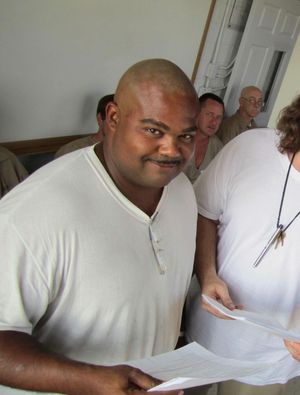
Derek R. Trumbo, Sr., a multiple-time PEN Prison Writing Award winner, is an essayist, playwright, and author whose writing has been featured in "The Sentences That Create Us: Crafting A Writer's Life
Sign up for Prism newsletters.
Stay up to date with curated collection of our top stories.