Palestinian women come forward with allegations of increased sexual violence by Israeli forces since Oct. 7
While Western media pushes unsubstantiated claims of a coordinated campaign of sexual violence led by Hamas, Palestinian survivors are punished for reporting Israeli soldiers for abuse
Kifaya Khraim works as the international advocacy coordinator at the Women’s Centre for Legal Aid and Counselling (WCLAC), based in Ramallah in the West Bank. For the last two years, Khraim has documented reports from Palestinian women and girls who say they were subjected to sexual assault, sexual torture, and rape by Israeli soldiers.
Since the events of Oct. 7, 2023, WCLAC has observed an increase in reported incidents of sexual violence against dozens of Palestinian women and girls in the West Bank, Gaza, and Jerusalem. According to Khraim, the experiences of Palestinian women detained by Israeli authorities share some of the same elements: Women are arrested without charges and held under administrative detention. The women say they are searched, forced to strip, repeatedly beaten on their genitals, photographed naked, and then threatened with or sometimes subjected to rape. The violations occur at detainment centers or checkpoints as a condition of the women’s ability to move from one place to another, or, increasingly, when soldiers invade their homes in the middle of the night. Some of the women Khraim has spoken to said they were afraid of falling asleep in Israeli jails because they believed they’d be raped or assaulted.
Khraim and her colleagues believe that soldiers have been given a “directive” for how to treat Palestinian women and girls, since sexual violence is so uniform across different regions and Israeli army units. She added that Israeli soldiers seem to understand and exploit the cultural stigma that prevents many of their victims from coming forward.
“Women are terrified to talk about what happened to them, and we have to give them so many assurances to convince them to talk to us,” Khraim said. “We’ve interviewed over 30 women prisoners, and they have all said the same thing: They were tortured, they were denied food, they were denied sanitary pads. … They were assaulted and beaten in front of each other, all to humiliate them.”
According to Khraim, it’s not just the genocide in Gaza that’s escalated sexual violence from Israeli soldiers across Palestine. Israelis are also emboldened by Western media coverage of the genocide, including extensive coverage alleging a systematic “mass rape” campaign perpetrated by Palestinian men against Israelis on Oct.7.
“Soldiers feel more compelled to retaliate and take revenge because that’s what they believe happened,” Khraim said. She added that Israeli soldiers feel comfortable posting their abuses to social media because Western media reports about sexual atrocities by Hamas have further convinced so much of the world that Palestinians are inhuman.
Unsubstantiated claims
Allegations of a coordinated campaign of sexual violence by Hamas are unsubstantiated. They draw on racist stereotypes that implicitly offer grounds for genocide and justify the occupation more broadly. This has long been a tactic of colonizing powers: painting colonized men as barbaric rapists who must be punished, tamed, and controlled because they cannot be trusted with freedom and self-determination.
Yazan Zahzah, a member of the Palestinian Feminist Collective, told Prism that Black and brown men throughout history have been smeared as rapists who pose an innate threat to white or Western women, justifying mass lynchings and executions by colonizing forces and white supremacists. Zahzah said that all the West hears about Palestine from mainstream media are “trigger words” about how Islam oppresses women, sexual violence, and how Israel is “trying to defeat this.”
In December 2023, the New York Times published a lengthy investigative report that made sweeping claims about systematic sexual assaults perpetrated by Hamas fighters against Israelis on Oct. 7. But extensive fact-checking from publications including The Intercept, Mondoweiss, and the Electronic Intifada—coupled with comments made by one of the Times reporters about the questionable process behind her own reporting—thoroughly discredit claims of any deliberate and planned rape campaign by Hamas. The Times reporter spoke at length to an Israeli radio station about how the reporting was largely driven by her preconceived conviction that mass sexual violence occurred on Oct. 7. Even after interviews with numerous hospital workers, police, and victim services facilities across Israel, she remained convinced a mass rape rampage transpired—even after all of these sources said they did not receive any reports or evidence of rape.
This January, the Israeli government blocked a request from United Nations sex crimes experts to probe the alleged sexual violence perpetrated by Hamas during the Oct. 7 attack. The Israeli newspaper Haaretz reported that Israel’s decision was an effort to avoid the scrutiny applied to widespread sexual violence perpetrated by Israeli forces against imprisoned Palestinians. A probe could result in Israel—not Hamas—being added to the U.N.’s sexual violence blacklist. Around the same time Israel blocked the U.N.’s request, an Israeli prosecutor conceded that there have been no rape reports associated with Oct. 7.
Disproportionate coverage
Journalist Adam Johnson has reported extensively on the double standards applied to Israel and Palestine in mainstream Western media coverage, detailing the real-time manufacturing of consent. On Sunday cable news shows from October 2023 to October 2024, Johnson found there were 15 mentions of rape related to the war, and each reference focused on allegations of rape committed by Hamas; none by Israel. Far-right, pro-war Zionist voices who have made extreme, debunked claims are still treated as credible sources by outlets like the Times. Meanwhile, the mere act of being Palestinian disqualifies sources and discredits journalists.
“Very early on [in Western media], it was positioned in a war on terror framing of the West versus an ontologically evil force,” Johnson told Prism, “and this fundamental premise that this is a noble, just war to eliminate Hamas.”
Israel is often “framed as reluctantly killing people,” Johnson said, even as Israeli forces have killed about 49,300 Palestinians, per Gaza’s Health Ministry. However, according to some researchers, the number is closer to 200,000. Johnston said that Western media outlets like the Times effectively frame Hamas’ actions on Oct. 7 as “killing people just to kill people as some kind of nihilist rampage. … So it follows that they would only do things to be maximally evil, not for any strategic goals.” Hamas’ actions were part of the group’s recurring strategy of taking hostages in exchange for Palestinian prisoners, Johnson pointed out, and decidedly not a senseless spree of raping and killing.
Dehumanizing, racist tropes about Arab men (and particularly Palestinians), as well as Western media bias that heavily favors Israel as an ally to the U.S., have allowed fearmongering reporting about Hamas-perpetrated mass rapes to flourish. As The Intercept has stressed, “The question has never been whether individual acts of sexual assault may have occurred on Oct. 7,” but the repeated media coverage of a weaponized rape campaign remains unsubstantiated and deeply rooted in racism—all while Palestinian victims of sexual abuse say this coverage has catalyzed heightened retaliatory violence against them.
Media coverage of a weaponized rape campaign remains unsubstantiated and deeply rooted in racism—all while Palestinian victims of sexual abuse say this coverage has catalyzed heightened retaliatory violence against them.
According to Zahzah from the Palestinian Feminist Collective, it is common for liberal Zionists to express some level of sympathy for Palestinians in Gaza, but that sympathy is tempered with references to the claim of Hamas’ coordinated campaign of sexual violence against Israelis.
This rhetoric attempts to equalize a severely imbalanced power dynamic between Israel and Palestine, Zahzah said. They added that the liberal Zionist movement is rife with such tensions and hypocrisies. As an example, they pointed out how liberal American Zionists often advocate for reproductive rights, but ignore the reproductive injustice across Gaza amid the genocide, including total decimation of the health system and cesarean sections without anesthetic, as well as surging rates of miscarriage and maternal and infant mortality and infections.
“Reproductive violence and the entire obliteration of reproductive health systems in Palestine is also gender-based violence and its own form of sexual violence,” Zahzah said.
Atrocity propaganda
On top of manufacturing consent, rape-related atrocity propaganda that smears Palestinians has another function: It obscures Israel’s well-documented role as a perpetrator of sexual violence against the men, women, and children they’ve colonized.
For all the Western media reports about mass rapes perpetrated by Hamas, Khraim points to the dearth of coverage of sexual violence perpetrated by Israelis against Palestinians. When Palestinian sexual abuse victims never see their stories or experiences come to light, they don’t see any point in coming forward and become even more distrustful of human rights groups that seek their testimonies.
“This makes it harder for us to collect data and testimonies because they ask us, ‘What are you using it for? We don’t see it in the media,’” Khraim explained. Consequently, the lack of data and testimony makes it more challenging to hold Israel accountable or push for transparency, protections, and change.
According to the testimonies Khraim has collected, one woman was arrested after soldiers asked her why she was wearing green. She was taken to a police station, stripped naked, and beaten on her genitals while cameras recorded. Khraim said many women are arrested for arbitrary reasons, including being insufficiently deferential to soldiers or for social media posts that soldiers deem dangerous or anti-Israel. In July 2023, Israeli soldiers raided a home in Hebron using large dogs and guns. The soldiers threatened five women in the home, including a 17-year-old girl, and forced them to get naked. Khraim said she’s tracked at least 30 similar cases of Israeli home invasions in which women and girls have been forced to undress.
Palestinian women are particularly vulnerable to sexual violence at checkpoints, according to documentation of five cases gathered by WCLAC. In one case, an Israeli soldier allegedly exposed himself to a woman and made her touch his genitals. Many women are unable to report this violence at checkpoints because they fear retaliation, which could result in being unable to pass the checkpoint and attend work or school.
Eva Tabbasam, the director of Gender Action for Peace and Security, warned in a Middle East Eye article in December that while sexual violence committed by Israeli forces is by no means new, it’s “increasing at an alarming rate.”
ProPublica reported in January that it appears the U.S. State Department has been aware of sexual abuses perpetrated by Israeli soldiers against Palestinians detained in prisons. In the report, children recounted torture and brutal mistreatment, including a 15-year-old boy from the West Bank who said he was tortured and raped in the Israeli detention facility Al-Mascobiyya. Child sexual abuse within Israeli prisons is well-documented. In 2014, the Palestinian Prisoners Club, an organization that supports the estimated 10,000 Palestinian political prisoners of Israel, reported that Israeli forces arrested at least 600 Palestinian children in Jerusalem, subjecting nearly half to sexual violence.
Through the years, global humanitarian organizations Save the Children, Human Rights Watch, and Defense for Children International have published corroborating reports showing the prevalence of child sexual abuse in Israeli jails. In December 2023, Defense for Children International informed the U.S. that Israeli forces raped a 13-year-old Palestinian boy in an Israeli jail. When the U.S. brought this information to Israel’s attention, Israel shut down the organization’s headquarters in the West Bank the following day and declared it “a terrorist organization.” In 2021, the Israeli government designated six prominent Palestinian NGOs as terrorist organizations for reporting on Israel’s abuses.
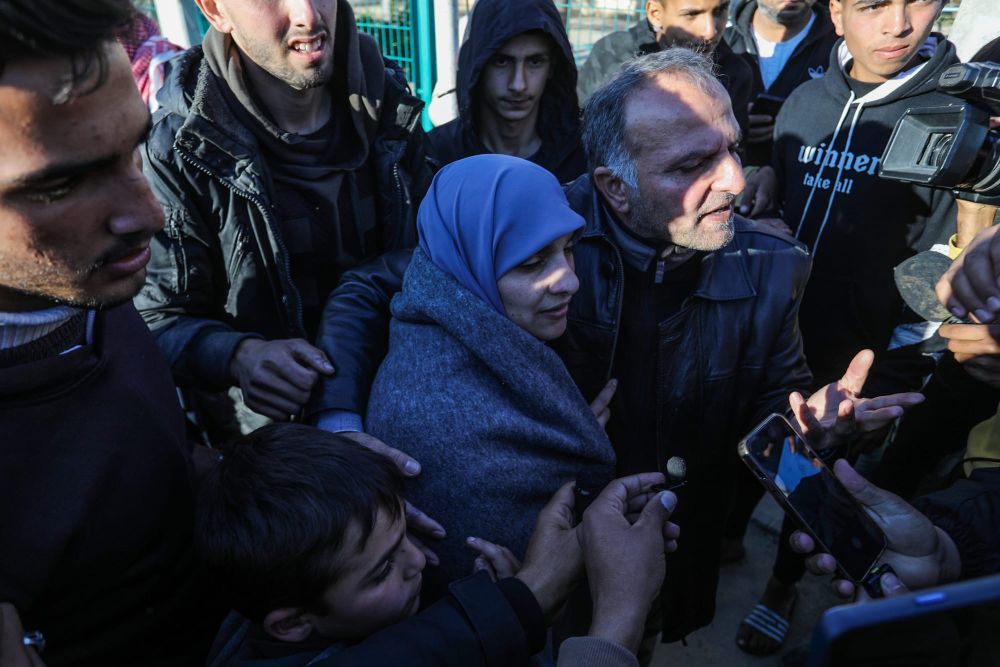
The stigma and terror that silences Palestinian victims remains pervasive, Khraim said. However, over the last several months, she’s been able to collect testimony from more Palestinian victims. As women come forward, more are emboldened to join them. “They were afraid to talk about it before, but now they do because so many are being sexually assaulted systematically,” Khraim said.
Editorial Team:
Tina Vasquez, Lead Editor
Carolyn Copeland, Top Editor
Rashmee Kumar, Copy Editor
Author

Kylie Cheung is a freelance writer reporting on politics and culture. She is the author of Survivor Injustice: State-Sanctioned Abuse, Domestic Violence, and the Fight for Bodily Autonomy.
Sign up for Prism newsletters.
Stay up to date with curated collection of our top stories.