Palestinian voices sidelined at DNC despite push for representation
Calls for a Palestinian American speaker at the DNC were denied, highlighting ongoing tensions with the Democratic Party over Israel’s genocide in Gaza
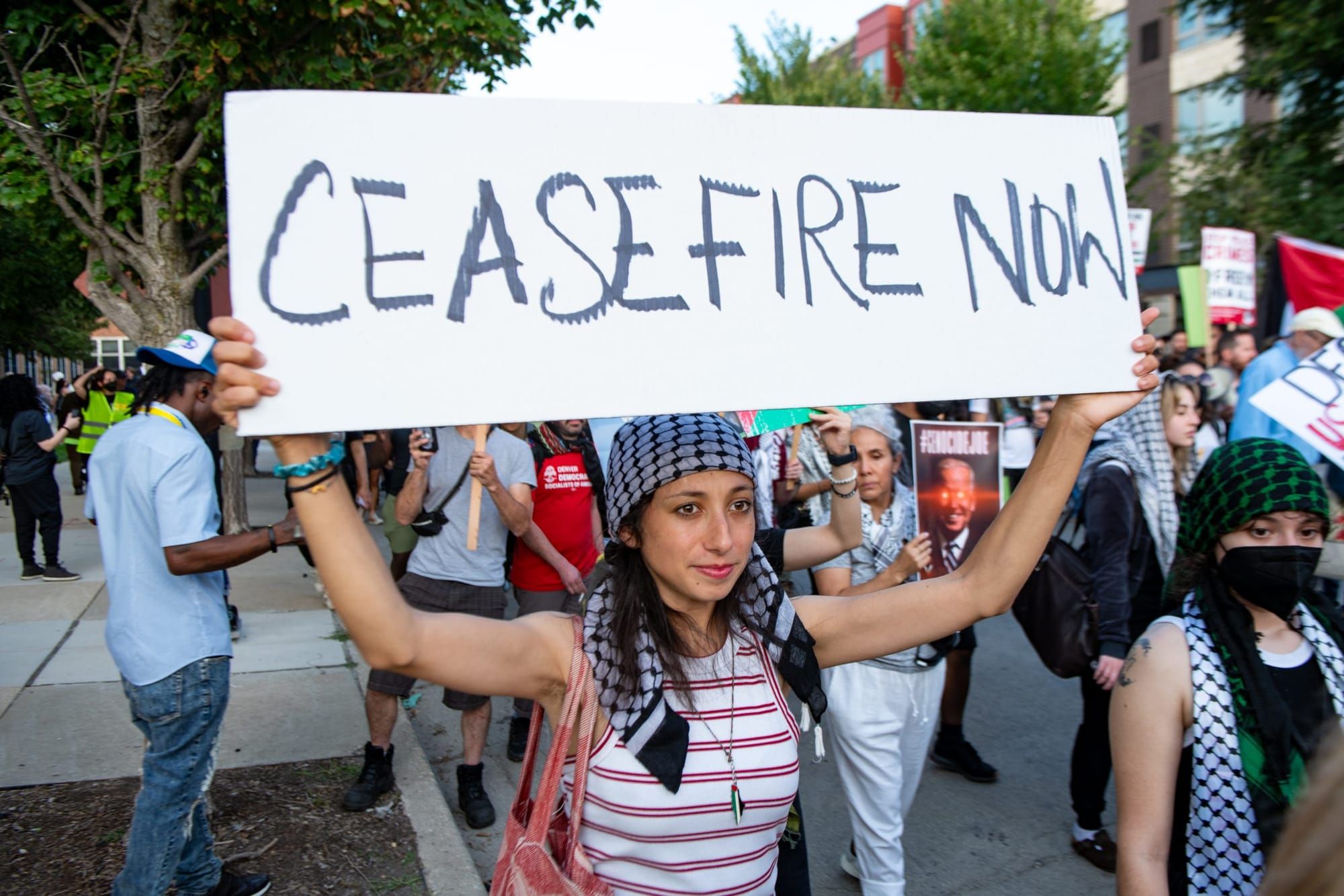
The Democratic National Convention (DNC) took place last week with pomp and flair in Chicago, Illinois. From celebrities to reproductive rights activists to military veterans, people across many demographics supported Vice President Kamala Harris as she accepted the Democratic Party’s nomination for president of the United States.
But with the genocide in Gaza looming in the background, one group that was noticeably absent from the main stage was Palestinians.
Pro-Palestinian advocates wanted to be represented on stage, especially since Chicago has the largest Palestinian community in the country. For weeks, the founders of the Uncommitted National Movement were in negotiations with the DNC to have a Palestinian American speaker on stage to address the hundreds and thousands of people killed and injured in Gaza due to Israeli air strikes. The movement first gained steam when thousands of people nationwide cast “uncommitted” votes during the Democratic primaries in hopes of pressuring President Joe Biden into taking more assertive action to stop the genocide in Gaza. The movement is also now turning its focus to Harris, and calling for an arms embargo on Israel and an end to Israel’s “long-term siege on Gaza.”
Approximately 30 Uncommitted delegates earned a spot at the convention. According to the Huffington Post, these delegates initially requested two slots, including one for a doctor who served in Gaza. But later in the week, delegates sought only a Palestinian American speaker, ultimately landing on Georgia State Rep. Ruwa Romman, the first Muslim woman elected to the Georgia House.
“We started pressing more when we found out the convention was going to give a prime-time spot to families of hostages, which we fully support,” said Waleed Shahid, co-founder of the Uncommitted National Movement.
According to Middle East Eye, “Uncommitted delegates publicly distanced themselves from the protests taking place outside and inside the convention, framing the group as committed Democrats willing to operate within the party’s electoral system.” They also held twice daily press conferences and on Aug. 19, pro-Palestinian advocates held a panel on Palestinian human rights on the sidelines of the main event, hopeful that their voices would be heard on stage as well.
But just one day before Harris was scheduled to accept the nomination and address the nation, delegates were told by a DNC official their request to have a Palestinian American speak at the convention was denied.
Uncommitted co-founder Abbas Alawieh and his fellow delegates staged a sit-in outside the convention, risking potential arrest and police force.
Support for a Palestinian American speaker came from various groups and politicians. The United Auto Workers union, a major supporter of the Democratic ticket based in Michigan—a crucial swing state with a large Arab American population—posted on social media that if “we want to win this election, the Democratic Party must allow a Palestinian American speaker to be heard from the DNC stage tonight.”
Muslim Women for Harris, which formed just weeks prior when Biden ended his campaign, disbanded on the third night of the DNC, issuing a statement saying its members “cannot in good conscience continue” in light of the DNC’s decision to exclude Palestinian voices from the convention stage.
Rep. Alexandria Ocasio-Cortez, who spoke on stage on Aug. 19 and referenced Israel’s war on Gaza, later wrote on X, “Just as we must honor the humanity of hostages, so too must we center the humanity of the 40,000 Palestinians killed under Israeli bombardment. To deny that story is to participate in the dehumanization of Palestinians.” Ocasio-Cortez also wrote that the DNC “must change course and affirm our shared humanity.”
A new poll of more than 1,100 people found that a “significant share” of voters in the swing states of Pennsylvania, Arizona, and Georgia are more likely to vote for a Democratic nominee who pledges to withhold weapons from Israel.
Ruwa gave her speech outside the convention on the last day. The representative explained how the speech was deliberated over and “sanitized” to gain acceptance by Democrats.
“[I]n this pain, I’ve also witnessed something profound—a beautiful, multifaith, multiracial, and multigenerational coalition rising from despair within our Democratic Party,” Ruwa said in the speech. “For 320 days, we’ve stood together, demanding to enforce our laws on friend and foe alike to reach a ceasefire, end the killing of Palestinians, free all the Israeli and Palestinian hostages, and to begin the difficult work of building a path to collective peace and safety. That’s why we are here—members of this Democratic Party committed to equal rights and dignity for all. What we do here echoes around the world.”
Some Pro-Palestine advocates expressed that the DNC was not a total loss.
“One of the loudest applauses tonight was when Kamala Harris stated that Palestinians have a right to self-determination. This demonstrates a public opinion shift in the Dem party base and while it’s absolutely not even the floor, this is still a moment to hold up,” wrote Darakshan Raja, the founding executive director of Muslims for Just Futures, on X.
In 1988, Dr. James J. Zogby, President of the Arab American Institute, was the last Arab American to speak about Palestinian rights at a national party convention when, in 1988, Democratic nominee Rev. Jesse Jackson worked with the Arab American Institute to pass resolutions endorsing a two-state solution.
Regarding the 2024 convention, Zogby wrote, “It was moving to see hundreds of delegates, including hundreds of Harris supporters, wearing kaffiyehs or ‘Democrats for Palestine’ buttons, including Vice President Harris’s niece. It was also important to note that when Palestine was mentioned by speakers, it was greeted by rousing applause. And while in her speech, Vice President Harris included the usual commitments to Israel’s security, her words about Palestinian suffering were passionate and punctuated by her commitment to their ‘freedom, security, dignity, and self-determination.’ And so, despite the hurt, the entire saga represented a win—one we must recognize and embrace, and on which we must now build.”
The Harris-Walz campaign did not respond to Prism’s requests for comment.
Author
Jennifer Chowdhury is a journalist and writer dedicated to human rights reporting with a special focus on women of color around the world whose voices are stifled by patriarchy, systematic racism, and
Sign up for Prism newsletters.
Stay up to date with curated collection of our top stories.