Palestinian Americans are fighting against housing discrimination
Tenants’ rights are a core issue in Chicago due to the unchecked authority that landlords wield over tenants
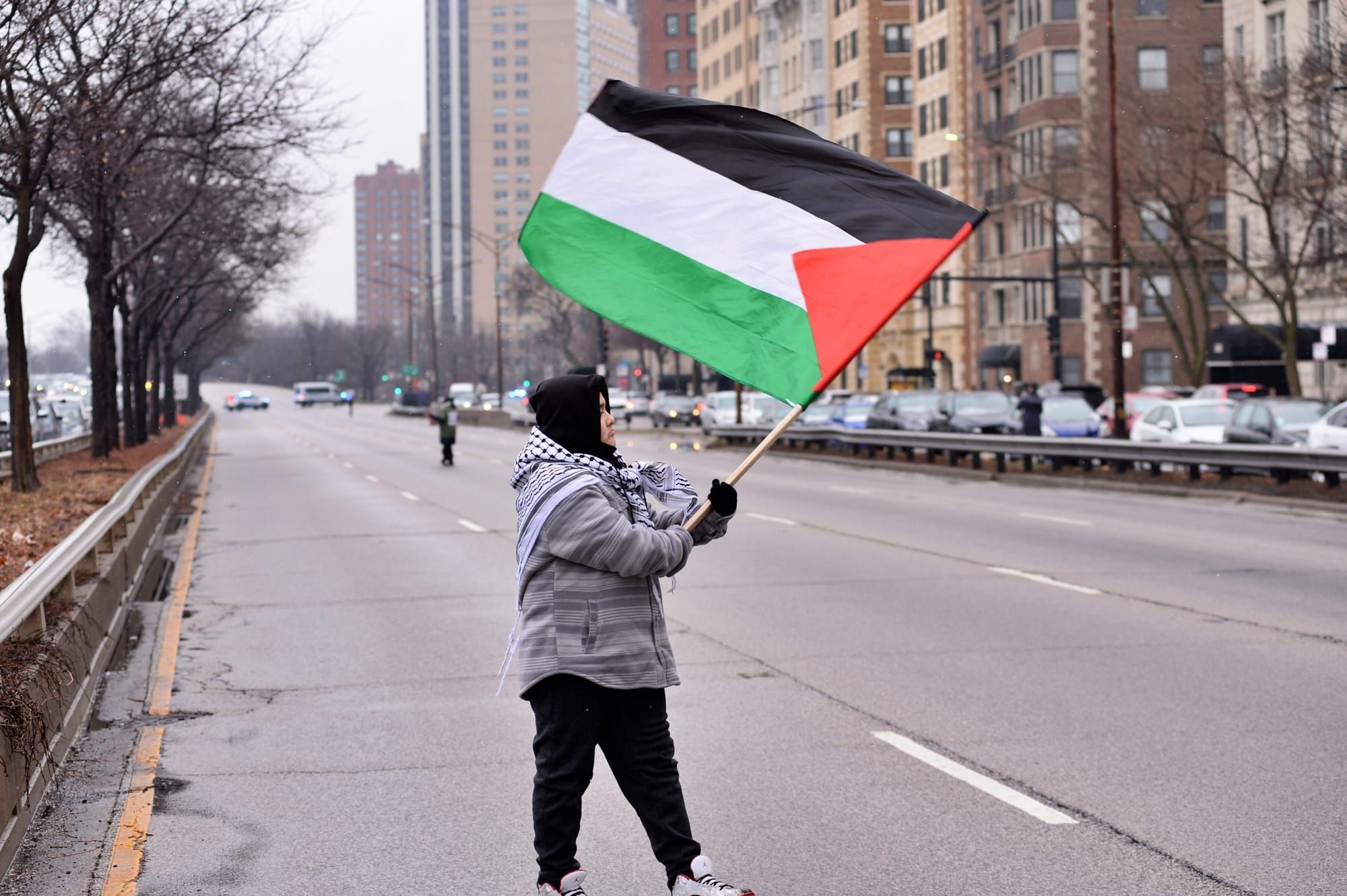
Since announcing their “Defend the Flag” competition on Jan. 9, the North Spaulding Renters Association (NSRA) in Chicago has distributed more than 250 posters in solidarity with Palestine across their Logan Square neighborhood for residents to hang over their doors. The movement aims to bring awareness to their Palestinian-American comrade Manal Farhan, who faces eviction for flying a Palestinian flag outside of her apartment.
Farhan’s ongoing legal battle with her landlord over discrimination has become an example among autonomous tenant unions to educate each other on their rights and to organize within respective communities to apply pressure from all angles, especially amid the ongoing struggle for Palestinian liberation.
The urgency among tenants to find support groups has become potent with the increase in targeted harassment and violence against Palestinians in America. On Oct. 14 in Illinois, a landlord stabbed and killed a 6-year-old Palestinian-American boy, Wadea al-Fayoume, and injured al-Fayoume’s mother Hanaan Shahin, in an anti-Palestinian and Islamophobic hate crime.
Farhan believes there are still many other examples of housing discrimination that are unreported because of successful suppression tactics.
“I think there is a massive, powerful force that silences the voices of Palestinians and people who support the struggle for Palestinian liberation, so people actually just don’t even take the step that I’m taking,” said Farhan in regard to her steadfast visual show of support for her homeland despite litigation. “The silencing is effective because it’s threatening people’s livelihoods.”
Farhan credits NSRA for educating her on responding to her eviction notice. She currently resides in her apartment until the court reviews the discrimination lawsuit she filed against landlord Mark Fishman and his company M. Fishman & Co.
“It was claimed that Manal broke the lease by hanging something outside her window, so it warranted a 10-day notice,” explained Ben Avis, a member of NSRA. “This does not mean that she would be out in 10 days, which we helped explain. It just means that after 10 days, if she does not cure the situation, which in this case would have been taking down the flag, then they would proceed with the eviction in court.”
Tenants’ rights are a core issue in Chicago because of the unchecked authority that landlords wield over tenants. Without a “just-cause” ordinance, the city allows a landlord to terminate the landlord-tenant relationship for any or no reason at all as long as proper notice is given before an eviction case is filed in court. A “just-cause” ordinance would provide tenant protection from arbitrary, retaliatory, or discriminatory evictions by establishing that landlords can only evict renters for specific reasons, such as failure to pay rent.
“No matter how effective my tenancy has been—they continue to take my rent every month, claiming that our agreement is in good standing—at any moment, they can say, ‘Oh we change our mind,’” Farhan said.
Before her eviction notice, Farhan received a phone call from her building manager saying the flag that she stitched herself as a healing practice was making another tenant uncomfortable.
“I don’t need there to be any kind of massacre going on for me to say, ‘Hey, I’m Palestinian, and I’m waving a flag in solidarity with my people,’” Farhan said. “And second of all, my right to housing is not contingent upon your desire to be neutral during a genocide.”
Farhan received her notice after her conversation with her landlord, which was the first time she saw any mention of a lease violation, citing a clause that no tenant is allowed to hang a flag outside of their window.
“Regardless of what ostensibly was written in [Farhan’s lease] contract, if it was any other flag of any other movement, nothing would have happened, and that tenant would not have said anything or started any eviction proceedings,” said Hatem Abudayyeh, the executive director of the Arab American Action Network (AAAN) and an organizing committee member of the Chicago chapter of the U.S. Palestinian Community Network (USPCN). “We know that it was because it was a Palestinian flag.”
Farhan reached out to NSRA shortly after receiving her eviction notice on Nov. 22. The tenant alliance responded quickly with a petition in solidarity with Farhan, which received more than 2,500 signatures, with a demand to rescind her eviction. Shortly thereafter, the group organized residents to call into Fishman’s office with the same message, followed by a banner drop on one of Fishman’s buildings showing support for Palestinian rights. NSRA’s recent “Poster Day” event yielded more than 50 attendees who made posters for renters to bring back to their apartments and hang on their doors, which NSRA believes that Fishman’s workers will see. Many of the posters are recreations of artwork made by Palestinian children during the First Intifada in 1987.
Although the short-term strategy is to show Fishman that solidarity with Palestine exists beyond Farhan’s apartment, NSRA’s long-term goal is to organize all of Fishman’s buildings and gain enough economic power to flex it and show their landlord that they are a force to be reckoned with.
“As one who provides money to the landlord … the ultimate form of this is a collective rent strike,” Avis said. “[Fishman] doesn’t really care about the public status of the situation; they only care about the money and control of the property. So we believe that the most effective weapon is stopping the money flow to the landlord, and [our current actions] are trying to build the capacity to rent strike to force the landlord to do things like rescind Manal’s eviction.”
A collective rent strike would allow tenants to address the handful of other issues that they faced while living in one of Fishman’s properties. Fishman, who owns more than 67 properties throughout Chicago by NSRA estimates, has previously been sued over rent disputes and neglecting to maintain habitable conditions for his tenants.
Farhan’s landlord provided a statement attributed to M. Fishman & Co. that states all tenant lease agreements forbid “any article or antenna outside the windows, or on the exterior walls, or on the roof of the building.” The landlord claims this is for the safety of community members.
“The tenant is in violation of the terms of their lease agreement for hanging a flag from their apartment window on the exterior of the building. In accordance with our procedures, we have attempted repeatedly to engage in open communication with the tenant to address the lease violation,” the statement reads. “Regrettably, these attempts have been unsuccessful, and the tenant has refused to take down the flag. After careful consideration and in accordance with the lease agreement, we have initiated the steps to terminate the lease due to the tenant’s refusal to correct these violations.”
Farhan states that she had sought a resolution with M. Fishman & Co., suggesting that a flag pole be installed to ensure safety.
“In [our] original conversation, there was no mention of the lease or safety concerns or any such thing,” she said. “I’d be happy to comply with any kind of safety concerns. And it just wasn’t that. That wasn’t the problem.”
Farhan moved to Chicago in 2005 so she could be among fellow Palestinians in America. Today Cook County is home to the largest Palestinian diaspora in the U.S. Farhan’s parents were once residents of the Al Malha village just west of Jerusalem before Zionist settlers displaced families and occupied their homes. For Farhan, her family history is inextricably tied to her own current eviction amid the U.S.-supported Israeli occupation of Gaza.
Abudayyeh, who has been colleagues with Farhan for more than 10 years, first heard of her housing insecurity through his network despite the initial press coverage. It was only until he heard from a peer that someone from the Al Malha village was facing eviction that he pieced together that it was Farhan. He wishes that she went to groups like AAAN and USPCN sooner.
“Manal is seasoned as an organizer, and she has resources and networks, but the one thing she could have additionally done is reach out to our community immediately [because] it’s a no-brainer that we are supporting Manal and anybody else who is under attack for our identity, our nationality, and our political perspective,” Abudayyeh said.
Public pressure campaigns are immensely favored in Chicago, where tenants’ rights remain tenuous. In a concerted effort with Farhan and NSRA, AAAN and USPCN organized their community members for call-in campaigns and to spread awareness by way of historical relationships with the National Lawyers Guild (NLG) and private attorneys.
Abudayyeh, who also faced some housing precarity when the FBI raided his home in 2010, believes the USPCN is a great resource for Palestinian diaspora members who do not live near metropolitan areas with progressive networks, let alone tenant alliances.
“If any of this stuff is happening to [Palestinians], they should reach out to the USPCNs of the world … so that we can do the community organizing from the USPCN side and the legal organizing necessary on the NLG and the People’s Law Office and the Palestine Legal side. It doesn’t mean that we are stronger than Zionism or U.S. imperialism, but we have institutions that have resources and capacity that we didn’t have even 10 years ago.”
Tenants unions exist to keep Palestinian renters safe when the law and political will don’t exist to do so, but cultural education is also critical to make the goals of such tenants unions more salient.
“Just because there’s nothing in the books doesn’t mean that we are powerless as the people,” Farhan said. “The more people learn about this particular example and repression that happens to an individual that is connected to a larger movement, I think that’s powerful. It empowers people and moves people to act in local ways that, in the case of a tenant issue, ties the two together. This is a real thing. People can see themselves in me and my situation.”
Author

Lisa Kwon is a writer and reporter born and based in Los Angeles, California.
Sign up for Prism newsletters.
Stay up to date with curated collection of our top stories.