Palestinian activists on Vermont shootings: Blank check for killing has to end
Palestinian and Arab activists for Palestinian human rights see the attacks as an extension of the ongoing genocide in Gaza
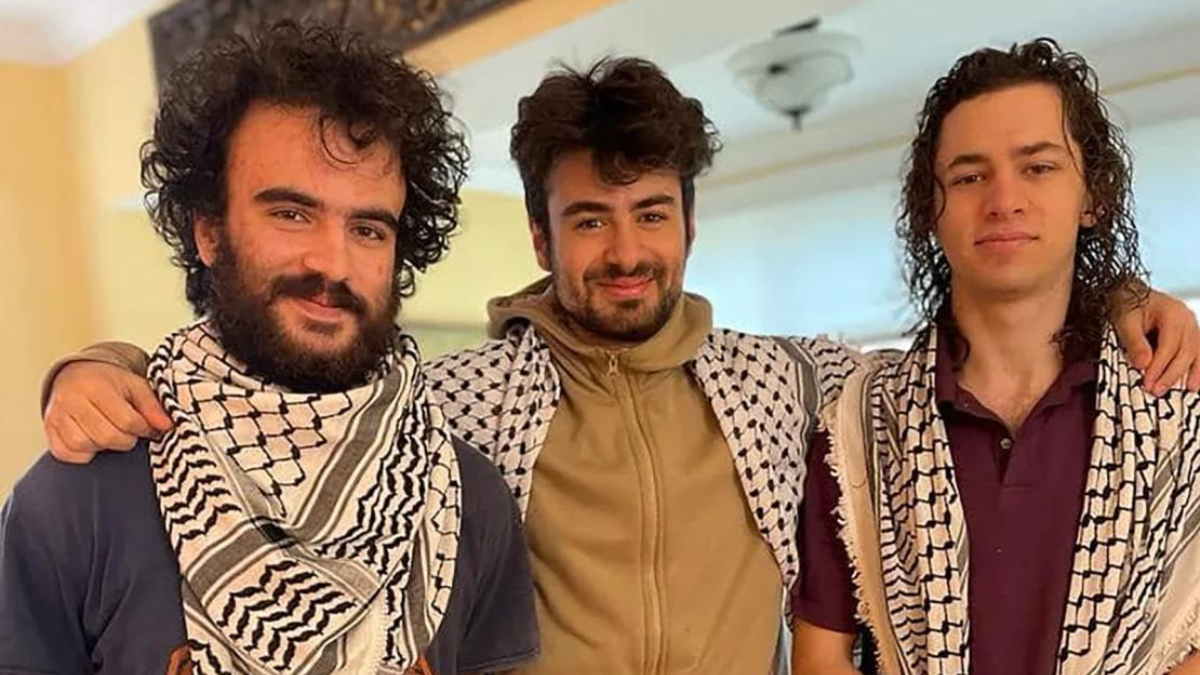
Three Palestinian college students were shot by a white man on their way to a Thanksgiving dinner in Burlington, Vermont, on Saturday night. The two of three students, Hisham Awartani, Kinnan Abdalhamid, and Tahseen Ahmed, all 20 years old, were wearing keffiyehs, traditional Palestinian headscarves, and speaking Arabic when they were shot on their way to dinner at Awartani’s grandmother’s home. Two of the students are in stable condition, but one sustained “much more serious injuries,” according to a press release from local police.
In a statement from Awartani read by a Brown University professor at a Monday vigil, Awartani connected the violence that he and his friends experienced with the ongoing genocide against Palestinians by Israeli forces.
“This hideous crime did not happen in a vacuum. As much as I appreciate the love of every single one of you here today, I am but one casualty in a much wider conflict,” he said. “Had I been shot in the West Bank, where I grew up, the medical services which saved my life here would have likely been withheld by the Israeli army. The soldier who would have shot me would go home and never be convicted. Any attempt like this is horrific, be it here or in Palestine.”
While law enforcement officials have yet to recognize the attack on the students as a hate crime motivated by the young men’s Palestinian heritage, Palestinian and Arab activists for Palestinian human rights see the attacks as an extension of the ongoing genocide in Gaza and the seemingly unconditional support for this genocide from the U.S. government.
“I wish I could say that we are surprised, but we are not—we’ve been sounding the alarm bells for weeks,” Edward Ahmed Mitchell, the deputy executive director of the Council on American-Islamic Relations (CAIR), told Prism.
Since the Israeli military launched its genocidal campaign on Gaza shortly after Hamas’ Operation Al-Aqsa Flood, Western leaders, including U.S. lawmakers, have smeared Palestinians and expressed support for Israeli violence, which has killed more than 17,000 people.
Mitchell said it “was obvious to anyone that the anti-Palestinian racism and anti-Muslim bigotry that we’ve seen in public discourse over the past month and a half could lead to violence.”
Prior to the shootings of Awartani, Abdalhamid, and Ahmed, last month, a white man stabbed a 6-year-old Palestinian boy in Chicago named Wadea al-Fayoume to death in his home and also stabbed and wounded al-Fayoume’s mother. In recent weeks, there has also been a rash of reported assaults, threats, and harassment targeting Palestinian, Arabic, and Muslim people.
Speaking to NPR on Monday, Awartani’s parents, who live in the West Bank, told the outlet they made the difficult decision to ask their son to stay in the U.S. over the holidays as they believed he would be safer there amid surging attacks from the IDF.
“My husband didn’t want Hisham to come back for Christmas. He thought our son would be safer [in the U.S.] than in Palestine,” Awartani’s mother, Elizabeth Price, said.
He was wrong.
Nerdeen Kiswani, the co-founder and chair of the Palestinian liberation organization Within Our Lifetime, sees a direct throughline between the targeted violence against Palestinians in the U.S. and the occupied territories’ suffering under the Israeli apartheid regime. All of this violence is a consequence of world leaders’ and U.S. politicians’ seemingly unconditional support for Israel, no matter the atrocities and terror that the Israeli state inflicts on Palestinians.
“This blank check, this broad support for killing on an ongoing basis, has to end because that normalizes Palestinian death and consigns Palestinian suffering,” Kiswani told Prism.
Even prior to this iteration of the genocide in Gaza since Oct. 7, Kiswani points out that the U.S. has sent more than $3.8 billion per year to Israel, much of which is used to enact violence upon Palestinians—the U.S. continues to send aid, anyway. To do so, Kiswani argues, validates violence against Palestinians not just in the occupied territories but in the U.S. There’s no path forward for safety for Palestinians here without safety for Palestinians abroad, requiring an immediate, permanent ceasefire and an end to U.S. funding and support for the Israeli government, she says.
“What we’re seeing happen in Vermont is 100% connected to what’s happening in Gaza and the blood of all the Palestinians who have been killed—it’s all on the hands of this administration.”
Continued support for Israel from most U.S. lawmakers has made statements from politicians like Sen. Bernie Sanders and Democratic Minority Leader Rep. Hakeem Jeffries “ring hollow” to Mitchell.
“You’ve spent the past month-and-a-half ignoring the thousands of Palestinian civilians killed in Gaza. If a Palestinian life matters in America, why doesn’t it matter in Gaza?” Mitchell said.
As Abdalhamid told the student newspaper of his college, Haverford College, last month: “I don’t expect much from Western media or the college to mention much about Israel’s oppression and apartheid. But I at least expect the thousands who were killed to be mentioned and mourned.”
American universities are also failing Palestinians, Kiswani and Mitchell agree. Columbia University suspended the student groups Students for Justice in Palestine and Jewish Voice for Peace for organizing against Israeli apartheid and genocide earlier this month, and other schools like George Washington University have similarly punished organized actions calling for Palestinian liberation, condemning these actions as antisemitic. Many schools have passively allowed Zionist groups to doxx, threaten, and harass students for supporting Palestinian rights and liberation, disproportionately targeting Arabic and Palestinian students.
“Anti-Muslim bigotry and anti-Palestinian racism are being weaponized in this country to silence people who support Palestinian human rights,” Mitchell said. One of “the ways to do that,” he says, isn’t just physical violence like the attacks on Awartani, Abdalhamid, and Ahmed in Vermont, but to “smear people who support Palestinian rights as bigots, antisemites, or terrorists,” doxxing students, or reporting people to their employers. This, Mitchell says, “has worked in years past, but I really don’t think it’s gonna work this time—it’s too transparent, and people are seeing through it.”
The demands that will keep Palestinians safe from the rising tide of violence in the U.S. are inextricable from the demands to protect Palestinians from Israeli violence in the occupied territories. Within Our Lifetime and CAIR are among the numerous diverse and interfaith groups demanding that U.S. lawmakers back a ceasefire—notably, 66% of all voters (including 80% of Democrats, 56% of Republicans, and 57% of Independents) support a ceasefire, though only a small fraction of Congress holds this position.
As for the responsibility of everyday people outside of politics: “Don’t just accept whatever you’re hearing from politicians or the mainstream media. Do a little research to get a better understanding about the plight of the Palestinian people and how our nation plays a huge role in that place,” Mitchell said.
Activists say the shootings of Awartani, Abdalhamid, and Ahmed mark a gutting watershed moment for Palestinian and Arabic people across the U.S. In a joint statement, their family members called the attack “a crime fueled by hate” and described the students as “brilliant, kind, and talented.” The statement continues, “Our children, Palestinian children, like everyone else, deserve to feel safe.”
Author

Kylie Cheung is a freelance writer reporting on politics and culture. She is the author of Survivor Injustice: State-Sanctioned Abuse, Domestic Violence, and the Fight for Bodily Autonomy.
Sign up for Prism newsletters.
Stay up to date with curated collection of our top stories.