Why Orthodox Jews opposed to Jewish nationalism join anti-genocide protests in the US
Threatened with conscription, some anti-Zionist Orthodox Jews in Israel are moving to the US, joining an increasingly vocal community who oppose the genocide in Gaza
Six months ago, Nachum Yehuda arrived in the U.S. from Israel, for good. The rabbi and his family belong to a community of Orthodox Jews who had effectively been exempt from conscription into the Israeli military until recently, when the ongoing Israeli genocide in the Gaza Strip pushed the Israeli government to disallow further exemptions. For Orthodox Jews like Yehuda who oppose Zionism, or Jewish nationalism, it was the final straw.
“They don’t just insist that we accept their movement, but they attempt to force our people to actively participate in their wicked actions and, by doing so, violate Judaism,” Yehuda told Prism, using a pseudonym for fear of his and his family’s safety. Here, he joined an increasingly vocal community of Orthodox Jews who oppose Israel and its actions.
While recent polling shows 75% of American Jews feel emotionally attached to Israel, many Orthodox Jews in the U.S., U.K., and even Israel militantly oppose the ongoing Israeli genocide, as well as the Jewish nationalism that animates it. As the U.S.-backed genocide nears the one-year mark, Israeli forces have killed more than 41,000 Palestinians, including 16,000 children, according to Gaza’s Ministry of Health. The true toll of the genocide, obscured by the ongoing Israeli attacks and blockade, may be as high as 186,000 deaths, according to estimates published in The Lancet.
In response, members of anti-Zionist Orthodox Jewish communities have become a fixture at many anti-genocide marches and protests around the world, and many in Israel are contemplating leaving, if they have not already. Activists from the community tell Prism that their opposition to Zionism is rooted in both religious and moral beliefs.
“A total violation of Judaism”
Zionism was first promulgated as a political ideology in Europe during the late 19th century, and it has ever since been opposed by anti-Zionists of all stripes, including from the Orthodox Jewish community. One of the most visible anti-Zionist Orthodox Jewish organizations in the U.S. today is Neturei Karta, which rejects Jewish nationalism on both religious and moral grounds. According to their religious interpretation, anti-Zionist Orthodox Jews believe that, just as Jews were brought to and exiled from the Holy Land during biblical times by divine intervention, their return must be a product of divine intervention—not warfare. In particular, they believe that their return must be heralded by a Jewish messiah.
“The Jewish people are forbidden to end exile by any physical means, forbidden to fight any nation,” Dovid Feldman, a rabbi with Neturei Karta, told Prism. “When does our exile end? This is something that we don’t know. In Judaism, there is no prediction when that time will come, but this is something that we wait for.”
Anti-Zionist Orthodox Jews also point to Zionism’s brutal history. The State of Israel was declared by Zionist militants in 1948 after they had, with British support, ethnically cleansed half of the Arab population from more than three-quarters of what was previously Palestine. The “Nakba”—or “catastrophe,” as Palestinians still refer to it in Arabic—was followed by the “Naksa”—or “setback”—when Israeli forces captured East Jerusalem, the West Bank of the Jordan River and the Gaza Strip in 1967. Although those territories are internationally recognized as belonging to a future Palestinian state, Israel continues to occupy them, subjecting the 5 million Palestinians who reside there to conditions amounting to apartheid, according to multiple leading human rights organizations. The U.N.’s top court ruled in July that Israeli settlements in the Palestinian territories are illegal and must be dismantled, which Israel has long refuted.
“This was supposed to be ‘A land without a people for the people without a land,’ something very peaceful,” said Feldman, referencing a Zionist slogan that erases the Palestinians who resided in what became Israel. “But when this happened in Palestine, it unfolded with these massive crimes against the nation of Palestine. It’s not only contrary to the standard of human rights, these are violations of Judaism—killing and stealing, oppressing an entire people.”
Refusing to join the army
Anti-Zionist Orthodox Jewish communities are concentrated in the U.S., especially around New York City; in the U.K.; and, perhaps surprisingly, in Israel. As Feldman explained, while anti-Zionist Orthodox Jews believe mass migration to the Holy Land is forbidden, individuals still live where they happen to be, including Jerusalem, which he described as having the strongest and largest anti-Zionist Orthodox community in the world.
In Israel, anti-Zionist Orthodox Jews are often described as part of the “Ultra-Orthodox” community—a characterization that Neturei Karta rejects—which makes up 14% of the general population. Although such Orthodox Jews may support or oppose Zionism, some members of the community have been able to avoid conscription by requesting deferrals for religious study until they reach the age of exemption, as Or, an activist with New Profile, an Israeli organization for conscientious objectors, explained to Prism. (Due to the nature of New Profile’s work, Or declined to share their last name.) Although New Profile opposes conscription from an anti-militarist, feminist, and left-wing perspective, Or acknowledged that anti-Zionist Orthodox Jews represent the strongest opposition to conscription in Israel.
“They do big demonstrations where they declare, and stand behind those who declare, that they would rather sit in jail than join the army,” said Or, referring to anti-Zionist Orthodox Jews in Israel. “They also say they’d rather die than join the army.’”
The Israeli government has deliberated doing away with deferals to conscription since at least 2001, but it only came to pass recently, as the ongoing genocide’s strain on the Israeli military finally pushed the government to freeze requests. Nevertheless, many in the anti-Zionist Orthodox community continue to demonstrate against conscription, vowing to instead go to prison—or into exile.
“People are leaving” in response to the threat of conscription, Feldman said. “There are all different kinds of limitations and restrictions that the government puts on them not to be able to leave, especially those who refuse to go in the army.”
Consistent presence at protests
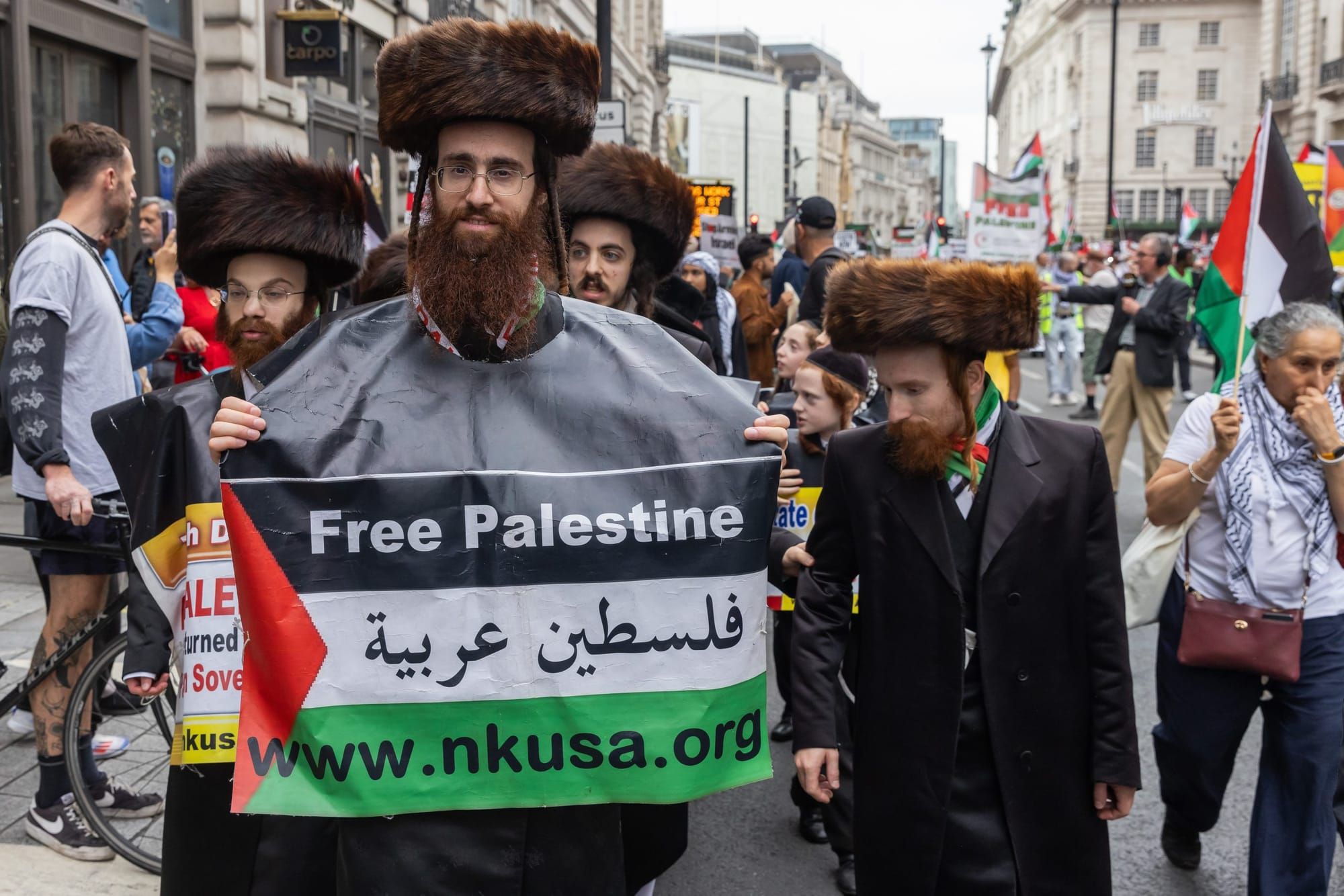
The immediate threat of conscription in Israel compounds the co-optation of Judaism that anti-Zionist Orthodox Jews believe Zionism inherently commits, driving groups like Neturei Karta to demonstrate against the Israeli government in the U.S., too. At the many demonstrations against the ongoing Israeli genocide in Gaza, Orthodox Jews with Neturei Karta have been a common sight, especially in the New York area. PAL-Awda NY/NJ, a local Palestinian rights organization, described anti-Zionist Orthodox Jews as steadfast allies.
“They help us make the vital point that Zionism is not Judaism and that anti-Zionism is not antisemitism,” Peter Feld of PAL-Awda told Prism. “These wonderful Jewish allies come to almost all of our actions—such as our protests against real estate events promoting the sale of stolen Palestinian land—often making a great effort, and they have faced harassment and vandalism for their brave stand.”
And according to Feldman of Neturei Karta, anti-Zionist Orthodox Jews will continue to take that stand.
“People need to understand: Contrary to Zionist propaganda—that all Jews support Israel and that the State of Israel represents all Jews and that everything Israel says and stands for is condoned or allowed in the Holy Torah and the Jewish religion—all of this is false,” he stressed. “The State of Israel does not represent world Jewry and it’s not condoned by the Jewish religion.”
Author

Arvind Dilawar is an independent journalist. His articles, interviews, and essays have appeared in The New York Times, Time Magazine, The Daily Beast, and elsewhere. Find him online at adilawar.com
Sign up for Prism newsletters.
Stay up to date with curated collection of our top stories.