Filed Under:
Like other ‘drag bans,’ Ohio’s HB 249 is an attack on trans people
In Kentucky and Ohio, lawmakers are considering ‘constitutionally vague’ bills that attack bodily autonomy by targeting drag performances
Mo Viviane
Real journalists wrote and edited this (not AI). Independent, community-driven journalism survives because you back it. Donate to sustain Prism’s mission and the humans behind it.
Real journalists wrote and edited this (not AI)—independent, community-driven journalism survives because you back it. Donate to sustain Prism’s mission and the humans behind it.
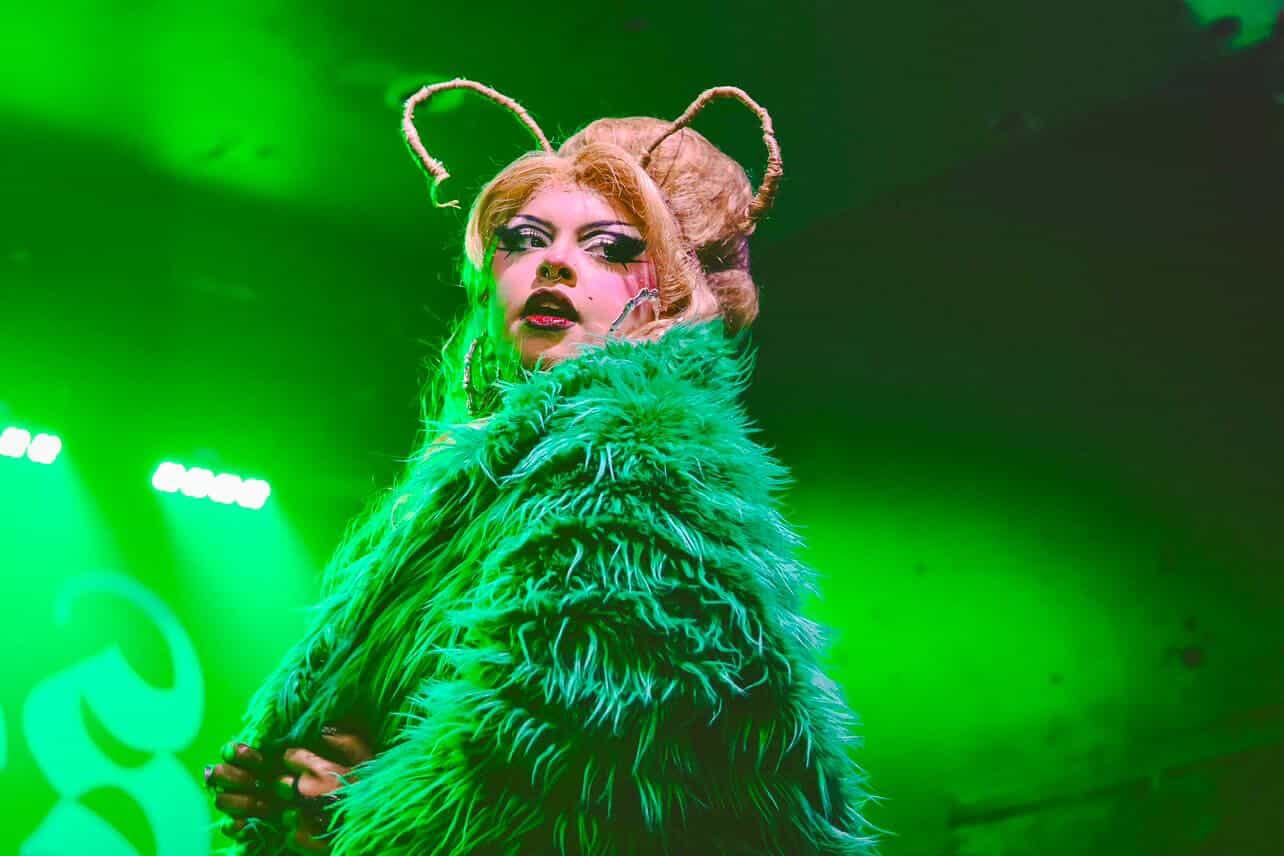
Indica Blows found drag the way that some folks find salvation: by accident.
She was in a theater, wearing someone else’s makeup and surrounded by community. In her hometown of Dayton, Ohio, she was a theater kid who grew up on the TV show “Glee.” In college, she joined a production of “The Rocky Horror Picture Show,” not as a performer, but as a production member painting Dr. Frank-N-Furter’s face night after night. Choreography. Costuming. She loved the magical transformation that performance allowed.
And then the production ended.
“I was really sad,” she said. “I knew I wanted to keep doing something like that. I just didn’t know what that would be or what that would look like.” But then, an ex-girlfriend dragged her to an open stage at MJ’s on Jefferson, a gay bar in Dayton.
And Indica Blows was born.
Today, Indica, who is only using her stage name for safety reasons, is a traveling performer, working throughout Kentucky and Ohio. She is a cisgender woman doing drag, and she knows her identity gives her a privilege that some of her closest friends do not share. The fact that she is cis provides a kind of cover, especially now that Ohio is considering House Bill 249, the “Indecent Exposure Modernization Act,” one of many recent bills introduced nationwide attaching criminal penalties to various aspects of trans life.
“I’m not in a state of panic right now,” she said. “One, it’s in the Senate, so it’s not law yet. And if [Gov.] Mike DeWine signs it, it’ll take a while before it actually gets into laws because other states have tried to pass stuff like this, and it’s just failed.”
Staying calm is what Indica calls “radical optimism.” It’s also a deliberate way to move the conversation away from herself and toward the people she says the bill is really designed to hurt: trans people.
A ‘constitutionally vague’ bill
Ohio’s HB 249 was introduced in the House in early 2025, and the bill passed along party lines in March, moving to the Ohio Senate. The bill sits in the Senate Judiciary Committee, waiting for a hearing date that could come at any moment.
The bill’s definition of “drag performance” is where the legal vulnerability—and the political intent behind the proposed law—is concentrated.
“Performers or entertainers who exhibit a gender identity that is different from the performer’s or entertainer’s biological sex using clothing, makeup, prosthetic or imitation genitals or breasts, or other physical markers,” reads a portion of the bill. This language purposefully ensnares not just drag queens performing as women, but drag kings performing as men, nonbinary performers doing anything that does not align with their birth certificate, and trans people simply existing in public. Because the bill also doesn’t define “performance,” there’s nothing stopping a prosecutor from deciding that a trans person’s everyday presentation constitutes a “performance.”
The bill’s only defining characteristic for “performance” is one that “exaggerates sex characteristics.” This is the clause that in written testimony against the bill, legal experts from the American Civil Liberties Union (ACLU) of Ohio characterized as “constitutionally vague.” What counts as “exaggeration”? The bill offers no answers, and legal experts are concerned that if passed, the law would lead to selective enforcement.
The penalty for being in violation of the vague law is also severe. A first offense is a fourth-degree felony, carrying up to 18 months in prison and a fine of up to $5,000.
But the real punishment is the mandatory requirement to register as a sex offender.
Under Ohio law, a felony conviction for indecent exposure, which is the basis of HB 249, is considered a tier I classification requiring sex offender registration for a minimum of 15 years. It also prevents people convicted of violating HB 249 from living near schools, parks, or playgrounds—and this would be true across state lines, as federal law requires sex offender registration to be portable.
This means that any drag performer convicted under HB 249 wouldn’t just lose the ability to perform in Ohio. They would lose resources, job opportunities, and housing options. In other words, they would lose everything.
“They want to eradicate trans people”
Ohio’s HB 249 has nothing to do with drag performers being unsafe. This was alleged by the bill’s sponsor, Republican Rep. Angie King, who said the bill’s goal is “protecting kids and restoring common-sense safeguards to protect their innocence.” In reality, the bill’s ultimate target is not a person performing in a wig, but a person whose existence—on and off stage—violates the bill’s implicit demand for legible, assignable, state-approved gender. Drag is merely an excuse, according to advocates. Trans existence is the real crime.
“At the end of the day, I am a cis woman,” Indica said. “I do drag, and of course sometimes people think I’m trans. … They just don’t ask me.”
When Indica takes off her makeup and goes to her day job, she becomes a person the state’s bill does not automatically criminalize. This isn’t the case for her trans friends.
“Trans women have to go through so much bullshit,” she said. “Trans men have to go through so much bullshit. … Even though HB 249 obviously concerns me, I ultimately try to prioritize: Yeah, it affects me, but how is it affecting my friends? How is it affecting the trans community?”
While many people with intersecting identities may find themselves in the crosshairs of state lawmakers and the Trump administration, Indica told Prism that the broader LGBTQIA+ community should focus all of its energy on protecting trans people.
They want to hide drag queens. They don’t want the public to see them. But they want to eradicate trans people.
Indica Blows, drag queen
“As much as people are giving shit to drag queens right now, it is nothing in comparison to what they are trying to do to trans people,” she said. “They want to hide drag queens. They don’t want the public to see them. But they want to eradicate trans people.”
Jaz Williams, a disabled trans Kentuckian and community organizer, told Prism that HB 249 has deeper historical roots than many people realize.
“We have been trying to police the way that people look and act in this country since it was founded,” Williams said. “I oftentimes have to remind people about the fact that it’s not unprecedented.”
Williams was also quick to note that drag bans are not new. These laws go back to the 1800s.
“Drag bans are absolutely something that has been part of this country for a really long time,” he explained. “The government did not like the way that you looked, did not like the way that you presented, and if it made them uncomfortable, they wanted to get you out of public society.”
The history of drag and the history of trans identity are not separate from one another; they are woven and wrapped around each other like the shared oxygen of underground ballrooms and late-night clubs, where the police did not bother to distinguish between a queen in full face and a woman simply living her life. The same Stonewall raids that targeted drag performers also targeted trans women. The same moral panics that paint drag queens as groomers also paint trans people as predators.
In other words, Ohio’s HB 249 does not need to include the word “trans.” It simply needs to be so broad and vague that it traps everyone whose gender is not easily identifiable to heterosexist regimes.
Reflecting on her experience as a drag performer—one of many in the region now facing a potential ban—Indica said the bill would affect her work, her joy, and the way that she shows up in community spaces across the state.
“If I never got to do drag again, I would be heartbroken,” Indica said. “But I would survive. I would be able to live. That same thing cannot be said for the rights of trans people if this thing goes through.”
For members of LGBTQIA+ communities gearing up to celebrate Pride in June, Ohio’s HB 249 is another reminder of how laws can be weaponized against them by hostile, transphobic lawmakers. While HB 249 is ostensibly written to target “performance,” it’s really a strike against bodily autonomy for trans people. As the ACLU of Ohio noted in its opposition to the bill, “Ohio has plenty of legitimate problems. Drag shows are not one of them.” Notably, Ohio ranks among the worst in the nation when it comes to education, health, the economy, and other metrics.
Indica is one of many drag performers watching their states become increasingly—and overtly—anti-LGBTQIA+.
In recent years, Kentucky lawmakers have proposed wave after wave of anti-drag proposals that would restrict performances near schools, churches, and public parks. Many of these bills copy the language of Tennessee’s infamous drag ban. Passed in 2023, Tennessee’s law restricts “adult cabaret performances” in public and in the presence of children, and bans shows from occurring within 1,000 feet of schools, public parks, or places of worship. Those found violating the anti-drag law for the first time face a misdemeanor charge, punishable by a fine up to $2,500 and/or up to a year in jail. Subsequent violations can lead to a felony charge, punishable by up to six years in jail.
While these anti-LGBTQIA+ bills often die in committee, they leave their poisonous spores in the air.
Williams said that if you read the anti-drag bills emerging nationwide, many link drag performance, trans communities, and mental illness, weaving a harmful narrative about LGBTQIA+ people that he said wades into “tinfoil hat conspiracies” about the community. The real issue, he said, is that right-wing lawmakers simply want to make conditions so hostile that trans people are pushed out of society.
“And they will use any means of the government apparatus in order to do so,” Williams said.
What concerns members of the LGBTQIA+ community who spoke to Prism is whether the broader public would help fight on their behalf amid the authoritarian crackdown.
Indica told Prism that she’s already seen venues cancel performances and other drag-related events preemptively—not because they were ordered to, but because they feared losing their conservative donors.
“Owners need to stand on business a little bit more,” she said. “Appealing to the oppressor is never gonna work out to your favor. They’re going to have to be willing to go to bat, especially for trans people. Because a lot of these ‘LGBTs-without-the-Ts’-type gays think that they can get into Donald Trump world leaving the Ts behind.”
Editorial Team:
Tina Vasquez, Lead Editor
Lara Witt, Top Editor
Stephanie Harris, Copy Editor