Oakland federal court hears Gaza genocide lawsuit against Biden
Doctors, journalists, and organizers submitted amicus briefs in support of the lawsuit brought by Palestinians
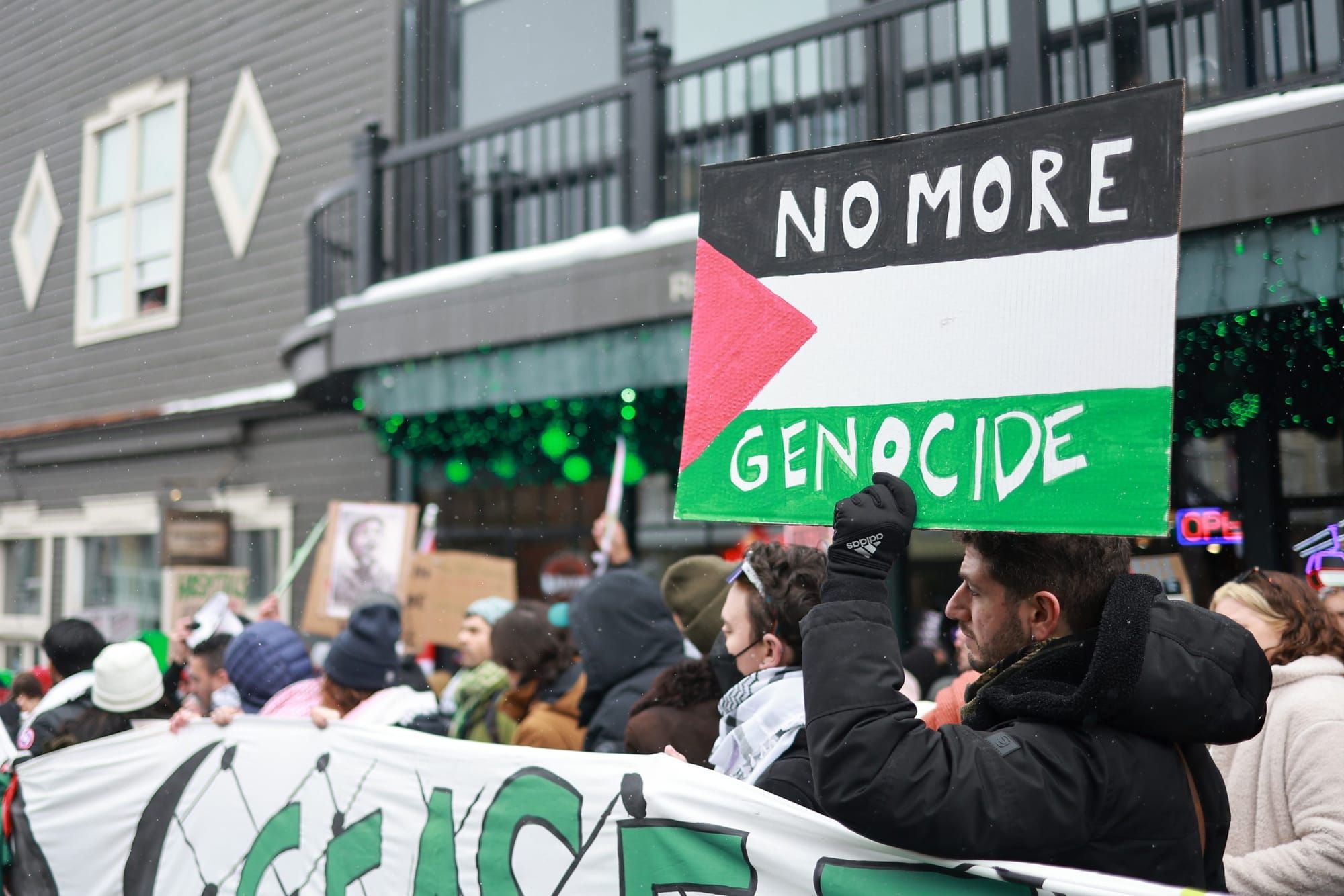
A federal court in Oakland, California has begun hearing oral arguments and live testimony on the request for a preliminary injunction barring the U.S. from providing military, financial, and diplomatic support for Israel’s ongoing genocide of Palestinians in Gaza, as well as on the government’s motion to have the case dismissed. The Jan. 26 hearing included testimony from Palestinian plaintiffs who brought the case and a genocide and Holocaust scholar who submitted a declaration in the case with other historians. The International Court of Justice in The Hague issued provisional measures on Friday morning, finding that South Africa has also made a plausible case that Israel is committing genocide against the Palestinian people in Gaza.
“Our plaintiffs’ testimonies today demonstrate just how urgent it is for the Biden administration to finally do what they and the vast majority of the people of the world have demanded: stop sending weapons to enable Israel’s genocidal campaign against Palestinians in besieged Gaza and instead uphold its clear legal duty to end, not further, genocide,” said Katherine Gallagher, a senior attorney at the Center for Constitutional Rights (CCR) who argued in court on Friday. “These are clear legal duties under U.S. and international law, and we call on the court to uphold its Constitutional role to hold President Biden, Secretary of State Blinken, and Secretary of Defense Austin to legal obligations and issue a preliminary injunction to stop the flow of weapons for Israel’s genocide.”
After over an hour of legal arguments, in which CCR attorneys cited a similar case that accused Russia of genocide in Ukraine that the U.S. government supported, three hours of plaintiff testimony followed.
“The images of our families and communities, Palestinian babies, children, women, and men from Gaza, are shaking us to our core,” said Ayman Nijim, a plaintiff in the case. “These are times of genocide, and we desperately need a U.S. court to intervene. So much hangs in the balance. Today, Palestinians spoke out in court and made a powerful case for why a preliminary injunction is necessary: we are hopeful the judge will agree with us and issue an order soon.”
At the hearing, U.S. Judge Jeffrey S. White acknowledged the pain Palestinians have been suffering through and the hand the U.S. has played in supporting Israel. He admitted that the case would come down to jurisdiction, but affirmed that he would be taking the case “extremely seriously.”
The lawsuit was filed in November on behalf of Palestinian human rights groups Al-Haq and Defense for Children International—Palestine, Palestinians who live in Gaza, and Palestinians in the U.S. with families who live in Gaza, by the CCR and Van Der Hout LLP. The U.S. government filed a motion to dismiss the case but does not contest that Israel is committing genocide or that it is complicit in it, but rather focuses on technical jurisdictional issues. They argue that the court cannot review its policy choices and that Israel is an “independent actor,” despite the U.S’ supplying of weapons, bombs, and ammunition.
Prior to Friday’s hearing, doctors, journalists, and civil and human rights organizations submitted amicus briefs in support of the lawsuit brought by Palestinians against Biden, Blinken, and Austin for their complicity in Israel’s genocide in Gaza.
One brief was submitted by four leading grassroots organizations representing Muslim and Arab Americans: the American-Arab Anti-Discrimination Committee, the Arab Resource & Organizing Center, the Council on American-Islamic Relations in California, and the Arab-American Civil Rights League. Together, they collected accounts from Palestinians in the U.S. of the extensive suffering in their communities and the country’s failure to protect even U.S. citizens in Gaza.
The deaths in Gaza, “are not numbers; they represent people with names, lives, hopes, and dreams,” the organizers said in their brief. “Many of the people killed by Israel are family and friends of community members in the United States.”
The brief cites Y.E, a 27-year-old law student in Illinois, who has lost 120 of her family members in the airstrikes by the Israeli military since Oct. 7. Y.E.’s two young cousins returned from the store to find their home destroyed by an airstrike. As they tried to dig their parents and sisters out of the rubble, another airstrike hit, killing them.
Another brief filed by physicians and other medical professionals details “the ways in which the Israeli government has intentionally attacked health services and the catastrophic effect those attacks have on the possibility of Palestinian life in Gaza. Collectively, these attacks constitute acts of genocide.”
Satya Sarma, a doctor who signed onto the brief, said it was important for her to be involved because of the genocide’s long-lasting impact on Palestinian’s health, hospitals, health systems, and public health facilities there.
“I think it’s really important for physicians to be true to their duty to society and call out when something is harmful to people,” Sarma said. “We take an oath to do no harm, and I think that goes beyond just the absence of harm. It means calling out when we see harm occurring.”
Sarma would like to see an end to the bombardment and better conditions for basic health, well-being, and life such as food, water, fuel, medicines, and medical care.
“I’ve lived through many conflicts that our country has been engaged in, in one way or another … I’ve never seen anything like this,” Sarma said. “I have never seen a situation where … an entire people is essentially imprisoned in one area while bombs are being dropped on them and they have no food, no water, and then no humanitarian aid of any kind, including medical supplies.”
Sarma says she is worried about what this says about the American identity and wishes there were more conversations being held to consider a ceasefire.
The Palestinian Journalists’ Syndicate, a trade union representing more than 3,000 workers in the occupied territory and abroad, also filed a brief addressing the deadly toll journalists have faced.
“Evidence strongly indicates that the vast majority of the journalists and media workers killed since the start of the genocide were specifically targeted for assassination by the Israeli military …” the brief states. “At least 84 of the 95 deceased journalists were killed in ‘surgical’ or sniper Israeli attacks that targeted either their homes (or, in one case, their personal vehicle) or the area where they were reporting, filming, or otherwise covering news stories.”
Anan Quzmar, a Palestinian journalist with the Palestinian Journalists’ Syndicate, said the reality of living in Gaza as a journalist is indescribable. One former colleague of his wished for his children to be spared from witnessing injured and killed Palestinians on the street and having to continue past them. This has become inescapable for most journalists in the region as Israel has directly targeted reporters and their communities.
“Words cannot describe what’s going on now,” Quzmar said. “I think even speaking to journalists who are going through this right now will be difficult for them to articulate the sorts of situations that they find themselves in … one story that keeps repeating itself is our journalists telling us about the sorts of decisions they have to make on a day to day basis regarding the imminent threat they feel to their life, and therefore, the lives of people who they spend most of their time with.”
Quzmar says that, compared to previous wars, Israel has taken a more aggressive approach to targeting journalists. In one example, Bilal Jadallah, the director of Press House – Palestine, a nonprofit that supports the development of independent Palestinian media, was killed in his car in Gaza in an Israeli airstrike. Quzmar said the press house was previously considered a safe space for journalists to seek shelter during times of conflict.
“It’s also the huge contrast between this war and previous wars where presence around journalists was considered to be a form of protection,” Quzmar said, believing the difference to be likely strategic, to stop coverage and also to “kill hope” for people in Gaza. “In previous wars, for example, many journalists would not be able to make it to their homes in the evening, so they would go and stay at the press house because of its important location … but [the founder] was assassinated, and the press house itself was bombed.”
Quzmar believes accountability is central to both the future of the Palestinian people and a pathway to a better future for all.
“First and foremost, this genocide is not just being carried out by the Israeli military, but in fact, it’s a genocide that is more than just supported by the U.S. and many governments around the world,” Quzmar said. “The responsibility in the U.S. is important for us to highlight. The legal tools are just a step or just one tool that we are using for us to also highlight the issue in the media.”
Author
Alexandra is a Cuban-American writer based in Miami, with an interest in immigration, the economy, gender justice, and the environment. Her work has appeared in CNN, Vice, and Catapult Magazine, among
Sign up for Prism newsletters.
Stay up to date with curated collection of our top stories.