The NYPD routinely abuses people in handcuffs. How do officers get away with it?
Court records and interviews with victims show that New York Police Department officers use force on people already restrained, which some experts characterize as “torture”
Real journalists wrote and edited this (not AI)—independent, community-driven journalism survives because you back it. Donate to sustain Prism’s mission and the humans behind it.
Mashed potatoes, fried chicken, and vegetables filled aluminum trays on a hot afternoon in Brooklyn in July 2023. On the corner of Fulton Street and Nostrand Avenue in the Bedford-Stuyvesant neighborhood, Terrell Harper danced and distributed free food and clothes to dozens of people. Harper, a New Jersey native, started the mutual aid group We the People NYC in 2021, because he said, “It’s the best way to show we keep us safe.”
“That line is there before we get there,” Harper told Prism, referring to the community members who lined up along the block to receive aid.
Later that day, a traffic cop arrived at the meal distribution site and ticketed an organizer as she sat on her car. According to a New York Police Department (NYPD) arrest report about the incident, someone grabbed the officer’s scanner and threw it before running away. As more officers arrived, Harper, who said he verbally taunted the officer, alleged that he was falsely arrested for throwing the scanner.
Once in the police car, Harper told Prism that the arresting NYPD officers pulled into a sunny spot in a parking lot and exited the car, leaving him handcuffed in the vehicle, his sweat making his eyes burn, for 40 minutes.
“They baked me, windows up,” Harper said.“Y’all doing torture? That’s the [NYPD] shit that gets scary.”
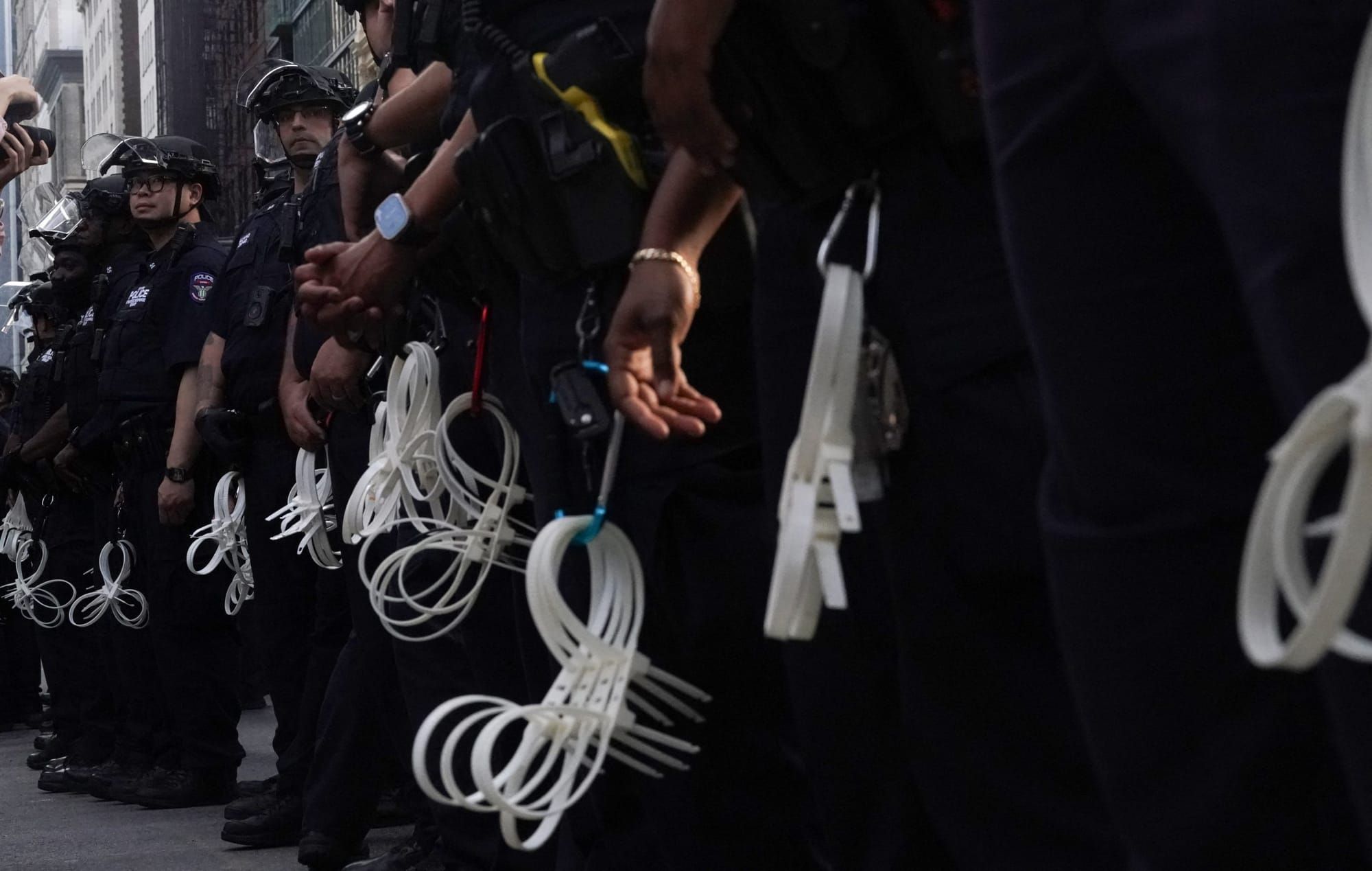
Over the last decade, thousands of lawsuits against the NYPD allege abuse while people were handcuffed. This includes painfully tight handcuffs that led to long-term injuries such as scarring and nerve damage, along with far more severe allegations related to sexual assault.
Prism requested comment from the NYPD multiple times regarding allegations of abuse from handcuffed New Yorkers. The agency did not respond.
Organizers and legal experts who spoke to Prism said the NYPD’s abuse of handcuffed people in custody has become a common practice and frequently escalates to other forms of state violence, including physical force, psychological intimidation, and denial of medical care.
Unreasonable force
According to lawsuits viewed by Prism, dozens of New York residents have accused the NYPD of abuse while they were handcuffed. This includes allegations that officers kicked people on the floor, conducted humiliating strip searches in public, and groped, beat, or body-slammed people in handcuffs. In one case, a couple said they were left in a police van for hours while the officers got breakfast. In another case, a woman alleged that she was drugged and raped by officers.
An analysis by the Legal Aid Society found that NYPD misconduct cost taxpayers more than $750 million in settlements from 2018 to 2025, with over $205 million spent in 2024 alone.
As part of her work as co-founder of Black Lives Matter (BLM) Greater New York, Chivona Renée Newsome documents allegations of police abuse for potential litigation. She told Prism that she can tell by a person’s injuries when the police “beat you while in handcuffs.”
According to the activist, common signs include road rash above the eye from being slammed into the ground, bruising around the collar bone or rotator cuff where the person tried to brace themselves, trauma to the back of the head, black eyes, and injuries primarily located on one side.
“Everyone who gets beat up by the police … the photos all look the same,” Newsome said.
L, a registered nurse and organizer using a pseudonym for safety reasons, said Newsome’s description of injuries around the eyes, shoulders, and head “makes sense.”
“It’s sadistic,” Newsome said. “If you asked any person, ‘How would you feel if you saw someone tied up and beat up by six people?’ No one would say that was OK, but it’s OK if they have on uniforms and a badge.”
In some of the most infamous cases of police violence, such as the 2014 NYPD killing of Eric Garner, handcuffs played a significant role. NYPD officers dragged Garner to the ground and handcuffed him as NYPD Officer Daniel Pantaleo choked him. The officer then pushed Garner’s head into the cement as Garner repeated, “I can’t breathe.” Pantaleo was never criminally charged, and an internal NYPD trial found him not guilty of intentional strangling.
George Floyd was killed in Minneapolis in 2020 while handcuffed facedown by Officer Derek Chauvin. The officer pressed his knee onto Floyd’s neck for over 10 minutes. While it’s rare for an officer to be charged or convicted, in 2021, Chauvin was found guilty of unintentional second-degree murder, third-degree murder, and second-degree manslaughter and sentenced to more than 20 years in prison.
According to the NYPD Patrol Guide, “use of force must be reasonable,” deescalation should be prioritized prior to using force, and use of force should only be used to prevent “imminent serious physical injury or death.” The guide also states that NYPD officers should watch for injuries of those in their custody and that people under arrest “should not be maintained or transported in a face down position.”
But there is evidence that the NYPD routinely breaks these guidelines, and has for decades.
A 1996 report by Amnesty International outlines multiple troubling cases committed by the NYPD against people in handcuffs. This includes instances of homophobic abuse, a case in which a man’s head was shoved through a window, and an instance in which officers threatened a man by putting a gun in his mouth.
There have also been several deaths of people handcuffed while face down, including the 1991 case of Federico Pereira. The 21-year-old was choked by an officer as he lay face down with his hands cuffed behind his back.
A 2024 investigation by the Associated Press revealed that abuse against people in handcuffs is a national issue. The report identified hundreds of deaths caused in part by police officers who left people handcuffed while face down. Known as prone restraint, in many cases, officers put their body weight on top of the person as they were restrained. Dozens of cases were also identified in which officers shocked people with a Taser while they were handcuffed.
Jennvine Wong, supervising attorney with the Legal Aid Society’s Cop Accountability Project, told Prism that the NYPD’s abuse of handcuffed people is deeply tied to “the militarization of America’s police forces.”
“Officers that buy into this warrior cop mentality, it’s like us versus them,” Wong said. “They’re not looking at the people in their custody as human beings, they’re looking at them as this other, which also means that they’re treating them like enemy combatants.”
Harper, of We the People NYC, said there’s another reason police abuse people in handcuffs: “It’s revenge—especially when it comes to protesting.”
Accusations of torture
According to Harper, when officers left him to overheat in a police car while handcuffed, it constituted “torture.”
The U.S. defines torture as “an act committed by a person acting under the color of law specifically intended to inflict severe physical or mental pain or suffering … upon another person within his custody or physical control.” But federal law only criminalizes torture committed outside the U.S., which in part has allowed the NYPD to commit torture against local residents for decades.
In 1997, Haitian immigrant Abner Louima was tortured by the NYPD while handcuffed. Louima was brutally beaten and sexually assaulted by Officer Justin Volpe, who shoved a stick into Louima’s rectum and then jammed it into his mouth. The officer threatened to kill Louima if he told anyone what happened. In 2023, Volpe was released early from federal prison after serving 24 years of his 30-year sentence.
In 2017, an 18-year-old known publicly as Anna Chambers was driving through South Brooklyn’s Calvert Vaux Park with two male friends when they were stopped by undercover NYPD detectives Richard Hall and Edward Martins. The police allegedly found drugs, but only Chambers was arrested. She was placed in handcuffs and taken into the officers’ unmarked van. Hall and Martins drove her to a parking lot, where she said they brutally raped her before leaving her on a street corner. The officers claimed that Chambers was not handcuffed, and they had consensual sex with her. The rape charges against the officers were dropped, and each was given just five years probation.
The NYPD was also accused of what could be described as torture in 2020. During a BLM protest in the South Bronx’s Mott Haven neighborhood, NYPD officers kettled protesters by surrounding and entrapping them in a small area. Officers then brutally beat and pepper-sprayed the protesters and arrested over 250 people.
According to a Human Rights Watch (HRW) report about the incident, dozens of people spent hours with untreated injuries while their hands were tied behind their backs. Some protesters and legal observers reported broken noses and fingers, lost teeth, sprained shoulders, and potential nerve damage due to tight zip ties.
HRW asserted that NYPD’s behavior in Mott Haven could be considered torture under international law, which defines torture as severe pain or suffering intentionally inflicted on a person for the purposes of obtaining a confession, punishment, intimidation, or discrimination with the consent of a public official.
According to Mark Berlin, an associate political science professor at Marquette University, existing U.S. laws on torture have “loopholes.”
Berlin, who researches allegations of torture against the Chicago Police Department, told Prism that the U.S. is in desperate need of “a dedicated statute that criminalizes torture.” In part, because it could open the door to more scrutiny and legal action against the police, which he noted is also the reason why such a statute seems highly unlikely in the U.S.
“They’re trying to scare me away”
According to recent data from New York City’s comptroller, people of color—and Black men in particular—are overwhelmingly the victims of the NYPD’s excessive use of force. However, New York’s history of racist violence in policing goes back centuries.
The U.S. Constitution’s Fugitive Slave Clause required free Northern states to return escaped enslaved Black people back to the South. But prior to the Civil War, a group of NYPD officers, marshals, and judges, known as “the kidnapping club,” terrorized Black neighborhoods and captured both escaped and free-born Black people alike and sent them to Southern plantations, Smithsonian Magazine reported.
“That’s the reason policing in America, the way that we know it … will never work,” said Newsome, of BLM Greater New York. “It was created on racism. It’s always honored and protected the ruling class for the last 400 years.”
Unable to more overtly engage in racialized violence, some officers have developed workarounds. For example, it’s not uncommon for NYPD officers to use handcuffs as a weapon, according to citizen journalist iamgodNY, who is using his online pseudonym for fear of retaliation.
IamgodNY first began posting videos of NYPD officers on YouTube in 2024 after he was assaulted by officers for filming a parade, according to a lawsuit reviewed by Prism. In the months since, he’s posted more than 400 videos and gained nearly 11,000 subscribers, but this has come at a cost.
Shooting the videos requires IamgodNY to interact with the police regularly, sometimes leading to arrest. According to the social media reporter, the NYPD has never treated him gently while he was handcuffed. Officers have often pulled him by the handcuffs and stomped on his shackles, he said, and these actions are done covertly so they aren’t captured in police body camera footage.
“There is no limit to what [the NYPD will] do to anybody,” IamgodNY said.
One video of IamgodNY being arrested last year shows his hands behind his back and an NYPD officer lifting him off the ground by his handcuffs as he screams. Officers then toss him into a patrol vehicle head-first.
IamgodNY told Prism that he used to believe there were good cops and bad cops, but he doesn’t believe this anymore. “[The NYPD] don’t stop abuse if it’s at the hands of one of their own,” he told Prism during an interview with his attorney, Nayantara Bhushan.
Bhushan said the NYPD targets her client because he films them, and that the agency uses handcuffs like a “physical and psychological weapon,” especially when they backcuff and shackle someone in a cell, the attorney said. According to IamgodNY, he was held in this way “for hours.”
“They’re trying to scare me away,” he said. But the agency’s tactics aren’t working. “It just makes me want to [film] more.”
Harper said when he’s been harassed by the police, it’s often hard to know what to do about it because of the tactics they use and the power they wield.
“So if I take it to trial, who’s showing up? [Not] the officer that beat me up,” Harper explained, referring to previous arrests in which he alleged that he was physically abused.
For example, he never learned the identities of the officers who left him in their vehicle on that sweltering day in July because they were not the same officers who filed his arrest report. He calls this the “pass off” and said it’s a very common tactic for police to use during protests.
Harper said he’s been arrested dozens of times and that protests “are always rough.” The NYPD tightens handcuffs and pulls on the chain “cutting up your wrists,” he explained. Harper said he’s actually offered to be arrested but the NYPD has tackled him anyway, punched him in the head, and then used his head to push themselves off the ground.
Still, Harper has continued to organize. We the People has grown in recent months, expanding from one weekly distribution to two in Brooklyn and Harlem. The group is now also looking to collect donated coats and other warm clothes for winter.
Harper told Prism that no matter the potential police harassment, he’ll continue his mutual aid work because his community depends on it.
“When I get money, it goes to this,” he explained. “It’s my passion. I don’t buy clothes. I don’t buy none of that shit. Strictly this.”
Editorial Team:
Tina Vasquez, Lead Editor
Carolyn Copeland, Top Editor
Rashmee Kumar, Copy Editor
Author
Elias Guerra is an investigative and audio reporter from Brooklyn. They cover ecology, organizing, and police accountability.
Sign up for Prism newsletters.
Stay up to date with curated collection of our top stories.