Street vendors and other NYC immigrant workers brace for renewed deportation threats under Trump
Advocates are focused on fortifying labor protections for immigrant workers at the state and local level: “These are frontline workers who are feeding and serving every New Yorker”
Immigrant workers in New York say they face daily threats of removal from the community where they have built a life.
These threats have intensified since the beginning of President Donald Trump’s second term, after he campaigned on a heightened anti-immigrant rhetoric and promised to deport millions of people living in the U.S.
But for workers, especially those most vulnerable to interactions with law enforcement in New York, hiding and waiting for the xenophobic storm to pass is not an option. Immigrant rights advocates say life before Trump was equally tough on migrant workers, especially street vendors and delivery drivers.
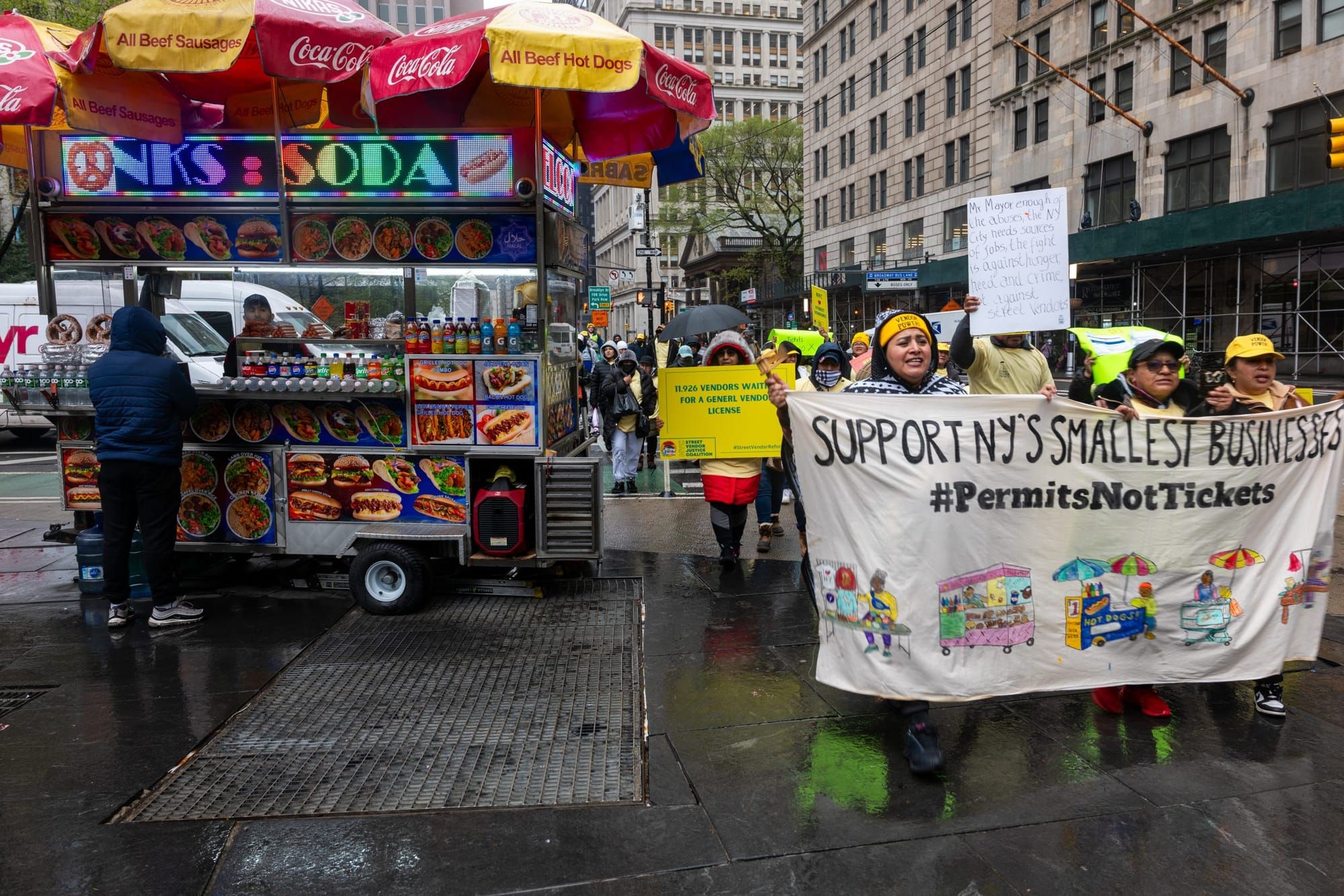
Street vendors, for instance, have worked along gray margins for more than a decade, with New York City officials unable and unwilling to clear a backlog of licenses and permits that dates back to 2016, according to a report from the Immigration Research Initiative. Ninety-six percent of street vendors are immigrants.
“In this current environment that we are in, everyone feels scared, feels unsafe, and is unsure about what could happen,” said Carina Kaufman-Gutierrez, the deputy director for the Street Vendor Project, a member-led organization made up of about 2,000 street vendors fighting for better worker protections.
For delivery drivers, the risk of encountering law enforcement is equally imminent. Workers delivering food and other essential items are often referred to as “deliveristas,” an adaptation of the word delivery driver into Spanish. They have spent the past decade fighting for fair wages, benefits, and better mobility options for bikes and other small vehicles that couriers use to transport the goods that power the city.
“Delivery workers and street vendors are an important part of the New York state economy that cannot afford to stay at home and close their doors in and simply stay safe,” said Ligia Guallpa, co-executive director of the Workers Justice Project (WJP), an organization building workers’ rights in New York. WJP started Los Deliveristas Unidos, an organizing campaign involving a group of delivery workers who have helped shine a light on the hardships of being an app-based delivery worker in New York.
Guallpa said these workers have faced the threat of removal for several years, including during the first Trump term, but now the rhetoric is stronger and more overt. The president’s slew of executive orders and what they represent for migrants are also much more hazardous, Guallpa added.
“The first Trump administration was a lot about making sure communities—same as now—know their rights,” Guallpa said. “We did experience some immigration raids, but it wasn’t at a massive scale that the federal government is proposing this time. I think that what we see right now is a Trump era with a lot more power and a lot more coordination and cooperation and from across agencies at the federal government.”
She added that worker-led organizations are focusing on advancing and furthering labor protections.
“The difference now is that we understand that it’s not just about defending, but it’s also about how we have a strategy to advance basic protections at the local and the state level,” Guallpa said.
The paradigm has also shifted under Mayor Eric Adams, who Guallpa said has stayed silent in the face of attacks against immigrant New Yorkers and even proposed bringing Immigration and Customs Enforcement (ICE) into the Rikers Island jail complex.
Adams has been meeting with the federal government to discuss immigration enforcement. Immigrant rights advocates recently condemned a memo issued by the Adams administration in early February instructing city agencies to authorize federal immigration enforcement to enter their premises without a judicial warrant if a city worker perceives a threat to their safety or the safety of others. These agencies include the shelter system and New York City schools.
“This memo once again makes clear: Mayor Adams does not respect the law. It’s one thing for Adams to waffle on his commitment to New York City’s sanctuary policies while cozying up to Trump, it’s entirely another when he sanctions his agency staff and city employees to completely disregard those same local laws when it suits them,” said Murad Awawdeh, the president and CEO of the New York Immigration Coalition, in a public statement.
Adams’ office did not respond to Prism’s request for comment.
Despite the palpable threats from federal officials, Guallpa said workers are not backing down.
“Despite their fear, nothing is going to stop them from continuing to be able to work as street vendors or delivery workers,” she said. “It’s a type of work that benefits every New Yorker during a storm or during any type of climate change crisis. These are frontline workers who are feeding and serving every New Yorker.”
She added that these workers strengthen the city and state’s economy.
“I cannot imagine New York City without immigrants, not just because they provide their labor, but because they’re paying their taxes,” Guallpa said. “They are keeping our economies thriving and growing.”
Tax experts say the fear of deportation for migrants might be detrimental to local and national economies.
Jon Whiten, the deputy director of the Institute on Taxation and Economic Policy (ITEP), wrote in an email to Prism that a 10-percentage-point decline in tax compliance among undocumented people would result in an annual loss of $9.5 billion. Of this amount, $8.6 billion would come from federal taxes, while state and local governments would lose $900 million.
A 2024 study from ITEP found that undocumented workers paid $96.7 billion in federal, state, and local taxes in 2022.
“That amounts to $8.9 billion in public revenue for every 1 million undocumented immigrants who reside in the U.S.,” Whiten said, “and most of that would evaporate if these immigrants were to exit the country.”
Editorial Team:
Sahar Fatima, Lead Editor
Carolyn Copeland, Top Editor
Rashmee Kumar, Copy Editor
Author

Eddie Velazquez is a journalist in upstate New York focused on covering organized labor, and the state’s housing and childhood lead poisoning crises. You can follow his work on Twitter @ezvelazquez.
Sign up for Prism newsletters.
Stay up to date with curated collection of our top stories.