Utica’s refugee community demands justice for 13-year-old boy killed by police
Karen refugee Nyah Mway was shot by police last June, fueling protests for accountability from the city and programs for local youth
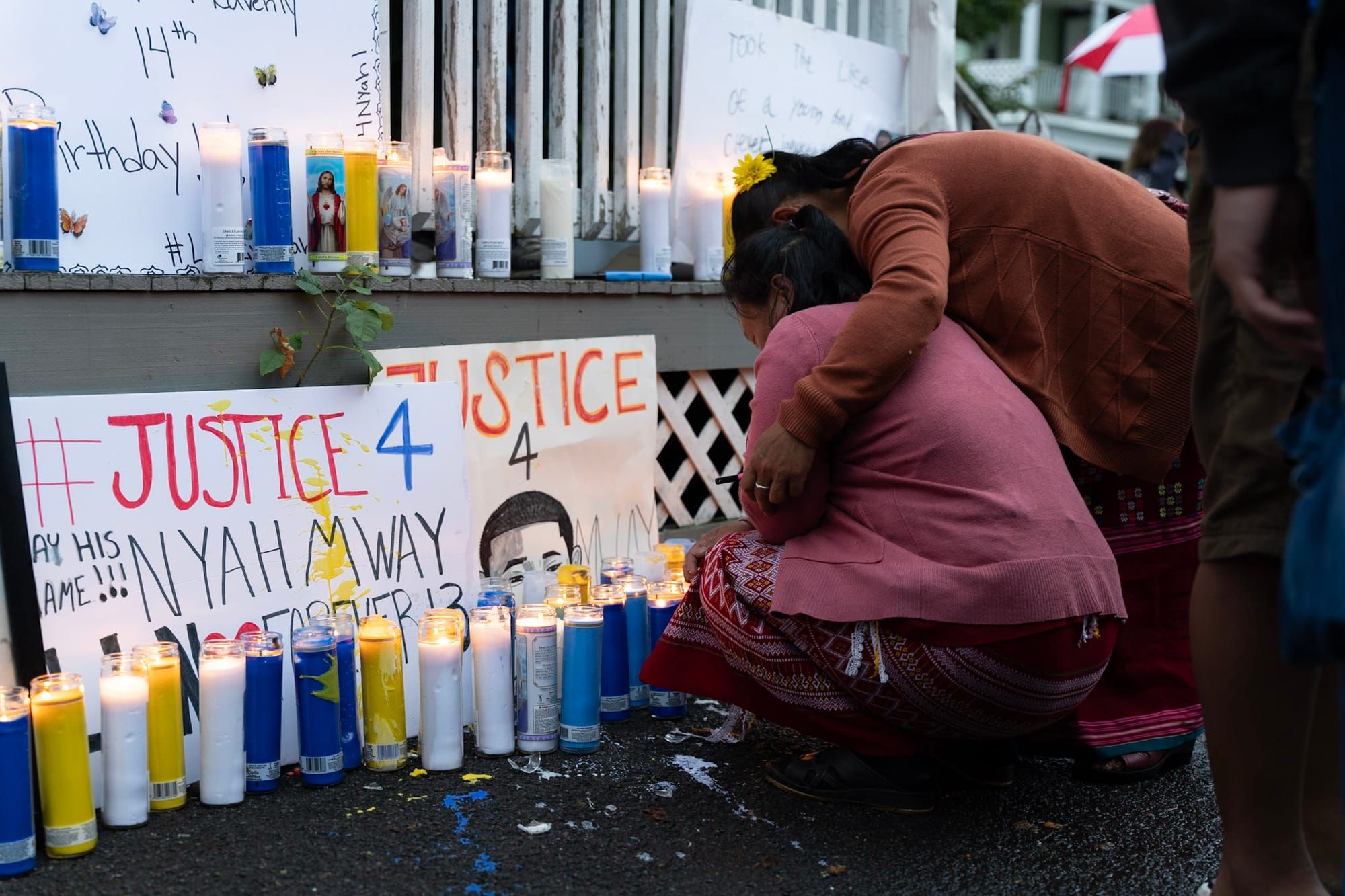
Around 10 p.m. on June 28, 2024, Nyah Mway, 13, a recent Donovan Middle School graduate and Karen refugee from Myanmar, walked on Shaw Street alongside a friend on a bike, a couple hundred yards from the midcentury highway that gashes through Utica, New York. Like many of the city’s neighborhoods, composed of aging multi- and single-family homes, the street was quiet.
Three white officers with the Utica Police Department (UPD) and two deputy sheriffs with the Oneida County Sheriff’s Department stopped them. According to body camera footage, one of the officers, Bryce Patterson, said they stopped the boys for walking in the street. (UPD would later say the boys matched the descriptions of robbery suspects.)
After police asked to pat Nyah down for weapons and approached the teen, he bolted. Where his community comes from, running from men with guns is a means of survival.
Video shows Nyah turned around, lifting an object while running; Patterson shouted that it was a gun. Patterson tackled Nyah, throwing punches while on top of him. Officer Patrick Husnay ran in from behind and fired a point-blank shot to Nyah’s chest.
The object, found next to Nyah who lay writhing in pain, was a pellet gun.
Represented by the same law firm that sued on behalf of the family of 12-year-old Tamir Rice, who was killed by a Cleveland police officer in 2014, Nyah’s mother, Chee War, filed a notice of claim against the city of Utica and the UPD officers on Sept. 17. She alleges wrongful death; excessive force; assault and battery; false arrest; civil rights violations; negligent hiring, training, and supervision; and conspiracy and failure to prevent or intervene in the unlawful acts. The city denies wrongdoing.
Many of Utica’s powers-that-be opted to stay out of the fray, leaving space for many Karen and progressive community members to take the lead. The city government and UPD became the targets of the strongest local protest movement in memory, rooted in a new constituency growing more organized by the day. But this movement was lost on most elected city officials, who spent much of the fall debating whether they should remove a new traffic island.
At a Common Council meeting on Oct. 16, a 12-year-old Karen girl, wearing a white T-shirt with Nyah’s image, told city council members that since Nyah was killed, “many of us feel afraid and angry. We came to this country for peace, but now we wonder if we will ever truly be safe. Losing Nyah has shattered our sense of security.”
“Utica is our home,” Karen protesters chanted at City Hall on July 1. “We are the future.”
Chipping at rust
Like most Karen in Utica, Nyah’s family arrived as part of a U.S. State Department refugee resettlement program. Nyah was born in a Thai refugee camp his family had fled to after experiencing persecution in Myanmar. But Nyah held onto his culture. This is partly why the rallies and gatherings following his death often included the traditional Karen don dance, Nyah’s favorite. A lover of basketball, he also spent late nights at the gym the summer of his death. He doted on his little sister, who was named after a flower to match with him.
Shaw Street is typical for many parts of Utica: some homes inviting with color and greenery, others in disrepair.
At around 65,000 residents as of the 2020 census, Utica’s 28.2% poverty rate is twice the rest of New York. About 41% of Utica’s children live in poverty, and a 2022 housing study commissioned by the city found thousands of households struggling to pay for housing, often in poor condition.
Located near the geographic center of the state along the Erie Canal, Utica was once a notable manufacturing city with elite appeal. The population peaked at more than 100,000 from the 1930s to the 1960s before entering a long decline as jobs disappeared.
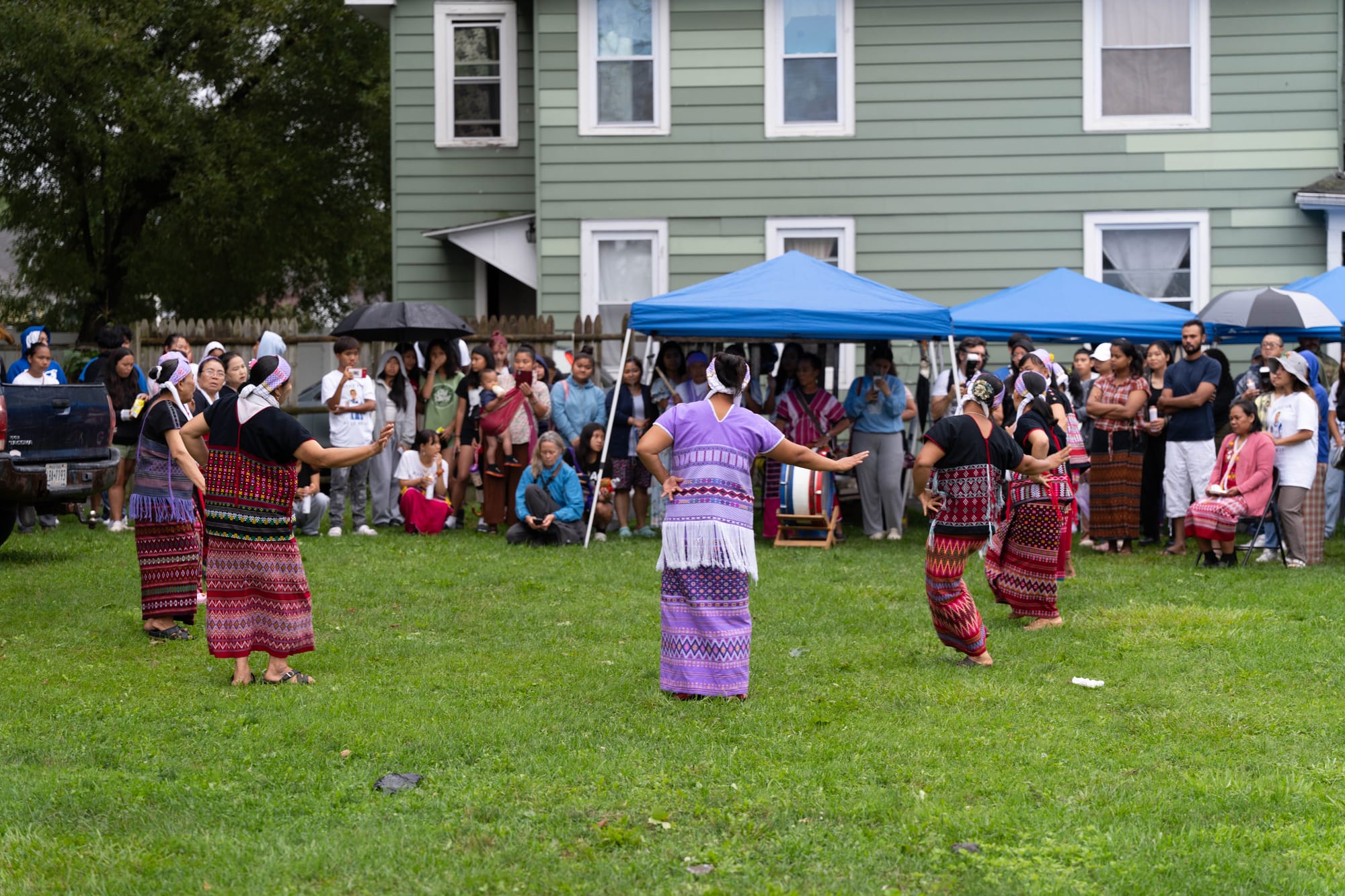
Buoyed by immigrants, Utica’s politics have often been linked with its changing population. Bound by their unique histories, often including state violence, many immigrants and refugees have maintained distinct communities.
“Even though people are sticking to their own groups, a lot of the kids are approaching each other,” said LuPway Doh, 42, chair of the Karen Organization of Utica, which is in the process of registering as a nonprofit.
Starting in the 1970s, the Mohawk Valley Resource Center for Refugees, now known as The Center, resettled thousands of Vietnamese, Cambodian, Laotian, Polish, Bosnian, Somali, Iraqi, and other refugees, reaching nearly 17,000 by 2021.
Utica’s Karen began arriving about 20 years ago, fleeing targeted violence in Myanmar. Mired in one of the world’s longest-running conflicts for self-determination, government forces have burned Karen villages, shot civilians, and committed rape. The State Department resettled over 4,000 from Myanmar, many of whom are Karen, in Utica via The Center. Though Karen identity spans multiple dialects and cultural backgrounds, the community in Utica—like that of many immigrant groups throughout American history—has been somewhat collapsed into one ethnic group.
The city, bordering rural areas that are over 90% white, is approximately 22% foreign-born and 45% Black and brown. Local leaders and media often embrace a title given by a 2005 United Nations publication: “the town that loves refugees.” Less acknowledged is the phrase’s implication that Utica and its refugee population are separate entities.
This is the first time Karen people have been speaking out, vocally, loudly.
Kay Klo, executive director of the Midtown Utica Community Center
Years before President-elect Donald Trump accused Haitian immigrants of eating cats and dogs, a former Utica mayor lamented refugees’ supposed hunting of local ducks, going to the bathroom in public, and lighting of living room bonfires. Refugees are often most visible behind registers and in factories, not in the halls of power.
“In reality, a lot of these people like the labor that refugees bring because refugees can be more easily exploited,” said Kay Klo, the executive director of the Midtown Utica Community Center (MUCC). Klo, who has emerged as a key community organizer since Nyah’s shooting, said Karen people like herself tend to be more quiet. “This is the first time Karen people have been speaking out, vocally, loudly.”
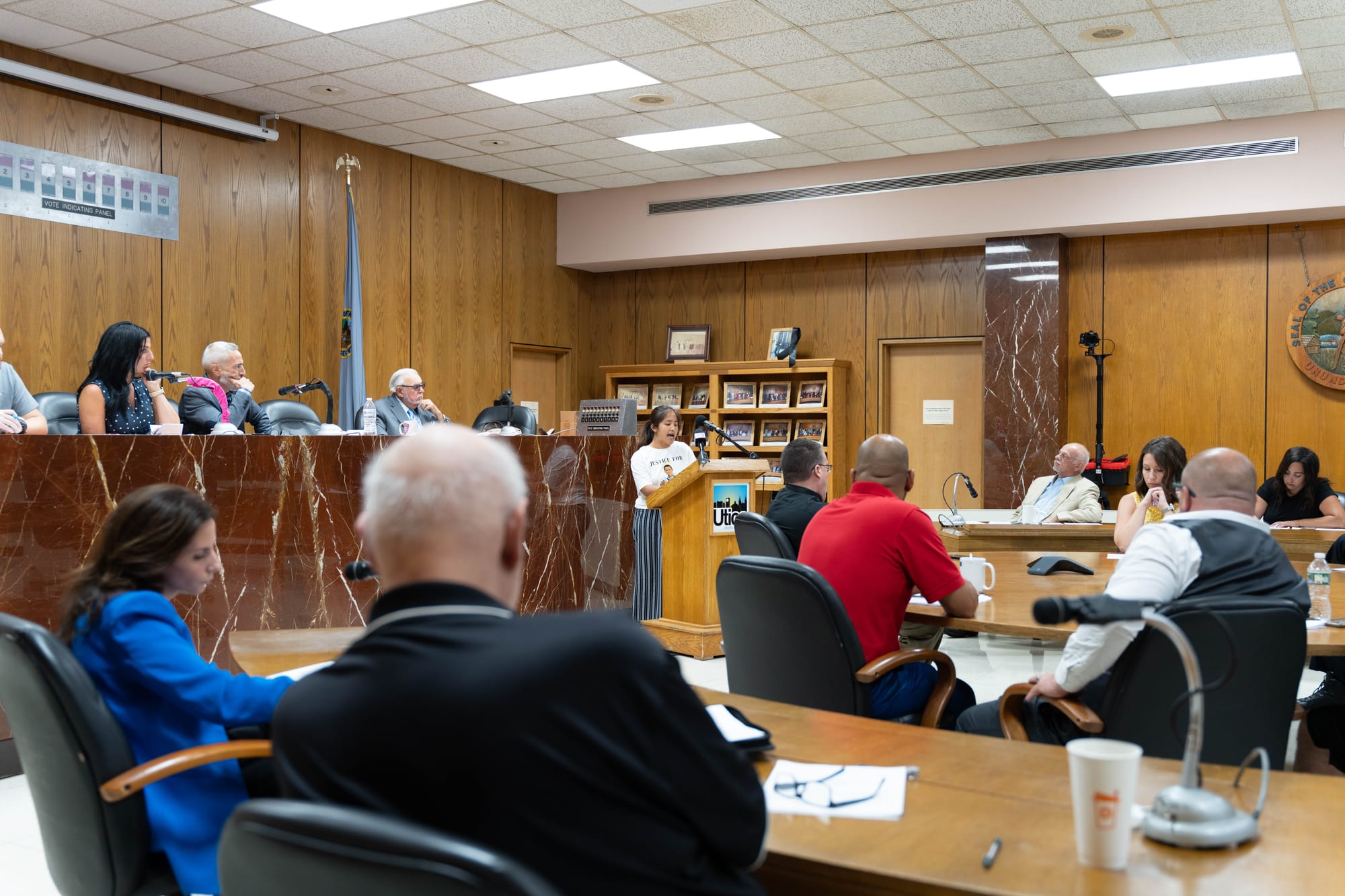
Many older refugees do not speak English, and there are limited resources to support them. “We just help each other out,” said Tamla Kyet, who works remotely as a Karen interpreter.
Another 12-year-old Karen girl told council members at the October meeting that she and other refugee families missed out on extracurricular activities, which are critical for keeping kids safe, because they weren’t translated or advertised to their community.
“That’s why we’re asking the city to allocate more funds to community programs that help kids, rather than directing those funds to more police,” the girl said.
For fiscal year 2025, the city allocated over $30 million of its $87 million budget to UPD and its employee benefits. The Youth Bureau was given just shy of $700,000.
“You can do a lot of great things” to build community trust, UPD Chief Mark Williams said in an interview at a public safety town hall months before the shooting. “If you have one bad incident, all that work you’ve done, you’ve lost. And so you start from scratch again.”
But even before the shooting of Nyah, the community didn’t view UPD as entirely trustworthy. UPD stops of young men are a frequent conversation in the Karen community. Doh said youth are stopped by UPD “a lot,” and many times law enforcement searches the whole car, doesn’t find anything, and still gives out tickets. Officers will also often ask about gang affiliation, particularly with the “Asian Boyz.”
At a summer meeting with Karen youth after the shooting, Kyet and Klo said many of them reported negative interactions with police. Kyet recalled an instance of someone being told they looked “suspicious” for exiting a store wearing a hoodie.
In one traffic stop video, obtained by Prism, officers ask an Asian man in the passenger seat to exit the vehicle after stopping the driver for allegedly twice failing to use their turn signal early enough. When the man asks why he’s being searched, the officer exasperatedly says, “Because you’re not answering questions, and you’re acting mad sketchy.”
The man in the passenger seat doesn’t exit as another officer approaches. “So listen, my partner has asked you to step out once. I’m telling you to step out right now, I’m not asking you to,” the officer says while reaching into the car. The passenger pushes the officer’s arm away, and the officer responds that he’s now under arrest for “harassment.” The video cuts out. One of the officers present, who identified himself in the video when asked by the driver, was Patrick Husnay, who shot Nyah.
Kyet, who volunteers with Karen kids, said that “instead of trying to make the city safer,” UPD will “terrorize the people.”
UPD Police Lt. Mike Curley told Prism that the department does not maintain aggregated data on the demographics of stops. In later statements to Radio Free Asia, he said allegations of discrimination and harassment against the Karen community “are false and baseless.”
The shooting isn’t the first time in recent history that UPD has been accused of brutality. In December 2023, an Asian man named Savon Khiemdavanh filed a federal lawsuit against the department, alleging, among other claims, the use of excessive force by five officers and false arrest without first being read his rights. One of the officers involved was Bryce Patterson, who first tackled and punched Nyah.
Norm Deep, a local lawyer representing Khiemdavanh who has filed lawsuits against UPD before, said he “can’t wait to try this case” because it is “the worst abuse” he’s seen “by any police officer, except for killing a person.”
UPD and Utica’s counsel declined to comment on the case. The city also denied the allegations in court filings.
According to UPD’s 2023 annual report, the department used force 147 times that year; 59% of which was against Black people, who made up about 17% of the city’s population in 2020. Two UPD-reported incidents were against Asians. Nationally, police have long disproportionately killed Black people, including 309 in 2024.
“Unconscionable and cowardly”
When UPD killed Nyah, over 100 locals filed into City Hall on June 29 for a press conference, which became so hectic that it was moved to a conference room for press only. Later that night, autonomous protesters had a tense standoff with police at the precinct. By July 1, hundreds protested again. Eventually, Karen community members and a cadre of young local activists formed Justice for Nyah Mway (J4NM), rallying supporters throughout the summer and fall.
For some Karen community elders, support for protests was contingent on whether they were peaceful, given their memories of state persecution. According to Klo, some older Karen women “spent all night praying” for protest safety.
In a Facebook comment, Republican Council Member At-Large Samantha Colosimo-Testa wrote, “The protests and people coming from our area that we don’t know who they are. We need to protect our community first.” She also wrote that she was “disgusted” with people she knew in the community who were “ask[ing] for violence.”
Colosimo-Testa, who is known locally as a vocal conservative, declined an interview and did not provide evidence for the claims made in her posts.
If we stand together, we’re a bigger voting bloc than everyone else.
Mike Ballman, Pastor at Cornerstone Community Church
At a march for Nyah on July 13, Mike Ballman, the pastor at Cornerstone Community Church, said that it was “unconscionable and cowardly” that some local groups remained silent or otherwise focused on training youth how to engage with police. Ballman, who previously became something of a political pariah for sheltering unhoused people at his church, also said he was “disgusted” by organizations’ statements that “said basically nothing, just large platitudes that didn’t address the systemic issues that caused this.”
Ballman said he hoped that marches would help build solidarity among Utica’s multiracial working-class and refugee communities. “If we stand together, we’re a bigger voting bloc than everyone else,” he said. “The city needs to fear our voting bloc, and they don’t currently, and so they do things that harm our communities because there’s no accountability.”
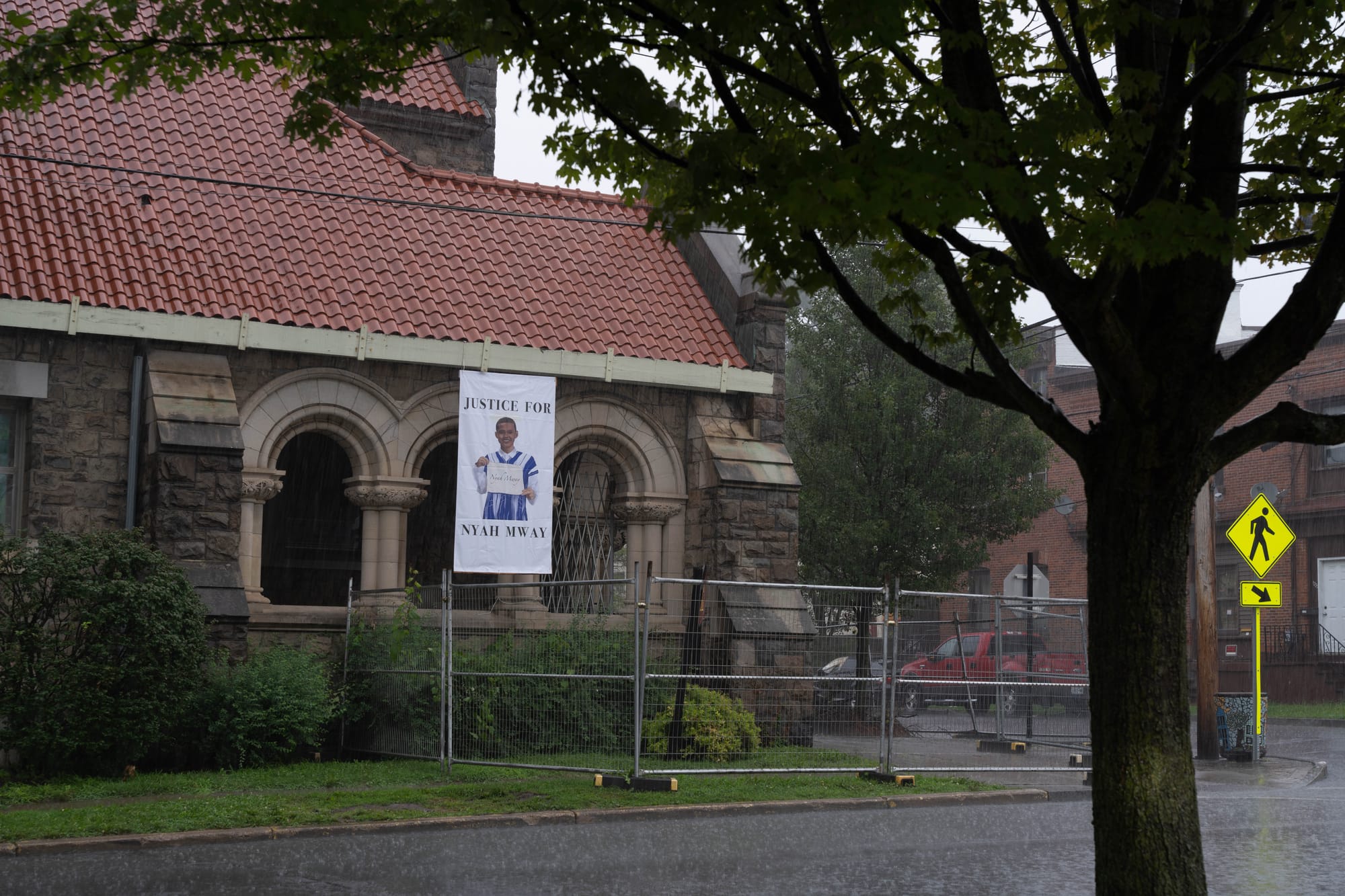
Many local nonprofit leaders are hesitant to openly get involved in politics, despite their significant influence. Caroline Williams, a former leader in the Lead-Free Mohawk Valley coalition, said she could speak more freely because she is no longer attached to an organization. She told Prism that when she used to tell coalition partners that it would be a good idea to go to Common Council meetings to advocate for legislative action on lead poisoning—nearly a third of Utica’s children have lead poisoning—“it would just be crickets.”
“No one comes right out and says, ‘We’re not challenging the city, that’s where our funding comes from,’” Williams said. “But when it comes up, you hear the hesitation.”
Others are far less hesitant. “Fuck your comfort, because a kid died,” Klo said. “And none of y’all spoke out about it.”
Discussing his church’s support for the unhoused community, Ballman said, “We’ve offended a lot of people, but we feel like the truth is more important than playing nice just to get funding.”
“We have a lot of people who work in the community, but don’t know anything about the community that they serve,” Klo noted.
Senya Bekui, lead organizer with the local chapter of Citizen Action of New York, is one of a handful of full-time community organizers in the area. Along with other young progressives hungry for change, he has worked closely with J4NM. Utica has “a lot of demographic power holding,” Bekui said, including older Italians who have leadership and economic positions in “a good old boys’ network.”
About a century ago, Italians rose from a downtrodden, discriminated immigrant labor class to dominate the city’s politics and institutions. Democratic Party boss Rufus “Rufie” Elefante held unparalleled influence during the city’s peak years before his machine decayed from scandal. Historian Phil Bean said, “It’s a combination of timing and cultural capital and sheer numbers that permitted” Italians to gain influence.
Remnants of the machine and its impact on political culture include the recent sentencing of former Utica Mayor and School Board President Louis LaPolla for mail fraud and former Utica School District Superintendent Bruce Karam for public corruption. Earlier in Karam’s tenure, the district denied wrongdoing in settlements with the New York Civil Liberties Union and state attorney general, who alleged that immigrants were being diverted to substandard education programs that didn’t offer degrees.
Reading the room
The wood-paneled walls and grid-tiled ceiling of the Utica Common Council chambers exude the 1970s—and those occupying the seats aren’t all that different. Of its 10 elected members, two are women, and nine are white (at least five have Italian surnames). No refugees are elected at any level of government representing Uticans.
Elected officials make few outreach efforts to refugee communities, even for their votes, according to Bekui: “They just sort of try to ignore them.”
Doh said that for years, his organization has extended invitations for the Karen New Year to local officials, and last year’s celebration was the first time one actually attended.
But the balance of power is slowly shifting.
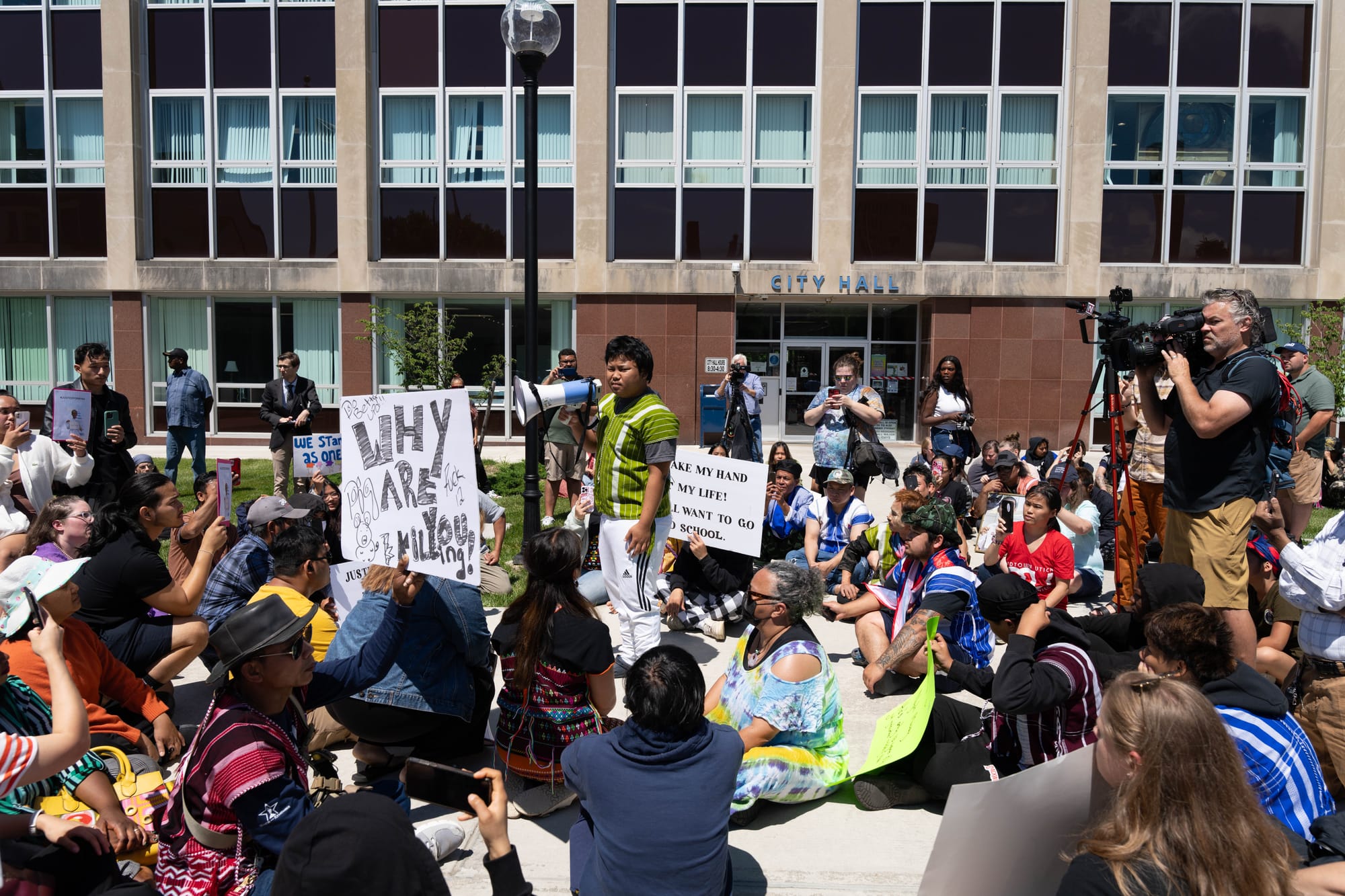
The pew-like wooden benches, rarely filled for Common Council meetings, overflowed with Karen and allied protesters after an Aug. 7 rally. Already expected to be a tense meeting because of the planned protest by J4NM, public interest grew when, in the preceding days, Republican Council Member Joe Betrus introduced legislation that would effectively ban homelessness by outlawing camping or sleeping in public.
Many officials seemed taken aback by the demonstrators, and the city’s counsel took small groups of council members aside before the meeting began. Democrat Katie Aiello, one of the few electeds to speak publicly on the shooting, said counsel advised council members not to speak about the shooting “for liability concerns.”
Public comments criss-crossed between condemnations of the shooting and the proposed legislation, often in the same speeches. J4NM supporters publicly grieved and made demands, ranging from an official city apology and firing the officers involved in Nyah’s killing to removing officers from schools and more funding for extracurricular programs.
Betrus walked back support for his own legislation, saying he’d only introduced it to start a conversation about homelessness.
Michael Gentile, who simultaneously serves as chief of staff to city Mayor Michael Galime and as an Oneida County legislator for the largely white, conservative stronghold of North Utica, declined to comment on the demands after the meeting. Asked how he works to represent the refugee community, he said, “I really think that’s an area where we succeed.”
“It’s discussed in every bit of our programming,” Gentile said, citing the city’s Youth Bureau and funding for groups like MUCC. “We are seeing some refugees in amazing leadership roles around the city. Maybe they’re just smart enough not to get into politics,” he added with a chuckle. Gentile said one way the administration addresses representation is through hiring, and he hopes refugees will attain elected office soon.
Six months on, parties await findings likely to be influential in any future trial from the New York State Attorney General Office’s investigation into Nyah’s killing, which a spokesperson said is still ongoing. UPD’s own “internal report will likely be released in conjunction with the AG report,” according to Curley, the Utica police lieutenant.
While public pressure has scaled back, advocates have met with the mayor’s office, mediated by the U.S. Department of Justice, to discuss demands and community relations. Oneida County drew national attention again in December, when corrections officers at Marcy Correctional Facility beat Robert Brooks to death while he was handcuffed, an incident that was caught on video. Advocates plan to hit the streets again to call for justice on January 11.
On Sept. 18, Chee War, Nyah’s mother, spoke before the Common Council with Klo translating. She said she suffers every morning when her daughter gets ready for school. “She asks where her older brother is. And she looks at the bed—his bed that’s empty—and she keeps asking over and over again, ‘Where is brother?’”
On these mornings, War said she tells her daughter, “The police killed your brother.”
Gabriel Bit-Babik contributed to this reporting.
Author
Eric Santomauro-Stenzel is a New York-based journalist focused on social movements, education, the environment, and labor. He is a recent graduate of the Columbia University Graduate School of Journal
Sign up for Prism newsletters.
Stay up to date with curated collection of our top stories.