Trump is using visa cuts to bully African nations, some Nigerians say
Nigeria is one of four countries facing restrictive changes to U.S. visa rules in what some believe is a pressure tactic for African nations to accept U.S. deportees
Abimbola was excited to travel from her home in Nigeria to visit friends in the U.S. whom she hadn’t seen in years. In August, 27-year-old Abimbola, who is using a pseudonym to avoid sharing her travel plans publicly, applied for a U.S. tourism visa.
After paying the nonrefundable application fee of $185, four times Nigeria’s monthly minimum wage of 70,000 naira (about $46), Abimbola was astonished to see she had been denied the visa for “insufficient financial account.”
“I understand the U.S. government is trying every means to reduce migration to their country,” Abimbola told Prism in a written response, but she was still feeling the pain of losing so much money on the visa application. Now, she has ruled out ever trying again. “Reapplying is just a waste of time and resources.”
Weeks before Abimbola applied for a visa, the U.S. Department of State had announced on July 8 that it was reducing the validity of some visas for citizens of four sub-Saharan African countries: Nigeria, Ghana, Cameroon, and Ethiopia. Since then, applicants for nonimmigrant visas from these countries can only enter the U.S. on a single entry for a three-month duration, a marked shift from traditional U.S. visa policy, which allowed for multiple entries of two years or more.
The decision, which is not retroactive, affects applicants for B-1/B-2 nonimmigrant visas for temporary visits to the U.S. for business or for tourism, pleasure, or medical treatment, respectively. Recently, Nigeria’s Nobel Laureate, professor Wole Soyinka, turned down a “strange and bizarre” invitation by the U.S. Embassy in Nigeria to attend a “visa reinterview” scheduled for Sept. 11.
“The new Rule will discourage applicants, especially first timers, from applying,” said Mojeed Adegboye, who operates a travel agency called Studyhub Educonsult based in Ota, a town 20 miles from Nigeria’s economic capital, Lagos, over WhatsApp. “Someone who has intention to stay for more than three months will be discouraged.”
Adegboye’s travel agency helps prospective visitors to the U.S. for study, business, and tourism process their applications. He said that although the new rules have no direct impact on visa approval, the rate of visa approvals has significantly declined since January, highlighting the deeper significance of President Donald Trump’s anti-immigration stance.
The State Department has, however, defended the sweeping cut, saying it is in line with “global reciprocity realignment,” a claim that the affected countries strongly dispute. Nigeria, for instance, has argued that it still issues multiple-entry visas to U.S. citizens, while Ghana’s government has stressed that it had issued more than 28,500 multiple-entry visas to U.S. citizens this year. U.S. citizens can also still get visas of up to a year in Cameroon and 90 days in Ethiopia.
“The United States values its longstanding relationship with Nigeria and remains committed to expanding our partnership based on mutual respect, shared security priorities, and economic opportunity, keeping both our countries safer and stronger,” the U.S. Embassy and Consulate in Nigeria said in an announcement. “We commend the ongoing efforts by the Government of Nigeria’s immigration and security agencies to meet standards of international best practices. We continue to engage with Nigerian government officials to address the remaining challenges.”
The visa curbs have become the latest factor provoking resentment against Trump in sub-Saharan Africa, a region where he has consistently received a high approval rating. Some lawmakers suggested that the move was intended to pressure African countries into submitting to the will of the U.S.
“We will not bow to pressure from the Trump administration to accept Venezuelan deportees or third-country prisoners from the U.S.,” Nigeria Foreign Affairs Minister Yusuf Tuggar said on Nigerian television in July in response to the visa curb. Trump had also threatened to slap an additional 10% tariff on Nigeria and other African states for aligning with BRICS, an alliance of nearly a dozen countries, including Brazil, Russia, India, China, and South Africa.
Since January, several African countries have found themselves slapped with tariffs, as Trump moved to rectify what he claimed were unfair trade practices affecting U.S. manufacturers and goods. This was on top of the gutting of the U.S. Agency for International Development and the shuttering of U.S. humanitarian and health aid that many countries in sub-Saharan Africa have relied on, in a marked shift of U.S. foreign policy.
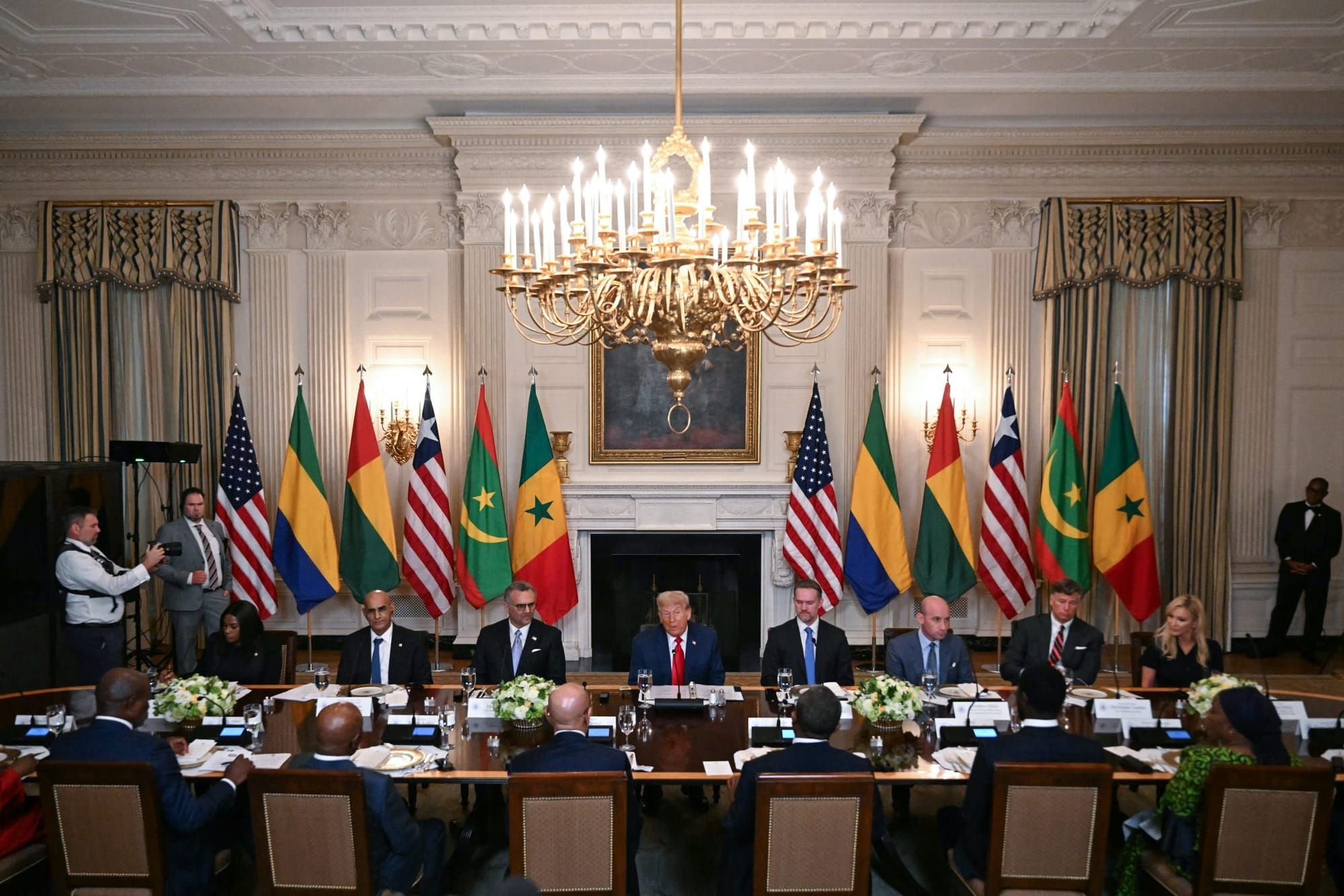
Tuggar’s comments came after a Wall Street Journal report quoted internal documents saying the Trump administration was pushing the leaders of Liberia, Senegal, Mauritania, Gabon, and Guinea-Bissau, who had recently met with Trump, to accept migrants deported by the U.S.
Earlier this month, Ghana, one of the four countries affected by visa restrictions, appeared to succumb to the pressure.
“We were approached by the U.S. to accept third-party nationals who were being removed from the U.S. and we agreed with them that West African nationals were acceptable,” Ghana’s President John Mahama told the BBC.
The unfolding situation highlights the changing dynamics of U.S.-African relations in the age of Trump’s “America-first” foreign policy agenda. Since coming to power for the second time in January, Trump appears to have replaced traditional U.S. foreign policy with transactional diplomacy.
Last month, at least three other African countries—Uganda, Rwanda, and war-torn South Sudan—struck deals with Trump’s administration to accept deportees from the U.S. But each of these countries already has enormous economic and social problems of their own, including internal displacement from multiple armed conflicts.
This reflects the grim reality facing sub-Saharan Africa—a region that is rich in resources and yet among the poorest in the world—that also accounts for the “migrant crisis” that emanates from it.
“Much of the problems facing Sub-Saharan Africa are not simply a product of failure of the local elite,” Nigerian public affairs analyst Zikora Ibeh told Prism in a written response. “They also reflect the role of the Global North, including Western corporate firms and imperialist institutions, particularly the US, in primitive accumulation, hostile resource extraction, environmental despoilation [sic], economic subjugation, and political interference.”
Ibeh said that the surge in African migration that Trump is ostensibly trying to curb is a crisis that is entirely of U.S. making.
“Instead of making it difficult for those fleeing poverty, wars, and persecution to be able to get out, what we need is a new global order anchored on equity, fairness, and justice,” Ibeh added.
Between 1980 and 2019, the population of sub-Saharan African immigrants in the U.S. surged from about 130,000 to about 2.1 million. The phenomenon, known locally in Nigeria as “japa,” or “escape” in the language spoken by the Yoruba, an ethnic group located in the country’s southwest, captures the desperation behind the surge. Nigeria accounts for the largest share of the African immigrant population in the U.S. The West African oil giant is also the seventh-largest source of international students to the U.S.
Foreign students applying to study in U.S. universities and colleges, including those from the four African countries targeted by Trump’s visa restrictions, will also face another new rule which subjects all international students who apply for F-1/F-2 visas to stricter vetting, including mandatory access to their social media activities for “any indications of hostility toward the citizens, culture, government, institutions, or founding principles of the United States.”
But, as Abimbola’s experience showed, “japa” is not the only reason Africans apply for American visas; sometimes, they simply want to reunite with friends and family members.
National security, Ibeh said, may be the official line behind the visa reductions, but “one only has to look at what is happening in the U.S. to doubt that it is the real reason.”
“The truth is that there is a growing tilt towards harmful nationalism, and many of the policies we are seeing now are manifestations of that trend,” Ibeh said. She also noted that the policy would unfairly target vocal public commentators and activists who use social media for social advocacy and critical engagement.
“Profiling immigrants from Africa won’t in any way reduce national insecurity,” Nigeria-based immigration lawyer Ayo Ademiluyi told Prism. He said the U.S. can only guarantee its national security by stopping Israel’s U.S.-backed bombing of Gaza and other military aggression against sovereign nations.
Editorial Team:
Sahar Fatima, Lead Editor
Carolyn Copeland, Top Editor
Rashmee Kumar, Copy Editor
Author

Taiwo Hassan is a Nigerian author and freelance journalist who lives in Lagos, Nigeria. Hassan's writing, which sometimes appears under the pseudonym "Obiora Ikoku" focuses on social movements and the
Sign up for Prism newsletters.
Stay up to date with curated collection of our top stories.