Nisolo promised ethical fashion before it went broke. Its former Peruvian factory workers are still waiting to be paid.
The handmade leather shoe brand was a darling of ethical fashion. Then it all came crashing down, and workers were left without severance payments
Real journalists wrote and edited this (not AI)—independent, community-driven journalism survives because you back it. Donate to sustain Prism’s mission and the humans behind it.
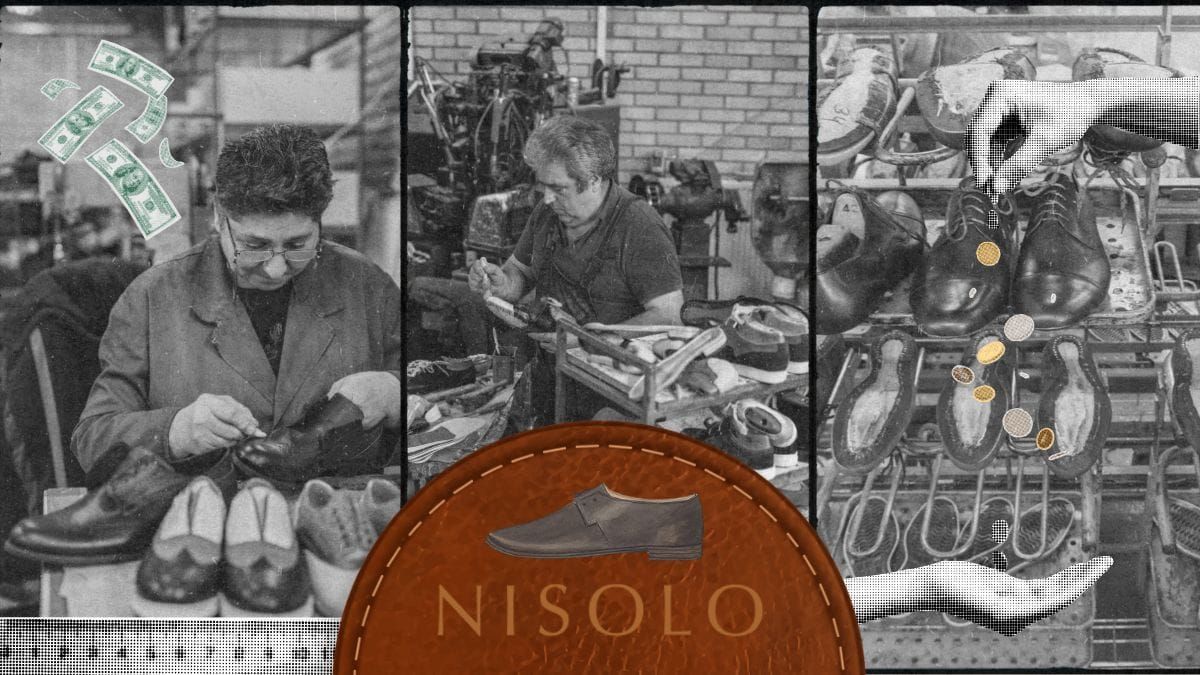
For years, Nisolo’s handmade, sustainably sourced leather shoes and bags made the company a darling of ethical fashion. Its oft-recounted origin story goes something like this: As a newly minted graduate from the University of Mississippi, Patrick Woodyard was in Trujillo, Peru, helping local businesses secure microfinance loans when he stumbled upon an artisan crafting beautiful leather shoes out of his home. Despite the craftsmanship, the local market for luxury shoes was small, and small-scale artisans couldn’t tap into markets in the Global North, where a desire for ethical, handmade goods was growing.
Woodyard believed he could solve both problems at once by setting up an e-commerce site that would connect Peruvian artisans to American customers with cash to spend. In 2011, Nisolo was up and running in Nashville, eventually employing nearly 100 workers at a dedicated factory in Peru.
Nisolo’s shoes came with a hefty price tag: Leather loafers or Chelsea boots could run upwards of $200. The brand promised that the higher price funded living wages and benefits such as health insurance and paid time off for its workers, who would otherwise have received low, per-piece rates at workshops.
“In its brightest moments, we intended for the factory to be a model for the industry at large—that fashion can operate differently, and we’re gonna do it right here,” Woodyard told Prism.
Alongside brands such as Everlane and Allbirds, Nisolo represented a new wave of “conscious consumerism” that blended style with social impact. But all of that came crashing down in 2025. As inflation and interest rates soared in 2024, and supply chain issues caused prices to rise, it became increasingly difficult to secure investments across the retail sector. Consumer spending declined as economic uncertainties abounded. The market for ethically produced, luxury leather goods was shrinking.
While the company’s financial woes weren’t publicized, loyal Nisolo customers began catching on, complaining that the company was no longer honoring its “Five for Five” program, which had allowed people to pay $500 upfront in exchange for 10 promo codes, over the span of five years, to redeem products from the website. In January, Nisolo was forced into a foreclosure sale by its lenders. The brand is now owned by a company called Project Bound, headed by a former Kate Spade executive. After the sale, Woodyard briefly served as Project Bound’s chief strategy and creative officer. He declined to provide details about the role, citing confidentiality clauses in his contract, and he is not currently employed by the company.
When the dust settled, factory workers told Prism that they were never paid the thousands of dollars in severance that they were owed when Nisolo stopped sending orders to the factory that produced its shoes, Creatra, which closed in July 2024 prior to Project Bound’s takeover. The exact amount owed is disputed between the workers and the factory owners, according to interviews with Woodyard and the workers, and the factory is in the process of tabulating each worker’s compensation based on tenure, which must then be certified by Peru’s labor department. According to Peruvian law, workers are owed 1.5 times their monthly salary for every year that they worked at the company, or for every month left on a fixed-term contract.
“I feel so disappointed with how everything ended,” Daniel Mercado Martell, who had worked at the company since 2020, told Prism over text messages in Spanish. “They treated us well within the company. … They always paid us on time.”
As much as Nisolo advertised itself as a different type of fashion company, on paper, its relationship with Creatra was typical of how larger fast fashion brands operate. Though Woodyard told Prism that the factory was a subsidiary of Nisolo, on paper, Creatra and Nisolo were separate legal entities with separate balance sheets, according to Woodyard and former Nisolo employees who spoke to Prism. The U.S.-based company that sold the shoes technically didn’t directly employ workers in Peru who made them.
Woodyard said that prior to the foreclosure sale, Nisolo’s management conducted a third-party audit, which suggested that a small number of workers were engaging in fraud and embezzlement at the factory via false invoices and over-ordering of supplies. (Prism reviewed a redacted version of the audit.) The resulting loss of hundreds of thousands of dollars was a huge hit to the company’s bottom line, he said.
Woodyard acknowledged that most of the factory’s workers were not involved in any fraudulent activities and are still rightfully owed severance payments—but by Creatra, not Nisolo.
“It’s a difficult reality, but Nisolo LLC did not have a legal obligation to pay the severance,” Woodyard said. “[With] us being behind on payments to lenders, it would have been unlawful for me to say, ‘We’re going to pay support payments to this entity that legally we’re not obligated for.’”
The factory’s general manager could not be reached for this story, and Woodyard alleged that he fled the region as Creatra wound down. But a business manager at Creatra, who asked not to use their name due to concerns about harassment and because they were not authorized to share the information, confirmed to Prism that workers were notified about the factory’s closure two weeks prior and given termination paperwork at that time, along with a written promise that they would eventually receive severance pay. A legal representative in Peru is currently managing the factory’s dissolution and selling off assets to pay Creatra’s debts, including benefits owed to workers, according to Woodyard.
Nisolo’s new CEO, Taryn Jones Laeben, told Prism that Project Bound is not responsible for the debts and liabilities incurred by Nisolo’s previous owner, as it acquired the brand name, not the company itself.
“We acquired Nisolo because we believe deeply in the original mission,” she said. “The factory in question ceased operations in July of 2024, several months before the acquisition. We were not involved in the management, payroll, or any related legal matters. We can’t comment on those, nor do we have any affiliation or information on those proceedings.”
Prism was not able to review the terms of the foreclosure sale. Project Bound said that when workers contacted the company’s new owners, they redirected them to “the appropriate channels,” but some workers contend that they never heard back at all.
In a written statement, Laeben also said that Project Bound “cannot retroactively fulfill prior commitments” to customers in the Five for Five program and that it had been discontinued prior to the acquisition. Woodyard said that prior to the sale, he “incorrectly anticipated” that the program would continue under new ownership.
Dream turned into a nightmare
The fashion industry is rife with labor rights abuses. Garment workers in Bangladesh, for example, supply products to some of the largest Western fashion brands in the world, and yet most workers are paid the equivalent of $113 a month working for a $38 billion export-oriented industry.
Within Nisolo, by and large, workers at the factory in Peru agreed that their experiences were positive before the company’s financial woes became apparent. Marlon Terrones, who worked at Creatra for seven years, said that he appreciated the relaxed culture.
“We felt that the products we made with our hands reached people in another country who loved them, and we were making a product that benefited the planet,” he told Prism over text, in Spanish.
Growing up in Trujillo, Terrones said he was surrounded by leather workshops and started working at one as a teenager. “I really liked the smell of the leather, and the process of making a shoe from start to finish,” he said. But there were few options for steady work until Creatra started hiring. The job at Nisolo allowed him to start taking human resources classes at a local university while he supported his family.
For Carmen Rosmary Pacheco Polo, a single mother, the regular office-day hours and salary she received as a supervisor—a bit higher than Peru’s minimum wage—meant that she could spend more time with her son.
Juan Rodriguez, who worked as a cutter at the factory, said that when he injured his hand while using heavy machinery, Creatra helped arrange for his surgery and other medical consultations. If he’d been independently employed, he said, he likely wouldn’t have received that help.
Over the years, Nisolo collected a litany of accolades from fashion magazines, business outlets, and sustainable living blogs, including Fast Company and Vogue. Emma Watson, the actor of “Harry Potter” fame, wore Nisolo flats during a United Nations humanitarian trip. GQ and The New York Times’ Wirecutter put Nisolo’s shoes on their best-of lists, along with well-known brands such as Everlane and Teva.
Even after the COVID-19 pandemic slowed retail sales, Nisolo was growing. Woodyard said that the company was pulling more than $30 million in revenue by 2022. Its investors, primarily angel investors and venture capital firms, encouraged the company to continue pursuing growth even though the company was just breaking even, according to Woodyard.
“The idea was the more we grow our top-line and the overall footprint of the business, the more we’re going to be able to increase our social impact too,” Woodyard said.
When Creatra shuttered, the stability that workers had built up for themselves slowly started crumbling. The factory’s owners said they would pay workers their severance, equal to a few months’ full salary, in small installments over the span of two years, instead of the customary lump sum. For workers, that was highly impractical. Severance is meant to function like unemployment benefits, helping workers pay bills while they look for a new job.
Terrones decided not to take the offer and hired a lawyer instead, worrying that he would be shortchanged. He was unemployed for nearly five months and eventually dropped out of school. These days, he works night shifts as a security guard at a hospital. “I miss it a lot,” he said, adding that some of his neighbors are still in shoemaking. “I see how they work, and I can’t help but feel nostalgic.”
Mercado Martell, meanwhile, said he took out loans to support his family, and he’s had a hard time paying them back with irregular work at two different shoemaking workshops in Trujillo. “In the summer, they only make sandals. That doesn’t work for me, because they pay very little,” he said. He is paid for each pair he makes, not for the hours that go into making the product.
Other employees, like Pacheco Polo, accepted Creatra’s installment plan. She couldn’t afford to hire a lawyer and wait for court dates. For a few months, the installments were deposited into her accounts. She took a series of odd jobs, cleaning houses and working at a restaurant where she and her son could also eat meals. Then, this past summer, she stopped receiving deposits. She called Nisolo’s local offices, but no one picked up the phone.
The Creatra manager confirmed to Prism that some workers who accepted the plan had not received the installment payments, and that other employees who hadn’t signed the agreement haven’t received any money.
“I’ve seen that they’re complaining, and they’re within their rights,” the manager told Prism via text message.
Disjointed accountability
Nisolo’s structure and the liability around severance aren’t surprising, even for a small brand committed to ethics and transparency, said Ben Hensler, general counsel and deputy director for policy and research at the Worker Rights Consortium (WRC). The organization has advocated for garment workers around the world, fighting some of the largest global fashion brands based in the U.S. and Europe.
“The model of manufacturing is intentionally structured so that the brands that are selling the clothes are not legally responsible for making sure that the rights of the workers who make the clothes or make the shoes are respected,” Hensler said. “Workers only legally have a claim against this factory that employed them, even though they were making shoes that were being sold by someone else. But that factory has gone belly up and has no assets.”
That’s why the consortium pressures big brands to pay out wages and benefits, even under such legal arrangements. Recently, for example, WRC helped workers secure a $1.5 million settlement with American Eagle, Lucky Brand, and Puma after a factory that subcontracted with those companies shut down and didn’t pay out severance.
“[Severance checks are] the most amount of money that workers will ever see in one place in their lives,” Hensler said, given that most garment workers live paycheck to paycheck. “It helps them weather the loss of the job, and it’s a nest egg: People start their own small businesses or get their kids educated.”
Pressuring prominent brand names, including Nike and Adidas, has proven to be a successful tactic over the past 15 years, he said. But when an independent factory goes out of business, it’s nearly impossible for workers to get money out of the bankrupt business.
Brands understand that the most valuable thing they have is the image of their company. The question is, when something irresponsible happens in their supply chain, do they live up to that responsibility?
Ben Hensler, Worker Rights Consortium general counsel
“Brands understand that the most valuable thing they have is the image of their company,” Hensler said. “The question is, when something irresponsible happens in their supply chain, do they live up to that responsibility? And they usually don’t, unless it’s put out there in public.”
The fact that workers are still bearing the brunt of the fallout doesn’t sit well with former employees who worked closely with Woodyward to champion Nisolo’s ethical framework.
“It’s hard to imagine a world in which [Project Bound] didn’t know the debts and liabilities they were inheriting,” said Matt Stockamp, who worked at Nisolo for just over a decade until 2023. When the company was first starting up, he spent a full year living in Trujillo and setting up programs for factory workers, including health and personal finance classes. In 2020, he helped raise funds for workers during pandemic shutdowns.
“Workers are owed those [severance] payments,” Stockamp said. “That does haunt me.”
He said that after deciding production would be ending in Peru, Nisolo ideally should have found a way to put together a package for workers to receive payouts immediately.
Terrones, as one of the few former Nisolo workers who speaks some English, has tried to advocate for his former colleagues by posting on social media about their plight.
Nisolo’s social media accounts, meanwhile, were scrubbed of old posts some time after the sale. In June, new photos and videos on its Instagram account declared, “New look. Same sole.” The company touted its continued commitment to sustainability and fair labor standards under new leadership. The ads still displayed Nisolo’s B Corp certification, which rates companies on metrics such as sustainable practices, living wages, and transparency. Nisolo was quietly removed from B Corp’s online directory of sustainable companies. B Corp declined to provide a comment for this story, while Project Bound told Prism it is working with B Corp to renew the certification.
To see Nisolo move on is painful for the Peruvian workers left behind, who care little about the distinction between the brand and the factory
“When I see them keep saying they’re ethical, it infuriates me, and I feel mocked,” Terrones said.
Editorial Team:
Sahar Fatima, Lead Editor
Carolyn Copeland, Top Editor
Rashmee Kumar, Copy Editor
Author
Amal Ahmed is an environmental reporter based in Southwest Washington. Originally from Dallas, she has had her work published in the Texas Observer, Texas Tribune, Popular Science, Grist, and more.
Sign up for Prism newsletters.
Stay up to date with curated collection of our top stories.