Queer and trans organizers in Newark link environmental injustice, redlining, and the racism at the root of it all
While locals could not stop the construction of a fourth fossil fuel power-plant facility in the Ironbound neighborhood, their efforts illustrate their broader fight for a better world
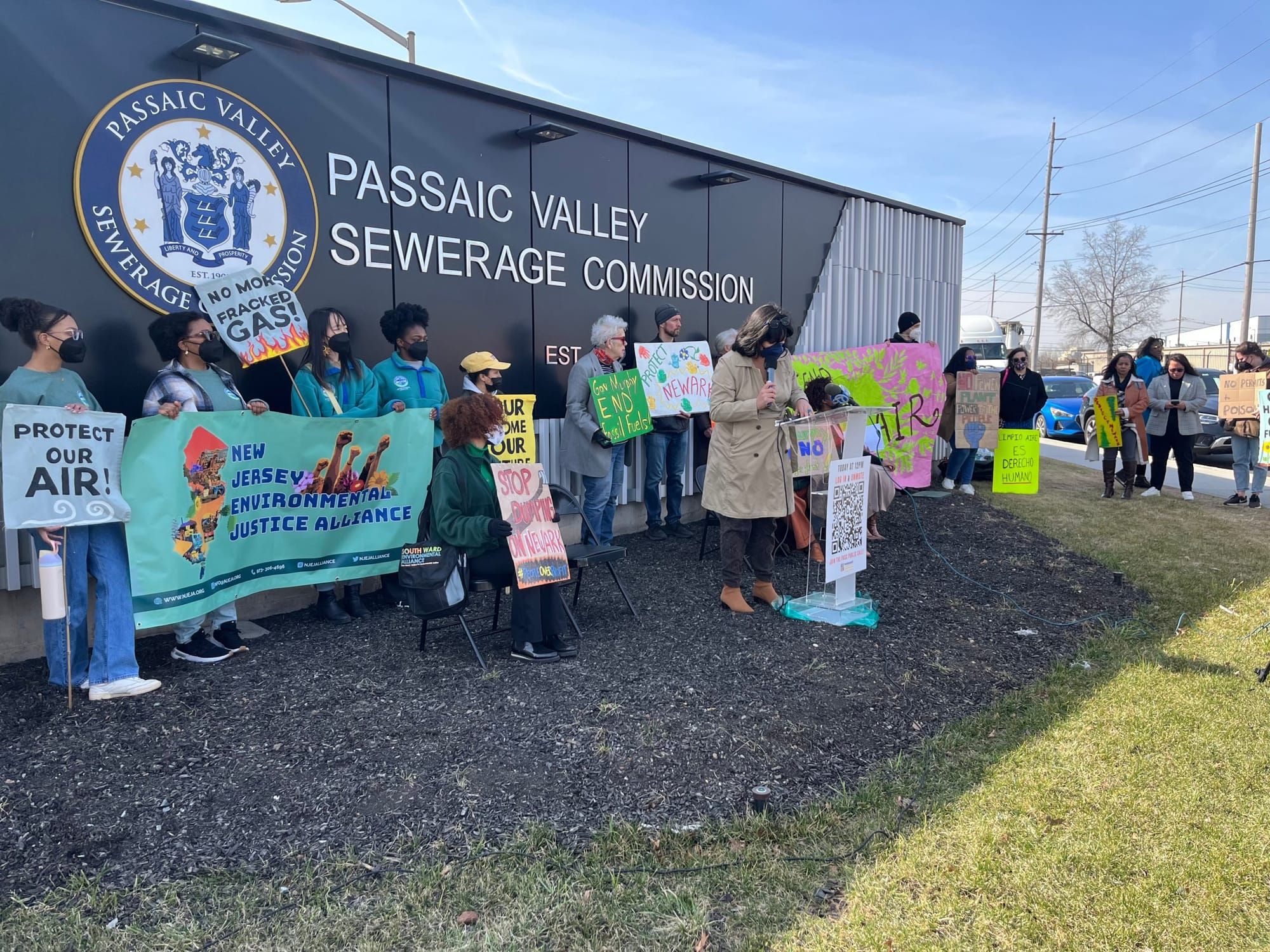
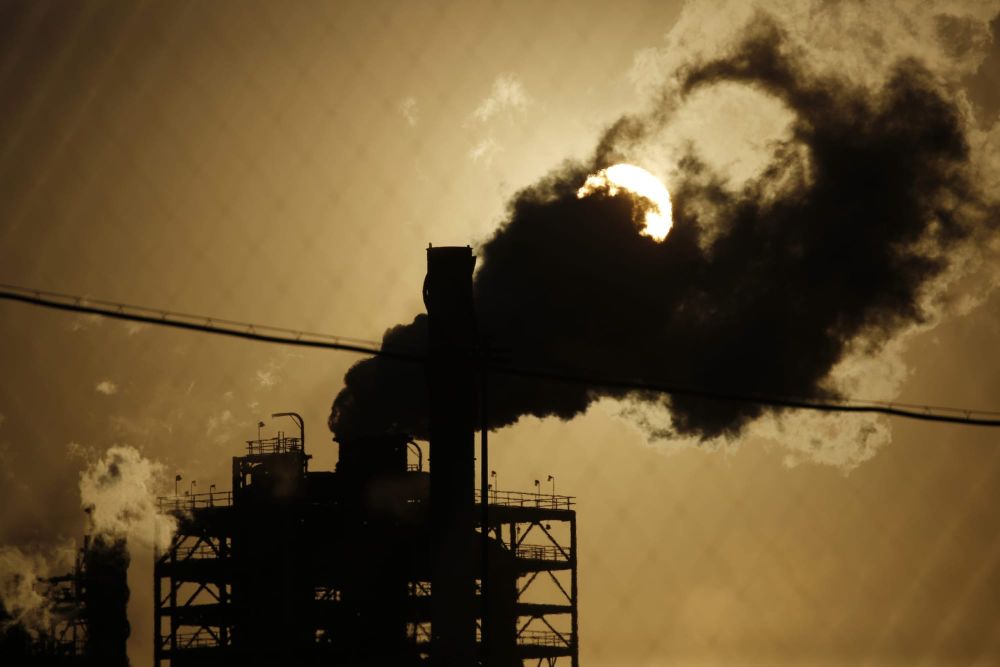
On a hot spring day in March, diesel trucks rumbled by, puffing black smoke that rippled hot over people’s heads as they gathered in Newark, New Jersey, for a press conference in front of the Passaic Valley Sewerage Commission (PVSC). The sewerage plant’s putrid fumes joined with the exhaust of two neighborhood power plants and a garbage incinerator, producing a nose-pinching smell that never seemed to clear.
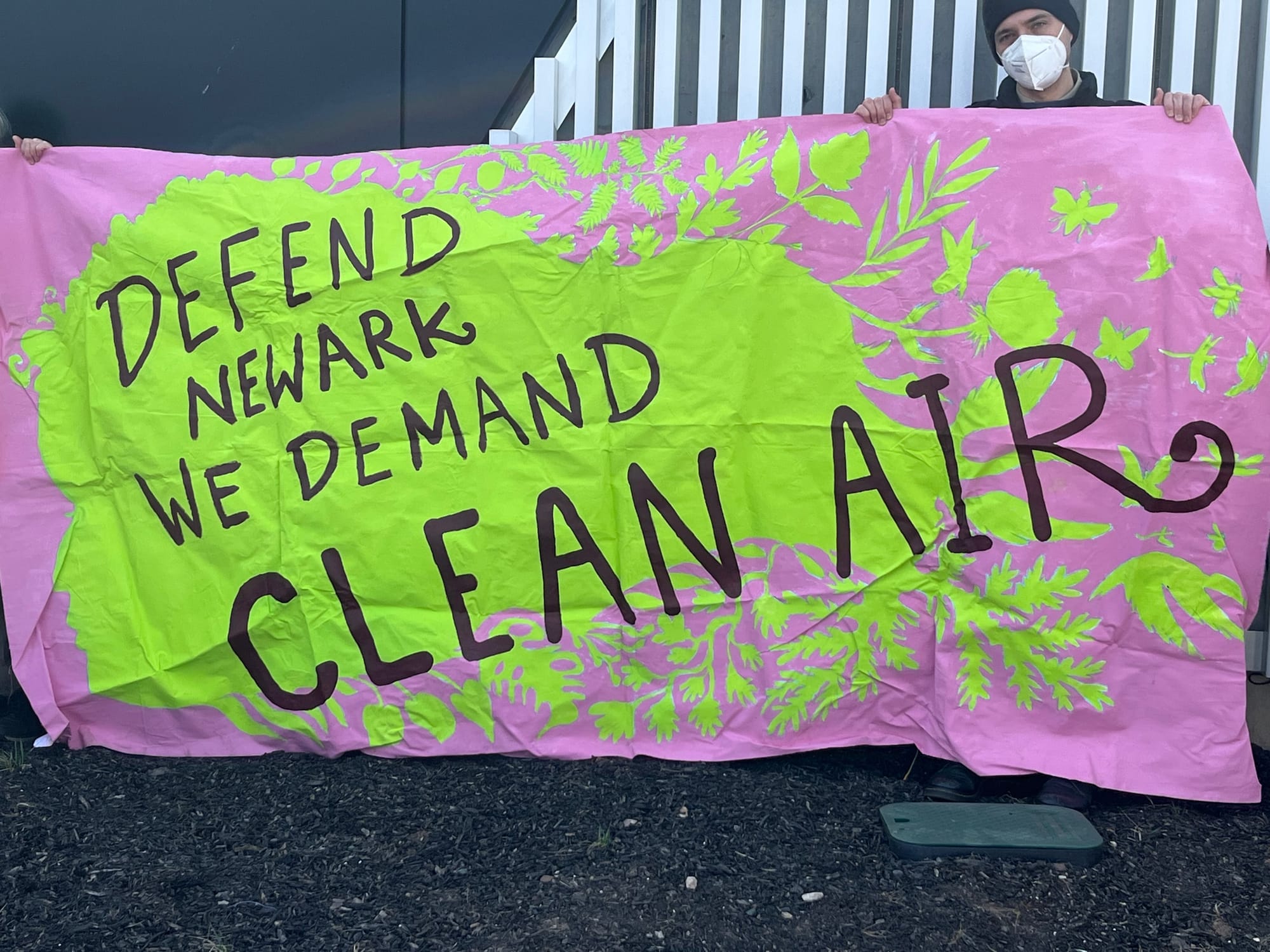
Determined activists, politicians, and concerned residents gathered. Some put on air-filtering masks as they lined up in front of cameras. They held colorful signs, one of them neon pink and green that read: “Defend Newark, We Demand Clean Air.”
The press conference was led by former Ironbound Community Corporation (ICC) policy analyst Chloe Desir and communications lead JV Valladolid, both of whom are also environmental justice organizers with the direct-services organization. For years, ICC has organized to oppose the building of a fourth fossil-fuel power-plant facility in the Ironbound, a 50,000-person neighborhood in Newark burdened by redlining.
“It feels like everyone is fed up across the country,” Valladolid told Prism in an April interview. All over the country, renewable energy is falling short, including in Newark, where the state is failing to meet its 2030 goals.
The plans for the fossil-fuel-fired plant have been underway since Superstorm Sandy in 2012 shut down the state’s sewerage plant, inadvertently dumping 840 million gallons of raw sewage into the Passaic River and the Newark Bay. For the last four years, activists have asserted the proposal for the plant is outdated, given the grid’s multibillion-dollar upgrade that was scheduled for improvements in 2014.
The Ironbound is “a community of Black and brown leaders, of immigrant families, of queer and trans people,” Valladolid said at the spring press conference. “It’s a community that, as a pregnant person, I plan to raise my family in.”
Valladolid is a native Newarker, first-generation American, and member of the LGBTQIA+ community whose parents descend from the Andes. To Valladolid, their lived reality is connected to the fight for environmental justice, an imperative for a better world for all people and living things.
“[I feel] like being able to have that resilience really empowers resistance from the oppressing powers that be,” Valladolid said.
Despite the opposition, the New Jersey Department of Environmental Protection approved the plant in July 2024, and last month, PVSC voted to construct the facility. These developments were a major blow to the years of work fronted by a community sick of persecution by way of environmental racism and injustice. PVSC did not respond to a request for comment by publication time.
Desir, who is queer, is deeply rooted in racial justice advocacy for a number of organizations, such as the Black Cultural League. She moved from Elizabeth to Newark, where she started her role in environmental justice organizing and eventually became a policy analyst at ICC.
The fight against the plant is just one of the many Valladolid and Desir have embarked on to protect New Jersey’s “last affordable city,” as Valladolid tends to call it, from the continued violence of redlining and environmental injustice. There’s a spirit for liberation within the communities of Newark, a glance at the future, that the ICC labors to nurture.
But in order to understand how redlining and queerness intersect, it’s imperative to understand how redlining came to exist.
As the U.S. came out of the Great Depression, governments enacted policies that filtered who and which communities deserved to persevere out of poverty, and who’d become further and generationally entrenched in it. Today, the same Black, brown, immigrant, and queer populations are neglected, leading to human rights and environmental violations that continue to unfurl in Newark.
‘Pernicious long-term generational effects’
Under President Franklin D. Roosevelt, the New Deal ushered in social programs to assist people after the Great Depression. These political reforms included the National Housing Act of 1934, which enabled low-income families to finance their homes under the guidance of the newly established Home Owners’ Loan Corp. (HOLC).
Upon formation, HOLC created “residential security” maps based on investment and mortgage “lending risk.” If an area was deemed “hazardous,” it showed up on the map as red. Yellow was the next bracketed neighborhood class line. In these two brackets, homeowners were denied loans to invest in their properties, and these neighborhoods were relegated to societal and political violence and abandonment. Meanwhile, green and blue areas regarded as “safe” or “valued” were where the investors, white collar workers, and businessmen of white-majority suburbia lived.
Redlining wasn’t necessarily about divesting from U.S. communities with the most defaulted mortgages. Redlining and suburban white flight happened in unison as the U.S. government and other investment partners further incentivized segregation by devaluing communities based on class, race, immigration status, and ethnicity, rather than on the merit of their labor.
These discriminatory practices laid the groundwork for the roadmap leading to Newark’s current reality as an overburdened community, pushed far out into the margins of society while carrying the weight of the rest of the state on its back.
“And this then has these sort of pernicious long-term generational effects in terms of public health,” said Mary Rizzo, an assistant professor of history at Rutgers University–Newark and a volunteer with Queer Newark Oral History Project.
“For example, those redlining maps became the sort of basis for things like the building of highways in the 1950s and 1960s, and so highways are often located along and through redlined areas because they are devalued.”
The same goes for where airports, power plants, and garbage incinerators are located. The effects of this urban planning cause increased rates of childhood asthma, infant mortality, and cancer.
In Newark, it’s estimated that one-fourth of children have asthma, far outpacing the national average, according to Rutgers School of Public Health. From 2017 to 2021, Newark’s infant mortality rate was 6.8 for every 1,000 live births, reported Patch News. In 2020, similar to the national average, Essex County’s cancer mortality rate was 13 deaths per 10,000 residents, reported the New Jersey State Cancer Registry.
The echoes of the New Deal’s redlining continue to chronically harm the same communities originally targeted by the people in power. This is a precise example of environmental racism’s stench, said Desir.
Redlining was outlawed in 1968, but the practice continues today in the form of continued disparities in mortgage lending. In a country that denies communities environmental justice, wealth, and housing distribution, it seems that nothing will change.
Climate change is exacerbated by fossil-fuel facilities, which, like highways, governments purposefully establish in specific communities. Even with complete opposition from local residents and officials such as Newark Mayor Ras Baraka, Newark City Council, and Assemblywoman Eliana Pintor-Marin, the fourth power plant is still underway.
“And [PVSC is] still considering this?” Desir said, dismayed. “There can’t be any other narrative to look at, aside from the fact that [PVSC is] considering profit over people, and that’s a precise example of what environmental racism is.”
Like many movements nationwide, interwoven into Newark’s fight for environmental justice are queer, transgender, nonbinary, and gender nonconforming community members.
According to Valladolid, who has also organized for reproductive justice, Newark’s LGBTQIA+ communities are active in the city’s fight for environmental justice because they understand what it means to be abandoned.
“[W]e’ve been failed by political systems, by policies, by funding that leaves our communities when we need it, and having to figure out how to keep going,” Valladolid said.
This is why Valladolid, Desir, Rizzo, and other LGBTQIA+ Newark residents are fighting for the future they want for today’s young people and those still to come.
Stress points
Similar to redlining, there was another pervasive practice used to segregate LGBTQIA+ people: lavender-lining.
In a 2018 essay, urban historian and Associate Professor of Architecture at New Jersey Institute of Technology Gabrielle Esperdy connected lavender- and redlined neighborhoods to systems of devaluation.
“Though the rainbow flags hanging from building facades and displayed in store windows suggested unity, fissures were already apparent between the well-heeled retail establishments catering to mostly middle-class, mostly white gays and lesbians and the social service organizations catering to at-risk LGBT youth and homeless people with AIDS, who were mostly Black and Latino,” Esperdy wrote. “New York’s gay mecca may have celebrated its diversity across class, race, and gender, but this was also a neighborhood whose stress points were becoming as visible as the queer folk themselves.”
Post-World War II, demarcated areas such as the West Village in New York City or the Castro in San Francisco became refuges for homeless youth, while also existing as epicenters of queer expression and celebration. Now “straightened” by gentrification, there is an undeniable history of the people hidden by the broad ban of discrimination of the status quo. And these “queer places existed in cities both large and small in every part of the country,” Esperdy wrote.
According to the historian, there is also evidence that suggests gays and lesbians frequently “settled in, worked in, or frequented neighborhoods devastated by the post-war cycle of deferred maintenance, disinvestment, and (straight, cisgender) white flight that redlining intentionally exacerbated.”
Understanding this overlap, Rizzo and her colleagues at Rutgers worked with the Queer Newark Oral History Project to untangle this ongoing history.
As part of an interview for the oral history project, longtime gay rights activist Laquetta Nelson discussed her organizing efforts and the “historical stuff” that kept her community disconnected from Newark’s white LGBTQIA+ communities in the 1970s.
“What I wanted to do was try to bridge the gap between the Black LGBT [communities] in Newark and the white LGBT [communities] that I was working with in the coalition, because they were separate,” she explained.
Nelson later established the Newark Pride Alliance, a space to organize for safety after the tragic 2003 murder of 15-year-old Sakia Gunn, a Black lesbian killed as part of a hate crime.
The work of Newark residents such as Nelson has been undervalued or ignored for too long.
“What I’ve really tried to do is figure out how to take those stories and then connect them with wider audiences,” said Rizzo. Along with other members of the Queer Newark Oral History Project, Rizzo is also working to capture the multifaceted work and history of the city’s new generation of LGBTQIA+ activists, including Valladolid and Desir, clearly highlighting the links between queer and trans rights, environmental justice, gentrification, and other issues.
“I mean, environmental justice is gay,” said Desir, who often gets into long conversations with Valladolid about the intersections of queerness, environmentalism, and redlining.
It’s not a coincidence, Desir noted, that most of the environmental justice conferences she goes to radiate queerness. As a Black, queer woman invested in environmental work, Desir said it’s meaningful that these spaces exist.
Today, Desir and Valladolid’s hope lies with connective struggles that underscore the intense relationships between privilege and oppression. According to Valladolid, people are connecting the dots more easily these days. The activist makes throughlines between the local increase in detention and the reopening of the Delaney Hall detention center, to the approval of the power plant, and the insidious racism that is the root of it all.
Under the Trump administration, as these connections are more apparent than ever, Valladolid said they are hoping things will soon hit “a turning point.”
In the meantime, the activists who spoke to Prism said they remain committed to organizing work that addresses the needs of those who are forcefully pitted against each other, with the understanding that our liberation is bound together.
Editorial Team:
Tina Vasquez, Lead Editor
Carolyn Copeland, Top Editor
Stephanie Harris, Copy Editor
Author
Lana Leonard (they/them) is a transgender, nonbinary freelance multimedia journalist, and social justice activist based in New York City. Their words have shown up in Assigned Media, LGBTQ Nation, Th
Sign up for Prism newsletters.
Stay up to date with curated collection of our top stories.