Drowning: New Orleans’ water utility is under attack from all sides—and within
The Sewerage and Water Board has been at the center of multiple scandals and crises—none of which are more alarming than the utility’s inability to prevent rainwater from wreaking havoc
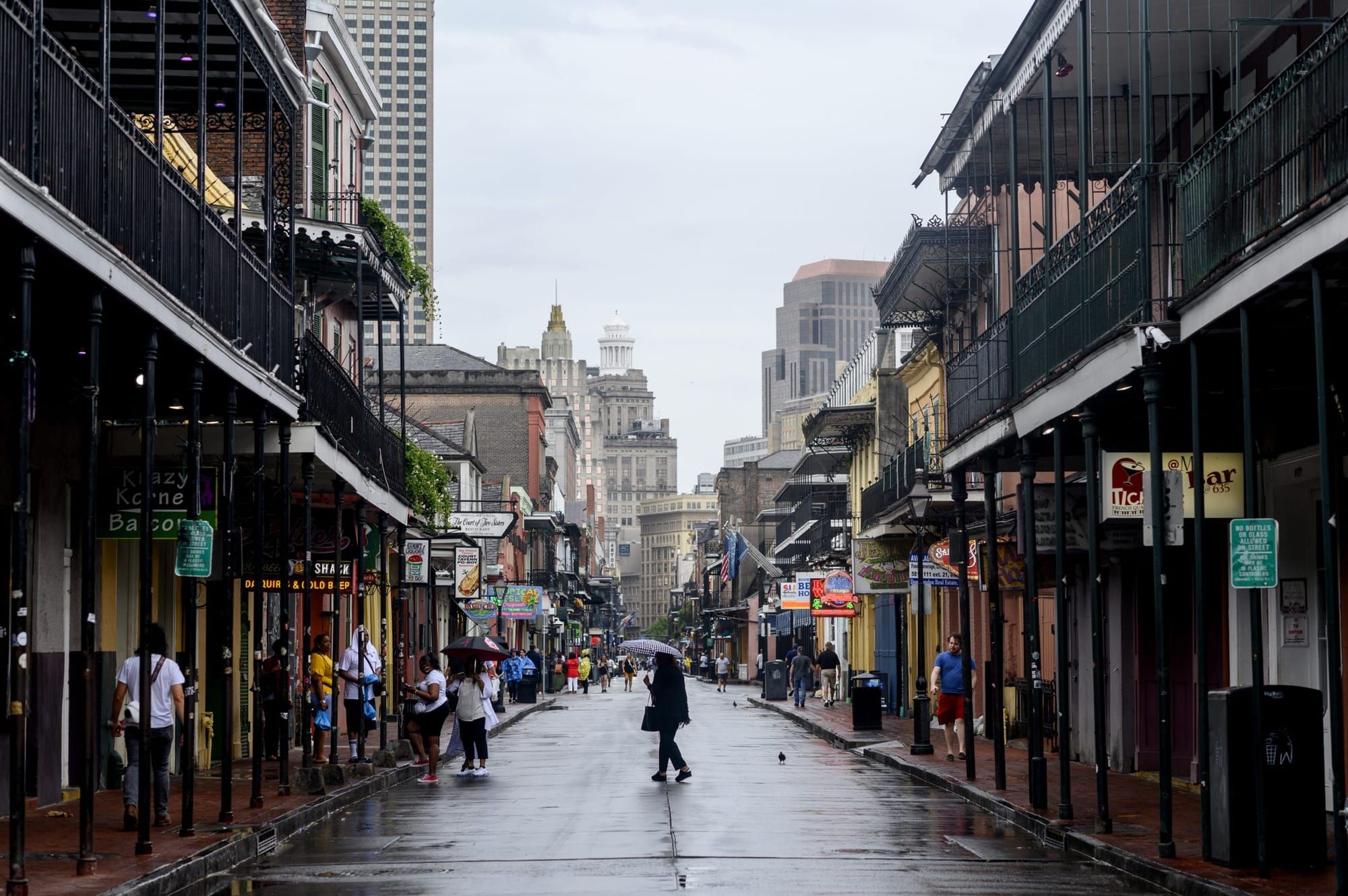
As New Orleans prepared for Hurricane Barry on July 10, 2019, the city experienced a freak downpour. For over six hours that morning, the Crescent City was inundated with seven inches of rain, submerging cars and streets and overwhelming water pumping systems. By noon, the bustling Central Business District experienced nearly a foot of rain.
Neighbors on Banks Street frantically tried to move their cars to higher ground, the same emergency measures they’d undertaken two months earlier when another unexpected deluge threatened their vehicles with more than five inches of rain and knocked out power for 11,500 people.
The next day, news outlets warned that New Orleans was in grave danger. Hurricane Barry, 48 hours away, could bring a three-foot storm surge and 10 to 12 inches of rain. The Mississippi River, which usually averaged seven feet deep in summertime, was already at 16 feet—more than double its typical size—and could top out at 20 feet. Regardless of whether the river overflowed, there could still be two feet of water on city streets. As residents were well aware, area levees could only keep 20 to 25 feet of water out of the city—and that was if the walls didn’t collapse, as they did to devastating effect in 2005 during Hurricane Katrina, when residential neighborhoods were almost completely submerged beneath 10 to 15 feet of floodwaters.
“Look, there are three ways that Louisiana floods: storm surge, high rivers, and rain,” then-Gov. John Bel Edwards warned. “We’re going to have all three.”
The city, even on the “high” ground of five feet in the French Quarter, was in jeopardy. Residents turned to the Sewerage and Water Board, the utility in charge of pumping precipitation out of Orleans Parish and preventing another Katrina. The “SWB,” as locals call it, was still dealing with fallout from a 2017 storm that swamped the city with nearly eight inches of rain in a single afternoon. At that time, more than a dozen pumps were nonfunctional, and only 40% of the turbines were operational; knee-deep water remained throughout the city for hours after the storm. Furious residents demanded changes at the utility. Surprisingly, the city obliged, ousting four public officials, including the SWB’s executive director.
Hurricane Barry mostly missed the Big Easy, and the water from the July 10 torrent quickly drained away. But this did nothing to quell the storm brewing inside the SWB, where, just weeks earlier, higher-ups successfully kept a scandal from seeping out into the media.
Scandal trifecta
In June 2019, the SWB discovered a payroll fraud conspiracy inside the Carrollton Avenue plant that oversees New Orleans’ water purification. It turned out to be only the first of several dominoes to fall.
First, several employees and managers allegedly conspired to gift themselves extra overtime and “chemical pay” they didn’t earn for handling hazardous materials. Three employees were reportedly investigated internally, which turned up others as potentially involved, but when an SWB investigator recommended firing and prosecuting them, only one employee was disciplined. However, the firing was reversed, and the SWB allowed the employee to retire with $39,000 in back pay and agreed not to ask the district attorney to prosecute. When the story broke in 2023, Ghassan Korban, who took over as SWB executive director following the 2017 flooding, said the deal was made to keep the employee from potentially winning back his job. Another employee involved in the conspiracy retired a few years later, and a third, Steven Ware, was promoted twice over the next four years. When the story finally came out, the press report alleged “favoritism, retaliation, unsafe working conditions, and unchecked harassment,” naming Ware as partly responsible for the toxic work environment.
At the time, Korban said he wasn’t aware that Ware had been promoted, telling the media that he would force Ware to take a three-day suspension. In the same news report, Korban lamented that the SWB couldn’t pay more, suggesting that low pay led to lackluster employees.
Nicol Jackson, a SWB employee, asked to be transferred in May 2019, accusing her supervisor, Brandon Plains, of cursing her out, sexual harassment, and not leaving her alone when asked. The SWB Board agreed to the transfer, sending Jackson to a different location away from Plains’ oversight. “However,” the panel of judges wrote, “the Board later transferred Ms. Jackson back to the previous location to address staffing shortages. The Board reasoned that because there were no further reports of continuing issues between Mr. Plains and Ms. Jackson, the transfer back was acceptable.”
But when the two began working together again in early 2020, Plains allegedly tried to run Jackson over with a company car. This time, Jackson showed the board two clandestine video recordings of her boss. Plains was suspended without pay and then fired. Prism only discovered this incident because Plains petitioned the Louisiana Court of Appeals to overturn a Civil Service Commission decision that reinstated Plains. The court overruled the commission. Prism could not reach Jackson or Plains for comment.
While these scandals barely made a dent in the media, the city obsessed over another story: the “secret sex room” at the Carrollton Plant. A whistleblower complaint Jackson filed in 2021 alleged that Ware and his “favorite employees” cordoned off a room at the SWB to be used for sex—both on and off the clock, with both employees and nonemployees. The room was stocked with a TV, fridge, and microwave, and there were reportedly framed pictures of naked women set on a shelf. Jackson claimed that there were two “sex rooms”—one may have been intended for sleeping on work breaks—and that Ware had used SWB internal funds to build them. When Korban learned of the complaint, he immediately had the room padlocked and broken down.
Just days after the SWB became embroiled in scandal, the freak July 2019 downpour destroyed vehicles all over New Orleans.
The ‘fiscal cliff’
In the years since, the SWB’s crises have only increased.
In April 2024, a photo of an SWB truck trapped in a flooded street went viral. That September, after Hurricane Francine grazed the area and left behind seven inches of water, one SWB customer told the media that it was the fourth time his house flooded. He blamed the SWB for patch jobs instead of outright fixes. After Francine, the SWB warned that stations in charge of transporting wastewater to its treatment facility were experiencing power issues, advising residents to limit running water. That same month, a grand jury indicted a SWB employee for allegedly “double-dipping,” fraudulently collecting full-time wages from the board and the New Orleans Police Department and lying to the FBI about it.
Such stories could appear almost weekly without surprising New Orleans residents, and apathy has set in, with locals convinced that it’s only a matter of time before a system-wide pump failure leaves their cars and homes submerged by a passing shower.
With universal contempt in Louisiana for the SWB, why has it proven so difficult to fix the utility?
The Sewerage and Water Board of New Orleans has an 11-member board of directors appointed by the mayor, who is board president. Actions such as ousting board members or making serious changes to the board must be approved by the mayor. The mayor’s office did not respond to a request for comment.
The GOP-controlled Louisiana State Legislature—which rarely needs an excuse to stick it to Democratic-heavy New Orleans—waffled on taking action after the sex room and fraud scandals. Members of the New Orleans City Council and the Louisiana House collaborated on an agreement that would have given the City Council more oversight of the SWB, but Democratic Mayor and SWB Board President LaToya Cantrell and Korban, the SWB executive director, testified against it. The Cantrell administration promised the City Council that it would hold a state of the utility meeting regarding the SWB’s faltering drainage system. It never happened.
“There’s no project managers or asset management checks and balances built in, so it’s no wonder as to why things have a tendency to flop,” Ricky Twiggs, a candidate for mayor this year, told Prism.
The sex room is a symptom of archaic leadership styles and no visibility from the city or the general public.
Bob Murrell, New Orleans city council candidate
“Ultimately, corruption continues to exist in SWB because it’s run as a political fiefdom that has access to significant sums of money with little to no oversight,” wrote Bob Murrell, candidate for City Council, in an email. “Low-level employees try to do good work under awful conditions from poor management and neglect. The sex room is a symptom of archaic leadership styles and no visibility from the city or the general public.”
A task force on the SWB’s future—assembled by the new right-wing Louisiana Gov. Jeff Landry—claimed that 90% of residents would vote “no confidence” in the SWB. The SWB, however, is known locally to have excellent customer service; they answer phones almost immediately and put high bills on hold for investigation without much resistance. In 2024, 4,600 SWB accounts were in dispute and 26,000 customers were reportedly behind on payments—collectively more than one-fifth of all accounts in New Orleans.
But residents aren’t satiated by the incremental changes in oversight or by the idea of new smart meters, which are meant to prevent billing disputes like the one a Central City resident experienced last year when he received a $40,000 billing statement.
The governor’s SWB task force, which did not invite any New Orleans elected officials to collaborate, released a report last year that proposed remaking the board so the sitting mayor no longer helmed it. State lawmakers would likely support such a change, as Cantrell, who is term-limited and will be replaced in November’s elections, is widely disliked. The report also punted on what to do with tax-exempt businesses. The city misses out on roughly $123 million in revenue from exempt properties, or 38% of all properties annually.
The SWB relies on property tax millages to operate, and the millages that provide a large share of the funds to run the board are in danger of expiring. Residents—more than 7 in 10 of whom disapprove of the board’s work—will vote next year on a property tax renewal to cover $20 million in drainage costs. Korban told NOLA.com that in the 1990s, one millage for the SWB was shot down by 85% of voters. By 2027, all three millages are set to expire, which would cost the SWB $70 million.
“It seems historically any additional funding that the SWB receives isn’t used to improve the current infrastructure,” Charlie D., a former resident who asked that only the first initial of his last name be used, said in a text message. When asked how he’d vote on the millages, he responded, “Probably no.”
Twiggs, the mayoral candidate, said budget shortfalls would only worsen the SWB’s struggles.
“That fiscal cliff is real,” he wrote in an email, noting that Hurricane Katrina recovery funds will soon expire, along with American Rescue Plan COVID-19 relief funds and other federal funding.
“If we fail to spend these dollars wisely before their deadlines, they will vanish—and so will our opportunity to easily begin to fix broken systems like the S&WB and ensure basic city services for generations to come,” Twiggs wrote.
Local reporting from earlier this year outlined how dire the situation is for the SWB and by default, New Orleans residents: “Hundreds of miles of water mains need to be replaced. Water treatment facilities need to be outfitted for saltwater intrusion. The drainage system, already in terrible shape, isn’t designed to handle increasingly ferocious rainstorms.”
‘Designed to fail’
The SWB is on the precipice of disaster in the face of those “increasingly ferocious rainstorms.”
The board’s system is powered by antiquated equipment that uses a lower frequency than the one produced by Entergy, New Orleans’ electrical provider and thus, cannot pull power from the grid and requires that it manufacture its own. For instance, the turbine known as T4, a crucial source of power to the pumps, runs purely on steam produced by the SWB. In recent years, T4 has gone down repeatedly, including from February to mid-July 2024. It would require tens of millions to permanently repair T4, Twiggs said, and this isn’t even the biggest issue with T4.
“There is one pump that’s super old,” he said, “but the other pumps are relatively newer. The problem, though, is that the generators are not good, and so they keep failing, and then the pumps themselves can’t sustain and then they fail.”
On the rare occasions he speaks about the SWB publicly, Landry hints that his administration is unwilling to pony up to fund these critical projects. “It’s easy to say we need $29 million,” he said in August, after the legislature declined an SWB request for that amount. “This area has received billions of dollars, and the question is, why are we in the same position?”
According to Twiggs, it’s easier for the governor to scare residents into believing a narrative than it is to spend necessary money that is within the state’s budget.
“My God, we have a ton of money from Covid relief just sitting here… money just from natural disaster relief just sitting in our war chest as a city, and we haven’t spent a dime of it,” Twiggs said. “We need to start using that money before [the Trump administration’s Department of Government Efficiency] comes looking and takes it.”
In February 2024, Landry’s task force made a recommendation that was actually accepted by the SWB: have the board handle the cleaning of the city’s small pipes and its 72,000 catch basins. The catch basins, when clogged with debris, can themselves be a source of street flooding. If a few inches of rain land on a residential street, there might be nowhere for the water to go. It’s been more than three decades since the last routine cleaning, and according to the board, it would need $25 million for such annual clean-outs.
Other ideas from experts were only half-adopted. When the City Council approved partial funding for a new substation to help with drainage, council members ignored a suggestion from the local water management nonprofit, the Water Collaborative, that the board slap “stormwater management fees” across all accounts, regardless of tax status.
In January, the SWB took over maintenance of the catch basins from the Department of Public Works, but warned that they needed roughly $40 million to maintain basins in year one and $25 million for each year thereafter. Without it, in the first quarter of 2025, the utility only cleaned 1% of the catch basins—a pace far below its projected goal of 12.5% for the year.
The SWB continues to push to remain under local control. The governor’s task force has suggested possibly making the SWB private, with the city as its only stockholder. Twiggs, an independent, has called out politicians on both sides of the aisle for sitting on the problem for years.
Why hasn’t anyone actually moved to privatize the SWB and, Twiggs asks, “get a company in here to clean this up? Or how about we listen to a few of these consultants and merge with Public Works or come up with a whole different solution? Why hasn’t that happened?”
Bob Murrell and Kenneth Cutno, another candidate for the City Council’s at-large seat, also want the SWB and the Public Works Department to combine to save money. “By merging those two together,” Cutno said, “the construction of the infrastructure can be done smoothly. Your people should be charged a flat rate for the water.”
However, as several local candidates acknowledged, these solutions cannot be easily executed and are unlikely to even be attempted by elected officials. Even at full capacity, the SWB can only pump out about an inch of rain per hour for the first hour and a half an inch afterward. Between December 2023 and late April 2025, there were five storms in which the city experienced far more than one inch of rain in the first hour of precipitation, the maximum the SWB’s systems can flush in that period. On April 21, a downpour soaked the Algiers neighborhood. While the pumps ran at capacity, 10 inches of rain collapsed the system. Rush-hour traffic stalled as water poured in car doors and into trunks. No current proposal appears likely to solve the rainfall issue, and regardless, climate change may prove the bigger issue.
With the city slightly above or even below sea level in places, and coastal erosion shrinking Louisiana’s “boot,” New Orleans is uniquely precarious. Between rising sea levels, manmade climate change, construction projects weakening coastal flood protections, and dying wetlands that protect the city, another Katrina-level event could be likely in the coming decades, regardless of whether the SWB’s pumps are running at capacity.
SWB General Superintendent Steve Nelson has claimed that nothing can stop the city from being swamped, not even a new power complex coming online this summer. Rather, a backlog of $1 billion worth of drainage projects is to blame, according to the SWB.
Candidates for local office, like Ricky Twiggs, remain unmoved. “[The SWB] admitted at least three pumps failed,” he wrote publicly on Instagram. “If that’s what ‘working as designed’ looks like—then we need to ask: Who was this system designed to fail?”
Editorial Team:
Tina Vasquez, Lead Editor
Carolyn Copeland, Top Editor
Rashmee Kumar, Copy Editor
Author

Brian Fairbanks was hired as a staff writer at the Hartford Courant, America’s oldest newspaper, at age 15. After serving as a protege to bestselling historians Stephen Ambrose and Douglas Brinkley at
Sign up for Prism newsletters.
Stay up to date with curated collection of our top stories.