Dear Reader,
If imprisonment were a legal thriller, one of the most dramatic scenes would be the courtroom as the guilty verdict is read. Mothers would burst into tears, lovers would plead their undying love, and the person found guilty would take their walk of shame amid cries of, “You’ll get a letter every single day!” and “I won’t abandon you!”
But imprisonment isn’t an exciting legal thriller. It’s a never-ending nightmare.
Usually, the letters dry up, and, over time, loved ones abandon you. The only people we really have in our lives end up being the people we are incarcerated with. It should come as no surprise then that many of the men I’ve met in prison have shared stories of their abusive homes, poverty-stricken neighborhoods, and empty lives where the vacant lots, fire-gutted shacks, and fields of syringes and broken glass were poor substitutes for Disneyland. In these places, raised fists, grunts, and angry voices were their only narratives. These were places where words like “love,” “security,” and “family” meant virtually nothing.
This week, I want to tell you about a recent visit with my best friend and mentor, Peter. He asked me an interesting question that made me take a second look at the people around me and consider whether they were indeed my “family.”
“What do you think hurts more: Leaving the people you’ve grown familiar with over the years, or being the one left behind?” Peter asked.
Honestly, both hurt just as much, I explained to Peter. The people who leave the prison are men I’ve been forced to live with; guys who have endured the same trauma as me.
“Would you say they are your family?” Peter asked.
I frowned.
What could I say about my family? They are the ones who went on with their lives in my absence. They decided to allow time and distance to separate us. These are folks I spent years of my life holding a grudge against because they weren’t here for me when I needed them most. Because they couldn’t be there for me or didn’t know how to.
So much time has passed, so much has happened. I don’t know if I can still call them my family.
“Why not?” Peter asked, the corner of his mouth lifting in a slight grin. “Obviously, they’re all you have. Right?”
“Most of them are little more than acquaintances,” I said. “And some, I’d cross the street to avoid outside of this place. I don’t reckon I’d call them ‘friends,’ let alone family.”
Peter took a deep breath and glanced around the near-empty room.
“What about the people who showed up today? Are they all family to these guys?” he asked.
Despite the snow on the ground and the frigid temperature, a few people had shown up for visits. Why? Who were they to my fellow incarcerated people? Were these folks actually family?
“The guys in here aren’t as close to me as you are,” I said.
“Didn’t you tell me that the guy in the bunk next to you sleeps less than a foot away?”
“Yeah.”
“That’s pretty close,” Peter laughed.
After considering my friend’s words, I realized that some of the men I was incarcerated with were pretty close.
“Tell me about Justin,” Peter said. “The one who just left.”
Justin and I had grown close over the years and had even participated in a playwright’s workshop together. I mentored and helped guide him since he entered prison at 16 years old. At the time, he couldn’t even imagine the day he would be free. He left the prison as a 31-year-old man looking forward to his chance at freedom.
“Is Justin why you asked me what hurt more?”
“Perhaps,” Peter said.
Justin was like a little brother to me. But sadly, everything is tinged in a place like prison—even the stuff that’s positive, I explained to Peter.
He nodded. “People thought you were too close?”
“Come on, man. Older Black guy, young white guy. What could they possibly have in common? It has to be a sex, or some protection type of thing. That’s what most people thought,” I said, growing upset.
Behind these bars, it often feels like people purposely ruin anything and everything that makes them feel good, all because they enjoy being miserable. They allow other people’s perceptions and negativity to outweigh the good.
As slowly as time moves here, time together is all we have—and the prison crams us all together, forces us to coexist, and then snatches us apart. One loss after another. Justin isn’t the only one. I had another friend, Bronco. He got shipped to a hospice facility a few days after Justin left. Cancer. I watched him battle his way through it the first time. He got better for a few years. It came back. He faded away so fast. Before he left for good, Bronco asked me if I thought he’d pull through this time. What was I supposed to say to that? What could I say?
Peter looked as if he wanted to reach across the table and hold my hand. We were allowed only a brief hug at the beginning and end of visits.
“What did you say?”
“I told him I looked forward to seeing him again one day,” I said, my voice breaking.
“You’re a good friend.”
“They were all I had.”
“Your family.”
“No,” I said. “My family … ”
“It’s not the family you have that makes you strong. It’s the family you make, Derek.”
I find myself having to repeatedly learn the lesson that some of us are blessed with support and strong family bonds. The rest of us have to make the most of what we have.
I glanced around at the guys and their visitors and tried my best not to see the differences. What drew them together, what formed the bonds of their relationships?
“Thanks for coming to see me, Peter.”
“I could’ve stayed home,” Peter joked.
“I’m just grateful. You didn’t have to come.”
“But I did. That’s what family does. We show up,” Peter said.
“Bronco left out of here all alone.”
“Yes, but he had something to look forward to,” Peter said.
“What’s that?”
“You told him how much you looked forward to seeing him again. You gave him hope.”
I changed the subject to another friend of mine, Billy. He’s spent more than 30 years behind the same fences as me, and he will be free in less than nine months.
Peter asked if Billy was ready, and I didn’t have a good answer.
“He’s as ready as anyone can be who’s spent three decades away from the world,” I said. “It’ll be quite the transition.”
“I’m sure you have talked to him about it,” Peter said. “That’s always the best place to start.”
Prison is a negative place, and that negativity sometimes has a way of seeping into everything. Even friendships are frowned upon. Everything feels like a transaction. Even saying “hi” or “good morning” to someone can be construed as manipulation. It doesn’t have to be this way.
Even as an incarcerated person, I often have to remind myself that we are still people. That incarcerated people are people. I choose to believe that inside, bonds can be formed, friendships can blossom, and a new family can be made.
The Right to Write (R2W) project is an editorial initiative where Prism works with incarcerated writers to share their reporting and perspectives across our verticals and coverage areas. Learn more about R2W and how to pitch here.
Author
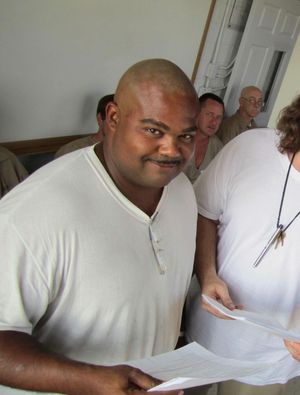
Derek R. Trumbo, Sr., a multiple-time PEN Prison Writing Award winner, is an essayist, playwright, and author whose writing has been featured in "The Sentences That Create Us: Crafting A Writer's Life
Sign up for Prism newsletters.
Stay up to date with curated collection of our top stories.