Never eat the candy on your pillow: Sun on my skin
I’ve been incarcerated for nearly 19 years, and during my time inside, I’ve often wondered whether the sun would feel better on the other side of the fence
Dear Reader,
I can still remember a teacher I had as a young child who enlisted my class to participate in a science experiment centered on a beautiful houseplant. Our task was simple enough: When our name was randomly pulled out of a box, it was our job to water the houseplant—that is, until the houseplant was placed in the closet. The teacher said this is how we’d learn about photosynthesis.
I knew nothing about plants or how they grew, but I did know the plant was vibrantly alive and would likely suffer in the dark closet. I loved how beautiful the plant was, and I looked forward to the day when it would be my turn to water it.
Once the plant was in the closet, the teacher created a watering schedule on the chalkboard that listed our names in alphabetical order. The unfortunate “T” that begins my last name meant that I was among the last students to water the plant.
When it was finally my turn, I entered that closet and saw something traumatizing. The plant was dying, and its entire body—which is how I thought of its stems and leaves—had leaned toward the door as if searching for a way out into the light.
By the end of the experiment, the plant died. The teacher taught us a valuable lesson about how plants need sunlight as a source of energy.
I found myself thinking about this science experiment recently when I became ill, my body a reminder of what happens when you’re trapped inside for too long.
A few weeks ago, I was taken for a medical trip outside of prison. The transport officer had me strip down to my boxers and socks and then gave me an orange short-sleeved shirt and pants to wear. The back of my shirt was stamped with the letters “DOC,” making it clear to anyone who saw me that I belonged to the Department of Corrections.
My wrists were cuffed, and a chain was fed around my waist and through a box-like contraption that allowed the officer to secure my cuffs to my waistline. Then came the shackles around my feet, also connected to the chain around my waist. Finally, I was led out into the sunlight and into the waiting van. I lifted my face to the sky and drank it all in.
“How long’s it been since you went on a trip?” the transport officer asked.
“A long, long time,” I replied.
I’ve been incarcerated nearly 19 years, and during my time inside, I’ve often wondered whether the sun would feel better on the other side of the fence.
In the van, my eyes followed the long prison driveway that led out to the main road—a road I could barely see from the window of my dorm, a road I fantasized about heading down. A road I no longer had to dream of.
I didn’t blink or breathe as we pulled onto that road.
I couldn’t help but grin from ear to ear as cars with makes and models I’d never seen before zoomed past us. Then my stomach tightened, like a kid on a roller coaster for the first time. Did cars always pass so close? Were we in danger of being hit? I fought down my sense of anxiety and did my best to enjoy the ride.
The pastoral scenery of fields, cows, and old wooden fences soon gave way to open highways and billboards with moving images, like huge television screens. I stared in awe at how far technology had come since I first lost my freedom. Childhood returned as I remembered the first time I saw the movie “Blade Runner.” The future was now!
The ride lasted over an hour, and despite the cuffs, chains, and shackles trapping my body, I had never felt more free.
The phrase “culture shock” came to mind as my eyes were bombarded by sights so different from the concrete block walls, fences, and razor wire I was used to. My thoughts raced with the sight of the Kentucky River and ads for foods and products I’d never tasted or knew existed. Everywhere I looked were people I’d never met. A community I’d been apart from for so long. I leaned closer to the van window to feel the sun on my skin and to look at the world I so longed to rejoin. How was it possible that the world had changed so much? What had I missed?
When we arrived at the hospital, I climbed awkwardly out of the van. It was the first time in many years that I found myself standing outside of prison. I’ve always heard folks say that they felt like kissing the ground when they were released. I could never relate to that, but now I could. I felt the sun and the cold February wind on my skin. I didn’t care that we had to stand outside for several minutes before we were let into the hospital. I could have stood there all day.
We entered the elevator, and I felt my stomach lurch. I was awash with giddiness until I imagined the looks I would receive as I clanked and jingled my way past civilians who would no doubt look at me in abject horror. Would they move away from me if I passed them too closely?
The doors slid open, and we exited the elevator. The people we passed barely looked up from their phones, and even fewer people seemed to care that a burly Black man in restraints was being led through the hospital corridors by an armed corrections officer. Once again, I felt free. I almost even felt normal.
The hospital’s nurses and doctors were obviously accustomed to treating incarcerated people. They provided me with care and then sent me on my way—like they would any other person. Did this make me a person again? Did I deserve to be treated like any other person?
My mood changed when I remembered this was but a brief foray into freedom. The realization that I would soon be back at the prison loomed over me. I was struck with a deep sadness. I’m sometimes my own worst enemy and because I know that, I very intentionally decided to just focus on the return trip to the prison. I had one more hour of freedom.
On the drive back, I breathed deeply and tried to appreciate my small adventure into the world I wanted so badly to reintegrate into.
A cold rain cascaded down the van windows, but I swear I could still feel the sun on my skin.
The Right to Write (R2W) project is an editorial initiative where Prism works with incarcerated writers to share their reporting and perspectives across our verticals and coverage areas. Learn more about R2W and how to pitch here.
Author
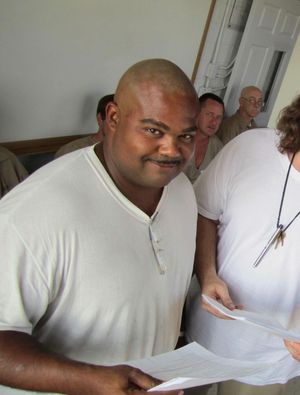
Derek R. Trumbo, Sr., a multiple-time PEN Prison Writing Award winner, is an essayist, playwright, and author whose writing has been featured in "The Sentences That Create Us: Crafting A Writer's Life
Sign up for Prism newsletters.
Stay up to date with curated collection of our top stories.