Never eat the candy on your pillow: A respect for silence
Prisons are raucous places that are not conducive to any form of therapy. When a recent session with Shakespeare Behind Bars was conducted inside a chapel, the quiet became an added measure of treatment

Dear Reader,
As much as I’ve tried not to, I often read aloud to myself. Many teachers would reprimand me for doing so, and quite a few bunkies have been confused as to whether I was talking to them when I was simply lost in an author’s world. I liked to fill up quiet spaces with words, though over time, I’ve tried to force myself to read with silence in mind.
This reading aloud thing was actually born from trauma.
When you think of trauma, maybe you recall something horrendous from childhood—the kind of thing that made your child self cry inconsolably, or perhaps you imagine a fist striking flesh? What if every time you closed your eyes, this trauma appeared to you, the physical or psychological made real all over again?
In this column, I want to tell you about how I came to make peace with silence.
Shakespeare Behind Bars brings the work of William Shakespeare to incarcerated people. At the Northpoint Training Center, I’ve been a part of the group since 2009, and recently, I found myself seated in a circle with a bunch of new guys in the group. Many stared down at their feet; others fidgeted with their pens and notepads or stared with wide-eyed wonder at Curt Tofteland, the group’s facilitator.
The goal of Shakespeare Behind Bars isn’t just to offer incarcerated people like me theatrical encounters with personal and social issues, but also to help us develop life skills to support our successful reintegration into society. Participating in the group has fundamentally changed me.
As a prison intellectual, I identify with Plato’s allegory of the cave. Caves are dark, pitch-black places. For me, Shakespeare Behind Bars is the match struck to illuminate the darkness. Through Shakespeare, self-reflections, and my desire to bring 100% of myself to the process, I’ve gained a new understanding about who I am and how I operate.
My recent Shakespeare Behind Bars experience with “Hamlet” was amplified by my sense of loss and mourning. In “Hamlet,” Shakespeare wrote, “There is special providence in the fall of a sparrow. If it be now, ’tis not to come; if it be not to come, it will be now; if it be not now, yet it will come—the readiness is all.” These words, written over 400 years ago, resonated with me. If left unaddressed, our trauma remains raw. Shakespeare understood that, which is perhaps why his words are still so meaningful today.
As part of our work with the group, one of our assignments was to come up with our best Shakespearean insult from a long list of vocabulary words from Shakespeare’s plays.
“Thou art a rascal, an eater of broken meats, base, lily-livered, glass-gazing rogue,” I read the words pulled from “King Lear” aloud. The man beside me chuckled. “I came up with nearly the same insult,” he said.
“Three suited,” also from “King Lear,” meant the individual only possessed three changes of clothes. No one chose that; it struck too close to home. My insult amounted to: You are a disrespectful, scavenging, crude, cowardly, narcissistic, reflection-gazing, immoral vagrant.
“What did you do differently?” I asked the man next to me.
“I didn’t use ‘base,’” he said. “My parents were middle class.”
Without discussing it, we both applied Shakespearean insults to ourselves. Believe it or not, incarcerated people are very hard on themselves.
In the middle of our exercise, a man entered our room to attend a court-ordered Zoom session. The dynamic of our group shifted immediately. The noise level rose as nearly 30 men struggled to be heard over the officer’s hurried footsteps, loud jingling keys, and the hearing. The workshop became a shouting match, so our group was ushered to the chapel to complete our workshop.
The chapel was so silent, it disturbed my nerves. Turning a page in my notebook sounded like thunder. Some of the men in the group seemed more at ease in the silence. For the rest of us, internal tensions exploded. A few men were brave enough to explain that the silence made them feel uneasy because in prison, quiet usually meant something bad was coming or we were suffering through the aftermath. No one dared speak on how long it had been since they last experienced quiet. The silence felt sacred.
My thoughts were on the recent loss of my mother. The silence was like a womb that sheltered me, allowing me to feel cradled as my heart broke all over again. I found myself looking up at the 40-foot-high ceiling and examining the wooden timber slats that made up the roof, wondering what my mother would think of me crying over her when I should have been pondering Hamlet’s grief after killing his two best friends.
Would my mother forever haunt me, like the ghost of Hamlet’s father? Would the pain of losing her always overwhelm me? I forced myself to stop crying. In the silence, my childhood trauma threatened to fill the room with the sound of its agonized suffering. I surely missed my mother, but not the many years of abuse I was subjected to. My parents weren’t as flawed as Hamlet’s, but they were far from angels.
The entire prison environment is one of raucous energy, which is not at all conducive to any form of therapy. Moving us into the chapel felt like an added measure of treatment. In the silence, I felt alone and forced to think, making peace with the traumas I’d carried around my neck like a sack of rocks, long after those who hurt me had moved on.
Billy, a close friend of mine who was recently released from prison, noticed my silent tears. “It gets easier,” he said. “The pain never goes away, but it does fade.”
I thanked him, and I went about the rest of the evening pretending as if I didn’t have a major breakthrough in the silence of that chapel—as if I hadn’t just forgiven my parents for putting me out when I was still just a teenager, as if my wounds weren’t reopened by how small I felt beneath that massive ceiling.
I pretended as if I didn’t beg the ghosts of my parents to forgive me for being so hard-headed and uncontrollable as a youth, like I didn’t spend the silence begging for the ability to forgive myself.
I’m obviously no prince or king. I’m a grown man, not a teenage misfit with a star-crossed lover. Yet I still feel deeply. Even though I’ve been in this place for nearly two decades, missing the deaths of both of my parents, I am still alive, and I have plenty of life to live. Rather than simply bemoan the tragedies I’ve endured, in that chapel, I finally appeased the ghosts of my parents.
I’ve attended over a dozen of these workshops over the years, and from each, I’ve gained another skill. This year, I found a respect for silence.
Editorial Team:
Tina Vasquez, Lead Editor
Carolyn Copeland, Top Editor
Rashmee Kumar, Copy Editor
The Right to Write (R2W) project is an editorial initiative where Prism works with incarcerated writers to share their reporting and perspectives across our verticals and coverage areas. Learn more about R2W and how to pitch here.
Author
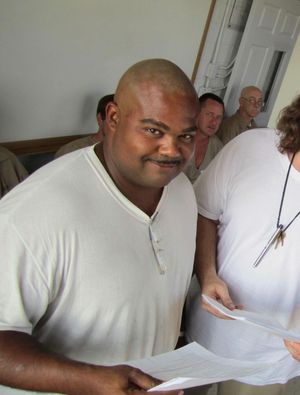
Derek R. Trumbo, Sr., a multiple-time PEN Prison Writing Award winner, is an essayist, playwright, and author whose writing has been featured in "The Sentences That Create Us: Crafting A Writer's Life
Sign up for Prism newsletters.
Stay up to date with curated collection of our top stories.