
Dear Reader,
When I came to prison nearly two decades ago, I believed my life to be completely over. Everywhere I looked behind the fences, there were broken people living broken lives. It was a cycle of brokenness. Prison isn’t a fix to anyone’s problems.
But the further I get into my prison sentence, the more I realize the harm in thinking everything is broken—especially myself. I used to discard whatever was broken. I found no value in the cracked, dented, or imperfect. Then I started to write. Writing taught me how to fix things. I looked around the prison, and I saw not just inmates, but also fathers, sons, and husbands. They weren’t irreparably broken; they were misguided, misused, and abused. To quote Shakespeare, their crimes were not the quintessence of their beings. One act, one moment, should almost never be allowed to define an entire life. Society cannot fix its problems by merely locking people away. The change has to start somewhere, so why not start with ourselves?
As you may recall from my last column, this is how a playwright’s circle called Voices Inside taught me how to break the cycle of my own trauma and use creative writing to speak my truths to a wider audience.
What I didn’t share in my last column was that my playwriting journey didn’t start off very well. My first year in the playwright’s circle was terrible. I tried to write 10-minute plays without knowing anything about how to write a play, and I refused to listen to the experts. Many incarcerated people like myself find themselves in prison in part due to a lack of communication and literacy skills and an inability to handle stressful situations. Writing, of course, requires all of these abilities.
Daily writing has since helped me attain these abilities and more. It is through writing that I’ve learned to push past my own discomfort, attain healing, and even hang on to hope.
All good 10-minute plays start with a strong character in a bad situation. One of my first characters was an incarcerated drug dealer named Dixon. His bad situation was that he refused to stop selling drugs.
Robby Henson, our facilitator and the co-founder of Voices Inside, told me that my dilemma was that I refused to confront the root of my character’s problem.
“Is your character in love with prison, or is there a deeper issue at work?” Robby asked.
If I knew what was wrong with my character and my play, I wouldn’t have been so upset by Robby’s critique. Every question felt like an attack on my writing ability. Each recommendation felt like someone else trying to control the words flowing from my pen. Why couldn’t I just write whatever the hell I wanted to?
“No one loves prison,” I told Robby. “Dixon is just a product of his environment.”
Robby let me vent for a minute before he asked for a show of hands.
“How many of you felt Trumbo’s character sounded like he loved prison?”
Nearly everyone raised their hand.
To me, it was clear that Dixon’s character doesn’t “love” his situation. He sells drugs to survive. He is good at survival, and he learns very quickly how to adapt to life behind the fence. His conviction is just a consequence of his lifestyle as a drug dealer.
“Does Dixon want to go home?” Robby asked. “If so, how prepared is he? Will he return to his old ways? Is his return to prison a foregone conclusion?”
I couldn’t answer these basic questions. I realized I didn’t even know my own character. To be or not to be? Why did this question keep buzzing around my brain—and what did 10-minute plays have to do with my thoughts of Shakespeare?
Robby told me to consider his questions before I rewrote my play. He wouldn’t let me scrap the piece entirely. He said it had “good bones.”
“You tend to throw the baby out with the bathwater. Don’t do that this time. I believe you are on the edge of a breakthrough,” Robby said.
The class ended. I trudged back to the dorm with my head down. On the verge of giving up.
“Hey, Trumbo. You got a second?”
Justin was going home in a few years. He joined the circle looking for something to keep him occupied as he awaited release.
“I liked your play,” Justin said. “I don’t think Dixon’s character loves prison. I think he just likes being popular. On the streets, he’s just another low-level dope dealer on the corner. Behind the fence, he’s sort of a celebrity, you know? He’s got the hookup. That alone makes him special to most of the guys in here.”
I realized I might have spent too much time focusing on the wrong things. “I can’t believe I don’t know whether Dixon wants to go home,” I told Justin.
It seemed like an abrupt shift when Justin told me he’d been thinking of a prior conversation we had about whether the Department of Public Advocacy (DPA) would ever do anything about Kentucky’s sentencing guidelines.
“I’ve come to the conclusion that the DPA can’t do anything, you know? If they did, it’d be like admitting the system they work for is actually broken,” he said.
But then it clicked: If Dixon admits he can’t survive on the streets and prison is the only place that he feels like he’s top dog, then he’s sabotaging himself—and admitting he’s become institutionalized.
That’s what I was going for, I told Justin. But I still don’t know if Dixon wants to go home.
Justin didn’t know the answer either.
“But he’s your character,” he said. “The future you write for him is the one he’ll have to accept.”
At the time, I struggled to think about what my own future looked like. Justin had a clearer idea. He was going to stay with his uncle when he got out and stay away from the same shit that led him here in the first place.
“That’s what your play taught me,” Justin said. “Maybe Dixon needs to ask himself what he’s willing to give up to remain free.”
What would freedom look like to Dixon? A return to the same neighborhood, the same lifestyle? If so, he’d be back for sure. Did Dixon love prison? Did he want to come back? I found the answer by asking myself the hard questions. The play would end with Dixon overdosing on his own supply. It was a tragic end, an all-too-common way men like him give in to what feels like an endless cycle of brokenness. Dixon believed he’d return to prison, so he chose to give up all hope.
Writing continues to teach me things about myself and the world around me. My 10-minute play about Dixon taught me a valuable lesson, one I hope you can take with you: Never lose hope. Without hope, everything appears broken.
The Right to Write (R2W) project is an editorial initiative where Prism works with incarcerated writers to share their reporting and perspectives across our verticals and coverage areas. Learn more about R2W and how to pitch here.
Author
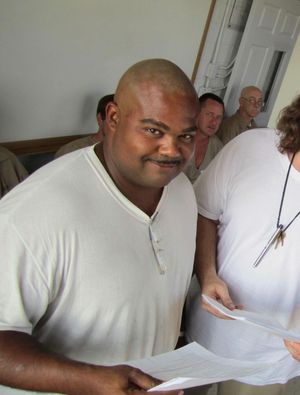
Derek R. Trumbo, Sr., a multiple-time PEN Prison Writing Award winner, is an essayist, playwright, and author whose writing has been featured in "The Sentences That Create Us: Crafting A Writer's Life
Sign up for Prism newsletters.
Stay up to date with curated collection of our top stories.