It wasn’t just a hurricane that devastated North Carolina: It was climate violence
Climate change is structural violence committed by the U.S. government
In my work as a climate justice reporter, I think a lot about violence. Not abuse and other interpersonal acts of harm that are more easily understood as violence, and not the externalities of the state that are used to surveil and control people, like police. (Though of course, these expressions of violence are related to environmental and climate justice.) I’m talking about the violence of resource extraction and fossil fuel consumption within the U.S. economic system the government has built around, and in service of, these goals.
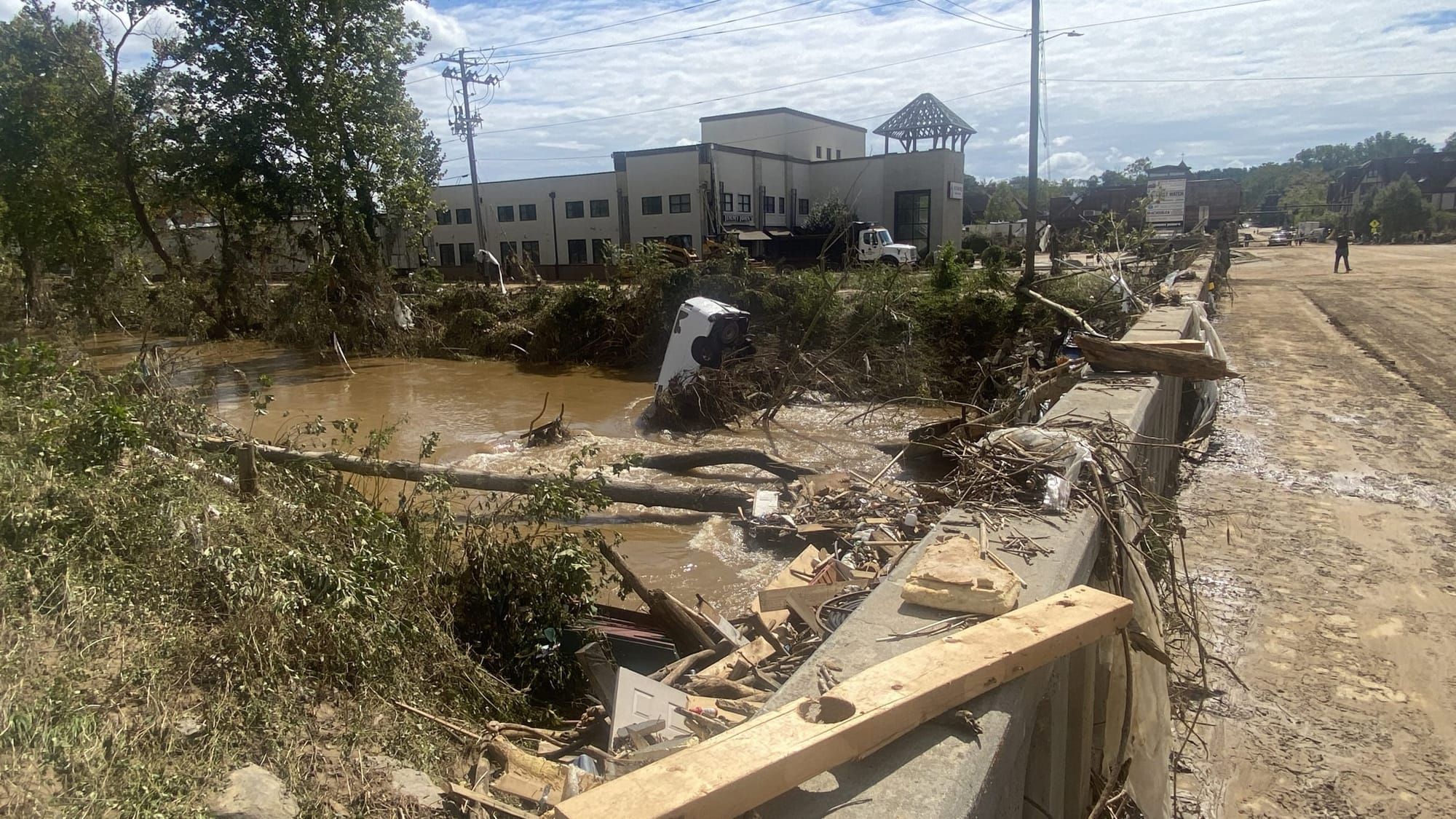
In the aftermath of catastrophic, climate-change-induced flooding brought on by a Category 4 Hurricane in North Carolina, I’ve been thinking about not just the violence at the root of climate change, but of the violence of climate change itself.
Make no mistake: The suffering, starvation, drought, extreme weather, debility, and lack of self-determination that marches in lock step with climate change is violence. Those in positions of formal power are all too content to keep these consequences coming.
U.S. government and state agencies have helped to foment the climate crisis, which has only served to pad the pockets of oil and gas executives and left communities to deal with increasingly destructive impacts. Meanwhile, private corporations bet on the future of climate systems and profit off of disaster. These executives often hold positions in, or maintain relationships with, government officials, a phenomenon that philosopher Olúfẹ́mi O. Táíwò refers to as the capture of public spaces by the elite.
The insidious actions of those who take a public oath to uphold the Constitution run deeper than their measly and lackluster response to North Carolinians, who they have abandoned in more ways than one. One part of this is what author Naomi Klein calls “disaster capitalism,” which allows corporations to turn a profit from other peoples’ tragedies. Another is what scholar Ruth Wilson Gilmore calls “organized abandonment,” which makes people vulnerable to premature death. The correlation between siting hazardous facilities within Black communities and the chronic health issues Black Americans experience is a stark example. But altogether, we can call it what it is: climate violence perpetrated by the U.S. government.
I’m certainly not the first person to think about climate change as violence, and moreso, as a crime against humanity. But shifting our understanding of what we read as state-sponsored violence, organized abandonment, and systemic violence may be a useful organizing tool. It may help us identify harm differently, meaning, identify new culprits of harm and new solutions for that harm. What the government sees as violence is very different from how the public experiences violences, and with climate change, the two are on opposite sides of the line. As Gilmore has said, organized abandonment is sustained through organized violence.
This spectacular violence, which lends itself well to media coverage, which in turn lends itself well to the anticipated neoliberal state response of disaster “relief,” is not the violence we need to be worried about.
Hurricane Helene devastated most of Western North Carolina, leaving hundreds of thousands of people without power or water and forcing them to flee their homes (effectively making them climate refugees), and destroying roads and highways, making it impossible to get in or out of rural mountain towns. Four days after the flooding began, the White House announced that President Joe Biden and Department of Transportation Secretary Pete Buttigieg directed the Federal Emergency Management Agency (FEMA) to begin relief efforts, coordinate food and water delivery, and perform search and rescue operations.
The spectacularity of Hurricane Helene’s aftershock allows the federal government to perform functions that seem normal and appropriate—doling out goods and services after a storm is what the Biden administration should be doing. Yet this spectacular violence, which lends itself well to media coverage, which in turn lends itself well to the anticipated neoliberal state response of disaster “relief,” is not the violence we need to be worried about.
Really, the Biden administration’s response is a kind of post-disaster white saviorism that should concern. As Teju Cole wrote, the “relief” comes from a country that “supports brutal policies in the morning, founds charities in the afternoon, and receives awards in the evening.” The Biden administration is all too keen to send in FEMA while concurrently sending subsidies to the oil and gas giants whose product has destabilized the Earth’s climate balance to the degree that we now face world-ending threats of mass extinction. The mundane violence is where the real harm lies, illustrating that even as FEMA rolls in, the federal government has already abandoned us.
Mundane, everyday environmental and climate injustices laid the groundwork for Helene, and empirically, these injustices claim far more lives than hurricanes each year. Asthma, which is deadly mainly for poor people who are overwhelmingly Black and brown, leads to 3,000 deaths annually in the U.S. Poor air quality, brought about by particulate matter pollution, ground-level ozone pollution, and other arms of the fossil fuel industry, led to 63,000 deaths in 2021. At least 2,325 people died from extreme heat in 2023. People of color are more likely to live in what are called urban heat islands, where a lack of green space and cooling centers make it impossible to shake the impacts of hot days that are also only expected to increase.
The government has no comprehensive plan to address these harms other than to encourage them. FEMA’s flood maps don’t cover much of America, and there’s no federal law that says homeowners need to be warned of flood risk before purchasing a home. There’s also no federal heat standard to protect the safety of outdoor workers, and amidst compounding crises of housing, healthcare, and education affordability, the government finds funds for projects that actively invest in death.
The week after Hurricane Helene touched down, Congress approved a $9 billion weapons transfer to Israel and FEMA announced a $9 billion budget shortfall. The Biden administration brags that the Inflation Reduction Act was the largest investment ever in renewable energy, but the president doesn’t plan to end the status quo of giving $20 billion in subsidies each year to the fossil fuel industry. And it’s looking like no one will be granted the opportunity to take the government to court and hold it accountable for supporting these climate crimes. Climate violence starts with how the government spends public money—and our tax dollars are invested in creating more disasters like Hurricane Helene.
Our political aims are so often measured against the limitations of the collective imagination, those limitations being known as what’s “realistic” to demand of those vested with power. But we have so many reasons to believe that we can and should demand life-giving rather than life-destroying policies. We already know how to bring the world we want into being.
Right now, mutual aid is gathering relief funds for impacted families, sending meals to people displaced from their homes, and providing money for workers who can’t afford to take a day off. Author Rebecca Solnit has written about this in books like “Paradise Built in Hell” and “Hope in the Dark”. In lieu of waiting for government aid that may never arrive, the people will always come to each other’s rescue. We survive because of each other.
Author
ray levy uyeda is a staff reporter at Prism, focusing on environmental and climate justice.
Sign up for Prism newsletters.
Stay up to date with curated collection of our top stories.