Never eat the candy on your pillow: Breaking through the noise
We often don’t hear about the experiences of disabled incarcerated people, but today we’re hearing from Mitch, who navigates prison life as a deaf person

Dear Reader,
It might not come as a surprise to you that many incarcerated people—myself included—describe prison as a nightmare come to life.
Mitch has a different take on it.
“Prison is like being deaf,” he told me. Mitch is hearing-impaired and incarcerated here at the Northpoint Training Center in Kentucky. Mitch was born partially deaf, and his hearing worsened as he got older
“That is what prison is like for me,” Mitch said. “I can remember freedom, like the sounds and words I knew as a child. But silence is all I know now, just like prison.”
Mitch and I met through a short-lived sign language class at Northpoint. But, so few people know American Sign Language at the prison that Mitch resorts to writing what he wants to say in a notebook that he shares, even with me. I am terrible at signing. I tend to spell most words out, leading Mitch to tap his watch at how slow I am.
When I told Mitch I wanted to interview him for the column, he grinned so big I thought he’d break his face. This column was originally going to be about what it’s like to be disabled in prison, but Mitch had other ideas.
“Being deaf in prison is big, yes,” Mitch wrote in his notebook. “But it’s coping with it that takes some getting used to—being in prison, not the deaf part. I’m used to being deaf. I’m used to feeling like no one listens. It’s prison that no one gets used to. Coping is all anyone can hope to do.”
According to Mitch, there are plenty of people in prison who are deaf, blind, or have other disabilities. But the real issue is prison itself and learning how to navigate it.
The lessons come early, and they come fast.
In the county jail where Mitch was first incarcerated, he noticed that people paired up to look out for each other. This was especially true of Latino men. Those who only spoke Spanish paired up with those who were relatively bilingual. Together, they navigated life in prison.
One of the first people Mitch roomed with in the county jail happened to be going deaf.
“He shouted a lot. We got along just fine,” Mitch wrote with a laugh.
It was at the county jail that Mitch developed the habit of showing people a note that read: “I’m deaf. I’m also a real good reader.”
Through his notes, Mitch was able to find people to communicate with. But the process wasn’t without its challenges.
“Benzo couldn’t spell worth a damn,” Mitch wrote in his notebook about a man he was imprisoned with. “I had the hardest time figuring out what the hell he was writing down, but the other guys got a real kick out of watching him scream it out at me all the time when I shrugged my shoulders and shook my head. He really thought I was messing with him. He did get better at spelling. That’s a plus.”
There are plenty of disabled incarcerated people whose experiences we don’t hear a lot about. Over the years, I have met men who rely on wheelchairs, walkers, canes, and crutches, as well as people with learning disabilities and physical abnormalities that earned them disgusting nicknames from staff and inmates alike.
“Who can forget Camel Joe?” Mitch wrote, referring to a man at Northpoint who had a spinal deformity and who didn’t appear to care that people made fun of him. “How do you think he felt about being in prison? If he didn’t get mad about being [made fun of], why should I feel bad about not being able to hear? Some people complain about all the noise in here. Guess what? I kind of like the peace and quiet.”
Ableism exists inside and outside of the prison walls. For disabled people new to prison life, it’s a matter of figuring out the shape it will take in their new environment.
When Mitch first came to prison, he said he took it day by day, “just like everybody else.”
“Prison is rough,” Mitch wrote. “I remember watching a guy lose all hope.”
The man was clearly depressed, but no one else seemed to notice, Mitch said. As a deaf person, Mitch pays close attention to people—their body language, their mannerisms, their demeanor. His mom called it his “superpower.”
Mitch began to write notes to the man, who slowly opened up to him. He was in jail for unpaid traffic tickets that he couldn’t afford and that his family refused to help with. While inside, his partner left him. He became depressed and stopped caring about himself.
To communicate with Mitch, the man had to write down what he was feeling and thinking, which over time seemed to help. It also didn’t hurt that Mitch did his best to make the man laugh. Mitch once told him that he had it far worse because he was going to be transferred to prison, where he wouldn’t be able to hear if someone was flirting with him. This got the laugh Mitch was hoping for.
When the man was eventually released from jail, he appeared to have made it through his depressive episode.
“It was close, but he made it,” Mitch wrote. “That situation carried me through a lot of my own rough times in this place.”
Inside, we all have different coping mechanisms for surviving the nightmare that is prison. Mitch copes by relying on his sense of humor to get by and make friends. Others keep themselves busy, reading or working out. Some cling to relationships, living for phone calls and visits from family.
For me, I’ve survived thanks to the openness of other incarcerated people who honestly discuss the daily pain and uncertainty they experience. Through them, I’ve learned to endure my own pain and uncertainty, and it is my hope that the lessons and stories we have to share can be heard by people outside of the prison walls.
The Right to Write (R2W) project is an editorial initiative where Prism works with incarcerated writers to share their reporting and perspectives across our verticals and coverage areas. Learn more about R2W and how to pitch here.
Editorial Team:
Tina Vasquez, Lead Editor
Carolyn Copeland, Top Editor
Stephanie Harris, Copy Editor
Author
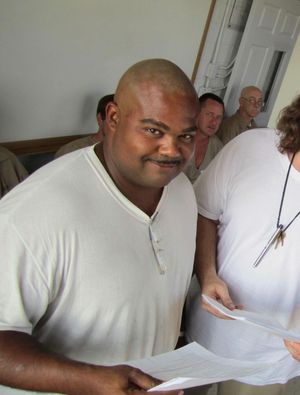
Derek R. Trumbo, Sr., a multiple-time PEN Prison Writing Award winner, is an essayist, playwright, and author whose writing has been featured in "The Sentences That Create Us: Crafting A Writer's Life
Sign up for Prism newsletters.
Stay up to date with curated collection of our top stories.