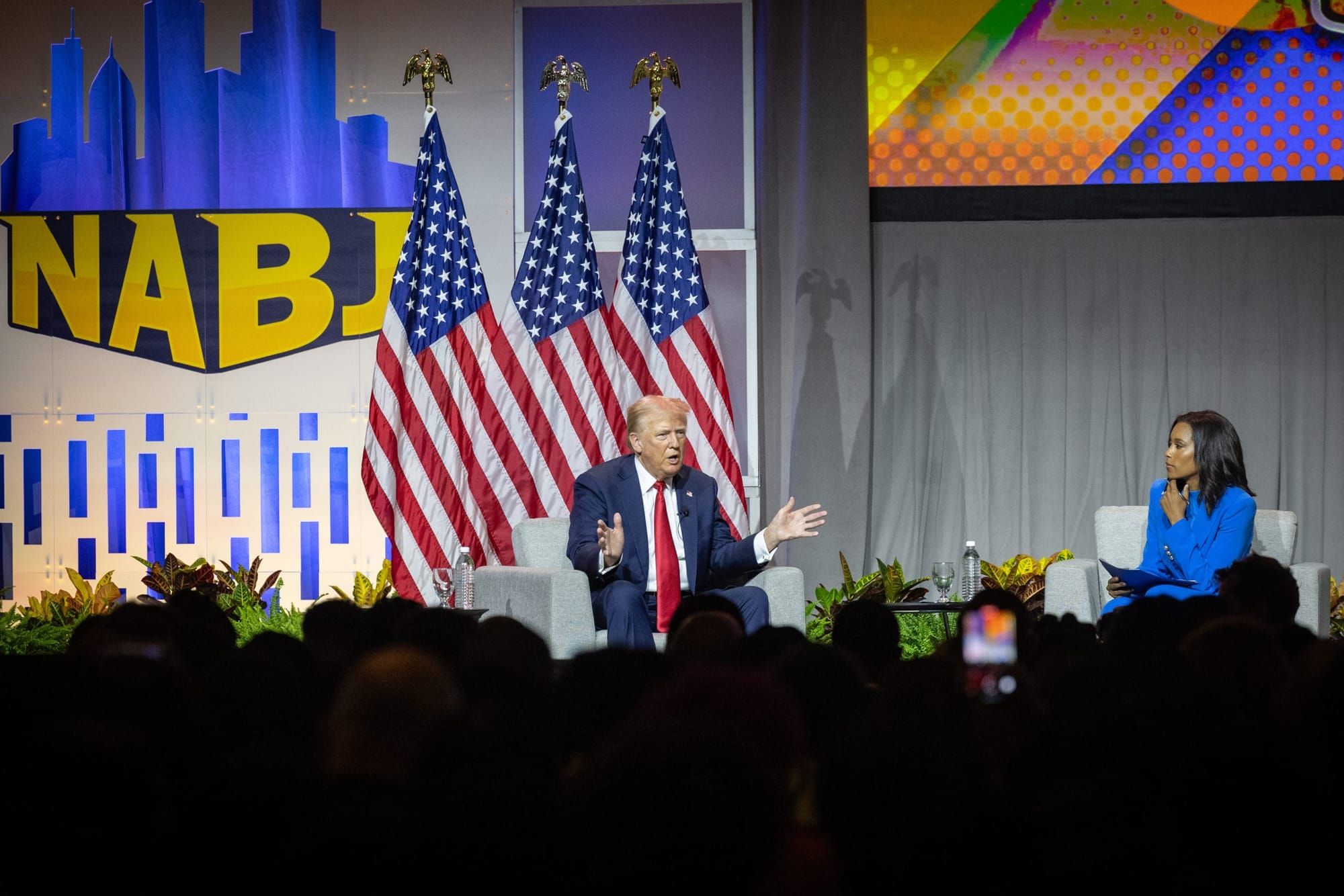
I have been a National Association of Black Journalists (NABJ) member for nearly a decade and have attended multiple conventions, so I know very personally that the yearly gathering serves as an important space for Black journalists in search of professional development, opportunity, and a brief reprieve from the daily grind of reporting.
The appearance of former President Donald Trump this year, however, flipped the convening on its axis.
After rejecting two previous invitations to the convention (including one in 2017 when Trump sent former Communications Director Omarosa Manigault in his stead), two nights before the convention, NABJ organizers unexpectedly announced that Trump would participate in a Q&A with three Black women journalists.
The announcement came as a shock.
While it is true that convention organizers frequently extend politicians invitations to participate and make their case to the press in attendance, Trump’s history of disrespect toward Black women journalists—including NABJ members April Ryan and Yamiche Alcindor—led the organization in 2018 to condemn the former president. NABJ’s primary objective is to advocate and support its Black membership. Extending an invitation to Trump was in direct opposition to this goal.
As many NABJ members critical of the decision to invite Trump predicted, his interview was volatile. Though it was livestreamed by major networks, Trump delayed the interview by more than an hour, refusing to go on stage over a fact-checking dispute. He was also openly antagonistic toward journalist Rachel Scott. He made incoherent arguments regarding “Black jobs” and police immunity; spoke poorly about the demands for action after the police murder of Sonya Massey; and made unfounded and dangerous claims about abortion. Most notably, he used his appearance to levy unfounded racist conspiracies about the racial background of Democratic presidential nominee and current Vice President Kamala Harris—a malicious line of inquiry that proceeded to dominate the news cycle for days following the ill-fated event.
The aftermath was damning but predictable. Many members (myself included) warned of the deleterious impact of inviting Trump—a man who has no respect for the press and merely saw the event as a means to further promote his racist and retrograde agenda. While journalists are used to speaking to people with harmful perspectives and engaging in contentious conversation, the NABJ convention is not a place where Black professionals are expected to endure racist abuse that then overshadows their gathering.
The mood shifted for the rest of the convention—a true shame given that this is one of the most anticipated weeks of the year for Black professionals who work in a particularly troubled field.
It is no secret that the journalism industry is more fragile than ever. Jobs are disappearing by the thousands as long-respected titans of the new era of digital media become subsumed by private equity and venture capital firms.
In a world where ad space dictates clicks and funding, the act of reporting, investigating, inquiring, and examining long-held truths has become disposable, subject to the whims of public virality and algorithmic suppression. This untenable market relegates journalists to being crabs in a barrel, fighting for contract and freelance work. It has also made a lasting impact on the viability of a media career, most notably for Black and brown employees. Not only are they victims of the declining job market, but the ongoing backlash against DEI has also slowly eliminated the few jobs that were expressly intended to connect mainstream news platforms to communities of color.
Affinity groups such as NABJ, the National Association of Hispanic Journalists (NAHJ), and the Asian American Journalists Association (AAJA) have long existed to service and support major gaps in infrastructure across mainstream media. NABJ, in particular, focuses on advocating for Black journalists and media professionals in the U.S. with a multipronged platform that includes training, networking, recruiting, and assisting with job opportunities. The NABJ convention is touted as the “premier multi-day conference for journalism education, career development, networking, and innovation,” and it serves as a major annual event for thousands of members.
However, due to Trump’s appearance, many panelists and other participants decided not to attend the convening, and some NABJ members, like Nikole Hannah-Jones, openly criticized organizers’ decision to invite the former president. The NABJ leadership was lambasted for not involving more people in the decision; for not including Black-led press in the conversation; and for allowing FOX correspondent Harris Faulkner—who is not a dues-paying NABJ member—to moderate the conversation.
Meanwhile, Trump continues to defend his actions and claims he did “the Black journalists” “a favor” by going to NABJ.
It’s also worth noting that the NABJ convention is an expensive affair. Between registration, flights, and hotel fees, reporters—who often make far less than other college-educated workers—spend thousands to connect with colleagues in the field in hopes of building important connections.
It is beyond regretful that a lauded event for Black journalists was turned into a platform for Trump to spew racialized hate, putting a visible damper on the remainder of the convening. Worse yet, the debacle could have been avoided if organizers listened to the concerns of members.
But let Trump’s appearance serve as a reminder to Black journalists regarding the myth of objectivity: You cannot be so beholden to neutrality that you allow abuse.
Author
Shamira Ibrahim is a Brooklyn-based writer and reporter by way of Harlem, Canada, and East Africa, who explores identity, cultural production, and technology.
Sign up for Prism newsletters.
Stay up to date with curated collection of our top stories.