The heavy burden universities place on Muslim women students
Muslim women students assert there were few safe spaces on college campuses even before the backlash against Palestine solidarity
Fifi doesn’t take public transportation anymore.
When she used to ride the train, Fifi, a hijabi Muslim woman, would encounter people who screamed at her or refused to sit next to her. So she caught rides with friends or paid for pricey Ubers.
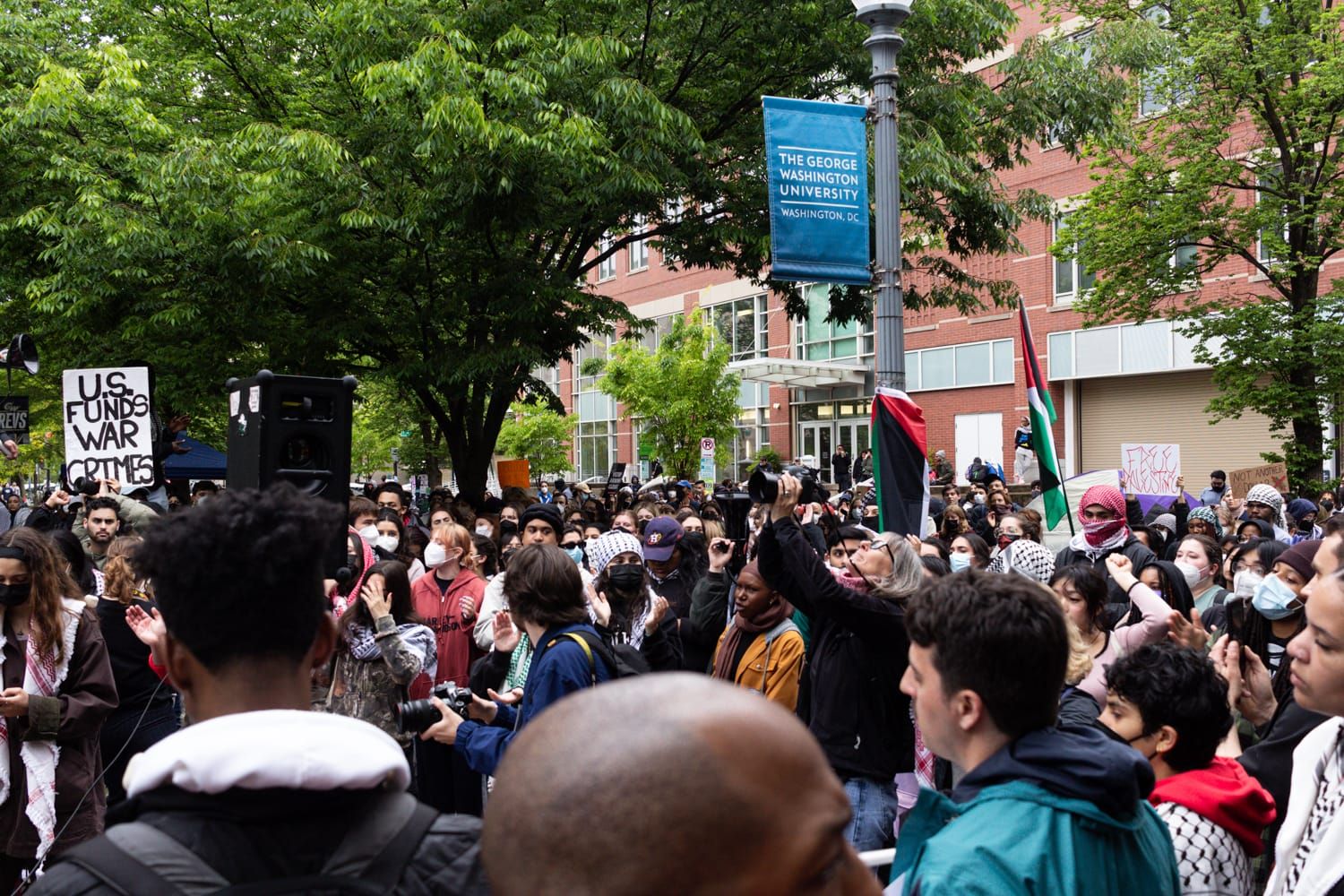
In February, she joined a blockade at the University of California, Berkeley to protest Israel’s invasion of Rafah in Gaza. Hecklers targeted her. She was pushed, yelled at, and even approached by a man with a knife, she told Prism. The man was escorted away by the police, Fifi said, but he was still seen around campus.
These are just some of the recent incidents Fifi has endured as a graduate student in California. She is using a pseudonym for fear of further violence.
“I think people have this perception that Muslim women are weak,” Fifi told Prism. “[It] took a lot of mental and emotional toll, people spitting towards me or calling me a terrorist. People would come and say, ‘I wish you got gang raped.’”
UC Berkeley spokesperson Dan Mogulof told Prism in an email that if the attacker was not part of the university, “then it is the law enforcement agency and the judicial system that would ‘take action,’ not the university.”
According to the Council on American-Islamic Relations (CAIR), since Oct. 7, 2023, there has been a widespread culture of Islamophobia and anti-Arab and anti-Palestinian racism at major American universities, including Harvard, Columbia, and the University of Michigan.
These universities instigate a culture of gendered Islamophobia by ignoring hate speech, death threats, and threats of sexual violence targeting Muslim women. Students and faculty at the City University of New York (CUNY), UC Berkeley, and George Washington University (GW) described a lack of mental health services for Muslim and Palestinian women, inadequate follow-up on reports of harassment, inadequate prayer spaces for Muslim students, and racist remarks and threats made by the administration—conditions students say have persisted for years.
“I think [UC] Berkeley takes part in this progressive, liberal facade, and I think it gives you this false security that you’re safe,” Fifi said.
Few safe spaces
At CUNY, New York City’s largest public university, Muslim students described a history of disregard for religious accommodations.
In March 2022, student Hafeezat Bishi began advocating for officials at CUNY’s Craig Newmark Graduate School of Journalism to provide a more suitable space for Muslims to pray. Former Associate Dean Andrew Mendelson emailed Bishi saying the school would make the temporary prayer room less cluttered by “clearing out the extra chairs.” He also suggested that she pray at off-campus locations several blocks away, according to emails reviewed by Prism.
Bishi explained to Mendelson that according to Islam, Muslims pray five times a day and that it was unrealistic to expect students to repeatedly leave and come back to campus between classes.
Before the current prayer room was created in August 2022 due to Bishi’s efforts, Newmark students reported praying under stairwells or having friends stand guard outside of classrooms so they could pray in peace.
Bishi said that as a Muslim with clinical social anxiety and one of the few Black students in her cohort, she felt unwelcome at the university. Still, she felt compelled to advocate.
“No matter how much my anxiety was kind of beating at me … I knew ultimately, if not for my benefit, it would be for the benefit of others,” she said, noting that she still remembers being 10 years old and students calling her hijabi Muslim friends “Osama bin Laden.”
Newmark Journalism School spokesperson Rachel Ramirez told Prism that there have been no recent complaints since the dean created the prayer room.
According to CAIR, until 2022, students at City College New York (CCNY) had to pray in small, cramped spaces like dirty hallways.
“They were putting us in small spaces, unhygienic spaces, loud spaces,” CCNY student Hadeeqa Malik told Prism.
Since women wearing headscarves are often targeted, giving them a safe space to pray is a simple step, said Corey Saylor, the research and advocacy director at CAIR. “I think people instituting such policies will give lip service to ‘we want to protect our students,’” he said.
Universities allowing violence
Muslim students also described a culture at universities that disregarded violent assaults on women, particularly those who wore a hijab or headscarf.
At City College, Malik joined Students for Justice in Palestine (SJP) and became a student leader protesting Israel’s genocide in Gaza.
Malik was doxxed, and photos of her without her hijab were shared online. When a classmate called her a “terrorist supporter” on Reddit, she filed a report with the school’s public safety department, and he deleted his posts.
But the photos of her without a hijab are still online. Malik said she has filed reports to have them taken down, but nothing has happened.
“I just wanna take them down. I feel so violated in every way,” Malik told Prism.
During one protest, Malik and others read the names of children killed by Israel. While campus public safety watched, students carrying Israeli flags heckled them, danced as the names of dead babies were read, and chanted, “Terrorists go home” and “No justice for rapists.”
Wearing a headscarf or hijab is the third most prevalent trigger for anti-Muslim bias, after ethnicity and being considered Muslim, according to a 2018 CAIR report.
Aanya, a GW student who requested not to use her full name, reported four separate incidents to CAIR of students’ hijabs being torn off, including one in which a white man cornered a Muslim woman in a stairwell.
Students at GW also reported having hijabs torn off and being spat on, making them fearful of wearing clothing that identifies them as Muslim. A GW professor has been linked to anti-Muslim think tanks that spread anti-Muslim conspiracy theories abroad.
Aanya said that GW did not take action on the assaults because students did not want to file official reports. But she said the university was using the lack of reports as a “scapegoat” for their inaction.
“George Washington University decries all forms of bias and discrimination based on protected characteristics, including Islamophobia,” GW spokesperson Julia Metjian told Prism. “The university promptly reviews reports received.”
CAIR designated GW, as well as the University of Michigan; University of California, Los Angeles (UCLA); University of Georgia; and a dozen other colleges, as “institutions of particular concern” for safety threats against anti-genocide protesters.
Those universities have destroyed Islamic religious materials, allowed harassment and assault of Muslim and Arab students by administrators and faculty, and invited the Israeli military during Muslim holidays. GW President Ellen M. Granberg called a student vigil for murdered Palestinians a “celebration of terrorism.”
At UCLA, campus security did not intervene when students protesting the genocide in Gaza were attacked with hammers, knives, and fireworks. The counterprotesters sexually harassed Black women, calling them slaves, and called students jihadists and terrorists. They also asked if the students were “cool with rape” and said, “Hamas would kill you f—,” using a homophobic slur.
We’re talking about one of the worst waves of Islamophobia we’ve seen in this country in the last 10 to 15 years.
Corey Saylor, research and advocacy director at CAIR
“We’re talking about one of the worst waves of Islamophobia we’ve seen in this country in the last 10 to 15 years,” Saylor said.
Sahar Aziz, a distinguished professor of law at Rutgers Law School and the founding director of the Center for Security, Race, and Rights, said at a recent teach-in that calling Muslims or Palestinians terrorists, misogynistic, or antisemitic without evidence is a common racist trope.
Aziz said there is little focus on issues like Islamophobia and anti-Palestinian racism on college campuses, pointing to how Muslims are losing free speech and academic rights, and facing violence at student encampments—even when praying.
“[Palestinians, Muslims, and Arabs] are presumed to be untrustworthy. They are presumed not to feel pain, trauma, or vulnerability. They’re presumed to be prone to violence and hate against others,” Aziz said.
Ellen Schrecker, a professor at Yeshiva University and expert on McCarthyism, said at the teach-in that the repression at universities today is worse than during the McCarthy era because the academic community is weaker. She also noted that ultraconservative billionaires took advantage of the backlash against student protests in the 1960s to shift American culture to the right by discrediting and taking over universities.
“As in the McCarthy era, trustees and top administrators do not resist these attacks, but capitulate to them,” Schrecker said.
University of Michigan President Santa Ono said in leaked audio that the federal government was asking questions about how universities are combating antisemitism, but not Islamophobia.
“To have the government say something like, well, we will withhold your $2 billion in funding if you don’t address antisemitism,” Ono is heard saying, raising questions about why Muslim students’ safety is disincentivized.
CUNY students told Prism that administrators have invaded Muslim women’s privacy, made racist remarks toward Muslim student groups, threatened to prevent student protesters from graduating, and threatened to revoke prayer rooms.
In 2020, CUNY Law allowed Zionists to cyberbully and send violent threats to former student and Muslim Palestinian activist Nerdeen Kiswani. In 2023, CUNY Law also censored student-selected commencement speaker Fatima Mohammed, accusing her of antisemitism because of her pro-Palestine speech, which was livestreamed and then removed by the university.
At CCNY, students told Prism that a CUNY administrator, Christopher Gorman, entered the women’s prayer room when Muslim women had their hijabs and niqabs removed and told them to leave because they were lingering.
A council across multiple campuses decides the rules for when Muslims can use the prayer room at CCNY. When students asked if SJP could be added to the council, a student told Prism that Assistant Vice President of Student Affairs Ramón De Los Santos said, “You have four Muslim clubs. How many more do you want?”
At John Jay College, a Palestinian American student who asked to be identified as Nada, said that public safety staff routinely did random checks in the prayer room and entered when Muslim women were praying. She said security officers have told them to remove a barrier for privacy and walked around the room picking things up. When a member of the pro-Israel Jewish student organization Hillel said they felt unwelcome in the prayer room, the school threatened to take it away.
When asked what losing the prayer room would mean to her, Nada said, “It would mean going back to praying in staircases.”
Representatives from John Jay College did not respond to Prism’s request for comment by publication time.
Caring for each other
According to Saylor, the CAIR staffer, both political parties support anti-Muslim policies. Islamophobia spiked after President-elect Donald Trump’s Muslim ban went into effect during his previous administration. Meanwhile, President Joe Biden condemned bigotry in the U.S., but he supports Israel’s annexation of Syrian land, and his administration has funded Israel’s genocide in Gaza.
“I would argue that Islamophobia is baked into U.S. society at this point,” Saylor said. “It’s in many ways just sort of waiting on a trigger to flip the switch to on.”
Maram Hallak, an associate professor at CUNY’s Borough of Manhattan Community College, offered counseling to Muslim women after 9/11. She told Prism that she offered to do counseling for Palestinian women at CUNY after Oct. 7, 2023, but the university told her that students who are not feeling well can simply go to the counseling center.
“Harassment is not always salient,” Hallak said. “Most people who get harassed, they turn into themselves. When I heard somebody say, ‘Let’s find all the Arabs and kill them,’ I didn’t tell anyone. I just went home and hid under the covers.”
You’re operating in a system where people are being slaughtered as we speak. Our taxes and tuition are funding this.
Fifi, a graduate student in california
Many women told Prism that they counted on each other for support. At the Gaza solidarity encampment at GW, non-Muslims protected Muslims while they prayed, Aanya said. “I felt very safe except for when the police showed up,” she said.
When police arrived at the encampment, they removed Muslim women’s hijabs, including Aanya’s. She was pepper-sprayed in her eyes and yet still helped another hijabi woman. Aanya and other women shielded her from photographers, poured water on her pepper-sprayed leg, and fixed her hijab.
“Unless you’re a hijabi woman, you’re not thinking about anyone else’s hijab,” Aanya said. “I didn’t enjoy getting pepper spray, but I was glad I was there to help out.”
Universities like GW and CUNY say they are combating antisemitism, but these efforts are often thinly veiled attacks on Palestinian activism, such as increasing surveillance of students and defining criticism of Israel as “antisemitic.”
Fifi, the graduate student in California, said being regularly harassed and assaulted at protests has taken a toll on her mental health. She started taking Lexapro to deal with anxiety and panic attacks from protesting. “You’re operating in a system where people are being slaughtered as we speak,” Fifi said. “Our taxes and tuition are funding this.”
Fifi has few regrets about how thin she has stretched herself to protest the genocide. “I definitely went over my limit, but I think in the grand scheme of things, I don’t think I could have done things differently,” she said. “I knew that my mind and heart was and still is with the people of Palestine.”
UPDATE 12/5: In an emailed statement to Prism following the publishing of this article, CUNY Press Secretary Noah Gardy stated CUNY has zero tolerance for Islamophobia, antisemitism, and all forms of hate, adding that allegations against the university’s colleges “are unsubstantiated or still being investigated. CUNY investigates all reports of discrimination and urges those who feel they’ve been discriminated against to report the behavior so we can investigate and take appropriate disciplinary measures.”
Author
Elias Guerra is an investigative and audio reporter from Brooklyn. They cover ecology, organizing, and police accountability.
Sign up for Prism newsletters.
Stay up to date with curated collection of our top stories.