Mothers in the West Bank risk their lives to meet and grieve their children together
The Mothers of Martyrs and Prisoners League helps women find the strength to continue their lives after Israel’s targeting of young Palestinians
Real journalists wrote and edited this (not AI)—independent, community-driven journalism survives because you back it. Donate to sustain Prism’s mission and the humans behind it.
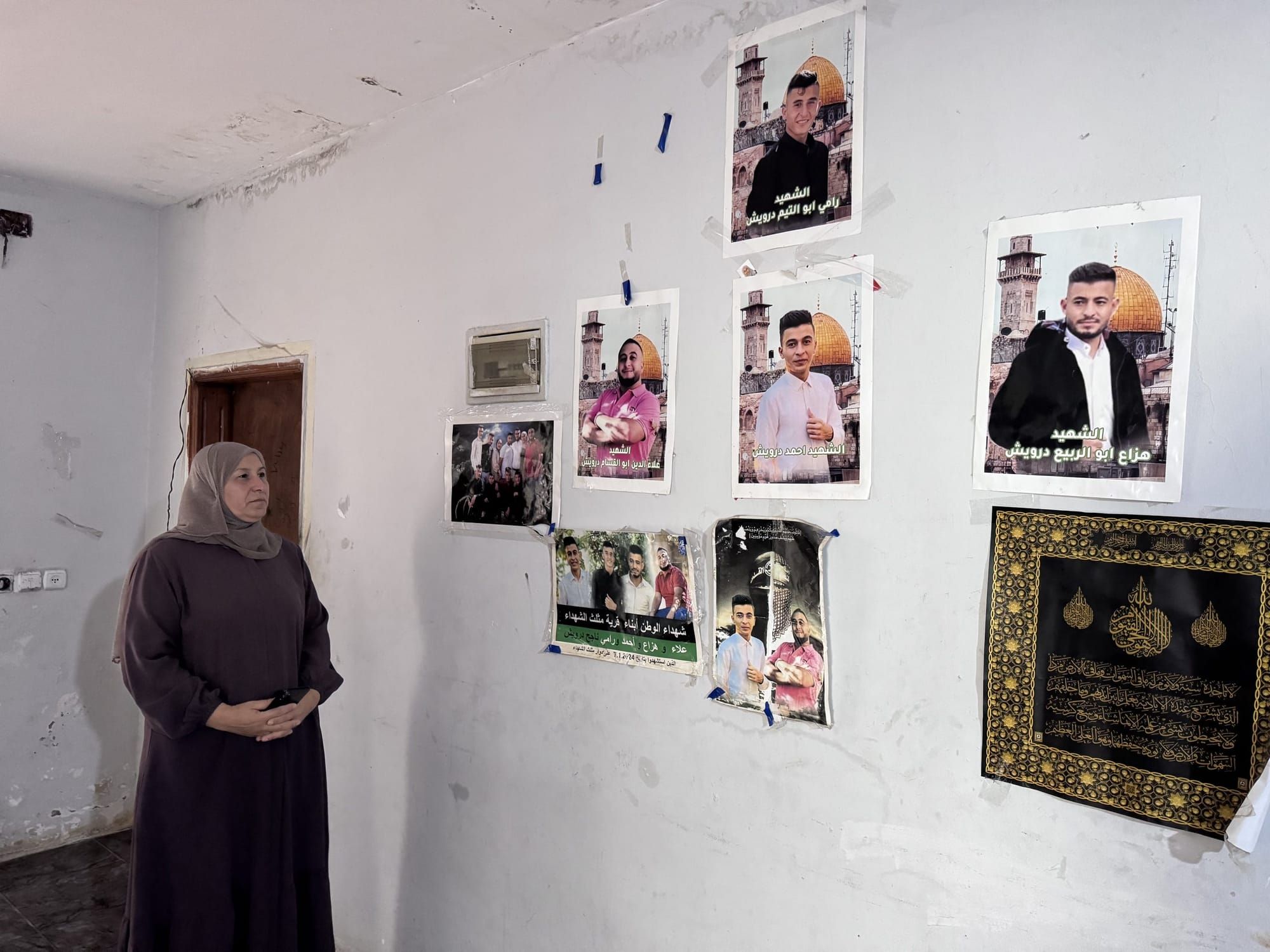
Ibtisam Darwish sat in her living room in the West Bank, Occupied Palestine, in late September, beside a wall covered in photos of her four martyred sons. The brothers were killed by an Israeli drone strike alongside three cousins while having tea in Martyr’s Triangle near Jenin in January 2024. Darwish learned they had been hit when she saw photos of her sons lying on the ground on a Telegram channel sharing news of the attack.
“People always ask me, ‘What did you feel?’ What can I say when my four sons are lying in front of me? What does one feel?” Darwish said. “You cannot find a single word to talk about it, to talk about what is happening inside you.”
As she tried to pick up the pieces of her life, one resource emerged as an essential source of support: the Mothers of Martyrs and Prisoners League, founded in the Jenin refugee camp in 2021 by the late Palestinian activist and educator, Wafa Jarrar. Amid the Israeli occupation’s systematic and calculated killings of young male Palestinians, the collective supports mothers grieving children killed or arrested by the settler colonial regime. While escalating settler and Israeli military attacks have made it increasingly dangerous for the group to drive to meet in each other’s homes, they continue risking their lives in order to comfort each other.
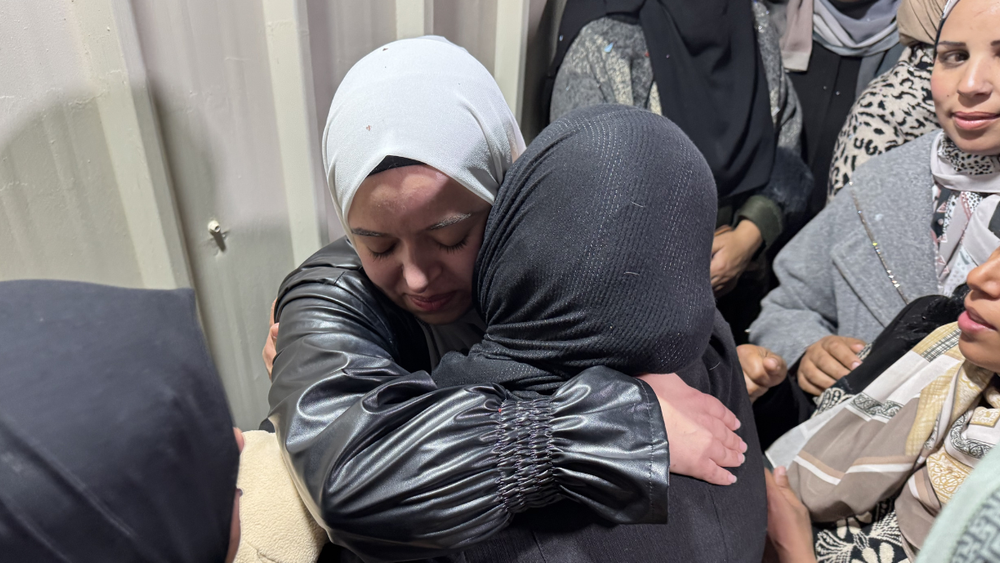
When a youth is killed, the league goes out to the home of the mother, where the women sit and get to know each other. “We all gather around her, and each one introduces herself by her name, and by the name of her son, the martyr,” Darwish said over WhatsApp.
“They were my source of strength, and I still go out with them,” Darwish said of the league, where her role has now changed from needing consoling to doing to the consoling. “We go out whenever someone has been martyred. To help her [the mother] endure just like we endured.”
A regular evening turned into a nightmare
Outside Darwish’s family home, on a gate leading to a garden full of plants, is a poster of the seven martyrs: Darwish’s sons Hazza’, 27; Rami, 22; Ahmed, 24; and Alaa, 29; and their cousins Mohammad Yasser As’ous, Wadee Yaser As’ous, and Razqallah Nabil Sleiman. Darwish cares for the plants every day, as a way of continuing life after her sons were killed.
Darwish remembers her sons waking her up that evening to let her know they were going to the Martyr’s Triangle area. She would never let them go out without telling her where they went, “so that my heart could be at ease,” she said.
The group of cousins had just sat down and ordered tea when an Israeli drone started circling over their heads.
“The owner of the coffee shop told me that he was just adding sugar to their tea when the rockets started falling on them,” Darwish said.
Shortly after going back to sleep, she woke up to a phone call from her eldest son, who was not with the group. He told her that there had been a bombing at the square where her children were. She tried calling them, but no one responded.
“I straight away opened the phone to see the news on Telegram. And people were writing, trying to order ambulances,” Darwish said. “I saw them, and they were lying on the ground.”
Darwish remembered that her sons always told her to be patient and strong in any situation, no matter how difficult. She rushed from the scene of the strike to the hospital where her sons had been taken. They were dead.
“Life is very difficult. It does not have any meaning anymore, especially here,” Darwish said. “There’s nothing called human rights. When the settlers come to your home, and they want to take it, is it reasonable to expect that you will not protect yourself?”
Israeli forces dressed up as doctors
The mothers’ league is full of women with similarly painful stories. One of them is Abeer Al-Ghazawi, whose sons, Basil and Mohammad Al-Ghazawi, were assassinated by Israeli soldiers who dressed up as medical staff and civilians to enter the Ibn Sina hospital in Jenin on Jan. 30, 2024.
Basil, 18, had been injured by missile fragments from an Israeli drone attack and spent three months in the hospital. His older brother Mohammad, 24, was there looking after him. They were both killed while they were asleep.
At that time, the league’s founder Jarrar had been there for Al-Ghazawi. Jarrar then started bringing Al-Ghazawi along for meetups with other women in the group.
“She was telling me that since you lost your two children, you can give them patience,” Al-Ghazawi said. “When I went and saw the mother of four martyrs, and many other mothers of martyrs—there are many—it eased the sadness. Alhamdullillah, the people are like me.”
“When I went and saw the mother of four martyrs, and many other mothers of martyrs—there are many—it eased the sadness. Alhamdullillah, the people are like me.”
Abeer Al-Ghazawi, Mother in the West bank whose sons were killed by Israeli soldiers
Jarrar, 50, was arrested and seriously injured during an Israeli raid in Jenin in May 2024, resulting in the amputation of both of her legs. She died due to the injuries the Israeli military inflicted on her, not long after she was released, in August 2025.
In the hospital raid targeting Al-Ghazawi’s sons, one other man was also killed. The Jenin Brigade militia group stated that two of the three men were members of the resistance group Islamic Jihad. Mohammad had been wanted by the Israeli military for two years, Al-Ghazawi said.
“Mohammad was working in a shop in the souk, and he lost many of his friends. Because of this, he walked down this road,” Al-Ghazawi said. “Like every mother, when she talks about her children, they exaggerate. But my children, alhamdulillah, everyone loved them. Mohammad was known for his laughter. They were simple, loving, calm.”
While her sons were killed, the Israeli military was also raiding Jenin refugee camp, and Al-Ghazawi and her family were thrown out of their home. She and her husband now live outside the camp, as do their two daughters.
Assassination of a journalist

Naheda al-Sabbagh, known as Umm al-Mutasem, joined the mothers’ league after her son Mutasem al-Sabbagh was killed by the Israeli occupation in March 2023. Her daughter, journalism student Shatha al-Sabbagh, joined the league frequently, filming and reporting on their activities.
“In the beginning, journalism was just something she was studying,” Umm al-Mutasem said. “But after her brother was martyred, she wanted to show what the occupation is doing to us, to our children, and to the Palestinian people in general.”
Less than two years after her brother’s death, on Dec. 28, 2024, Shatha, 21, was also killed. According to forensic evidence and eyewitnesses, she was killed by the Palestinian Authority security forces.
Shatha had gone with her mother, a friend, and two nephews to buy chocolate at the local convenience store in the Jenin refugee camp.
She was carrying one of her nephews and holding the hand of the other, with her mother standing behind, as bullets flew toward them. Umm al-Mutasem was closer to the door, so she managed to get back into the building, but her daughter, despite being so close ahead, was killed.
“Every time I stood up, there was shooting. I wanted to take my daughter and get her inside, but I could not do it,” her mother said. “I was screaming, and my voice was filling the mountains, filling the entire camp. And they did not cease the shooting. I was just holding and pulling her hand tightly, and I could not pull her toward me, so I just started looking at her, looking into her eyes, because my daughter was staring at me.”
For each of these mothers bearing unfathomable pain, the league has given comfort in the most difficult of times, a space to find hope and strength to continue living. Still, the memories of the martyrs live on. Darwish said that not a second goes by without her thinking of her four sons.
“They were everything, everything in my life. There is a huge absence at home now,” she said. “When you want to make food, when you want to make a cup of tea, when you get guests at night, it is as if I lose them all over again with every moment, with every second.”
Editorial Team:
Sahar Fatima, Lead Editor
Carolyn Copeland, Top Editor
Stephanie Harris, Copy Editor
Author
Synne Furnes Bjerkestrand is an independent journalist based in Amman, Jordan. She holds a bachelor's degree in Arabic and SWANA studies, and a master's degree in journalism. Her work has appeared in
Sign up for Prism newsletters.
Stay up to date with curated collection of our top stories.