This Minnesota abolitionist network is transforming how its community relates
When Relationships Evolving Possibilities responds to people in crisis, it has two rules: don’t call the police, and don’t police each other
Relationships Evolving Possibilities, or REP, is a Minnesota-based abolitionist network that supports community members during moments of crisis. The organization boasts two arms of work: a “radical ecosystem pods” that serve as community-based networks of care, and an emergency response hotline known as “revolutionary emergency partners.”
REP’s larger goal is to help community members transform the ways they relate to one another by diverting nonviolent situations away from the police, where situations often escalate into tragedy. While working toward a world without police, REP aims to create a society that doesn’t rely on policing while ensuring they don’t become a substitute for law enforcement. As the organization’s radical ecosystem pods manager Paige Reynolds says, “There’s agreeing not to call the police, and then there’s agreeing not to be cops with each other—and those can be two different things.”
Policing still shapes the landscape of the U.S. in ways that extend beyond just the physical presence of an officer, a department precinct, or a cop car. Policing also permeates our relationships, causing us to surveil one another, treat our neighbors with suspicion, and move in fear. REP’s work through their pods and community hotline seeks to dismantle those carceral frameworks, inviting members to change their perspective on their peers and show up for one another in ways that are generous and generative—all while centering the organization’s three core values: Black love and liberation, ancestral knowledge, and radical consent.
Prism spoke with REP co-founder Jason Sole, radical ecosystem pods manager Paige Reynolds, and community connections manager Yordi Solomone to discuss their work and the practice and potential of evolving possibilities.
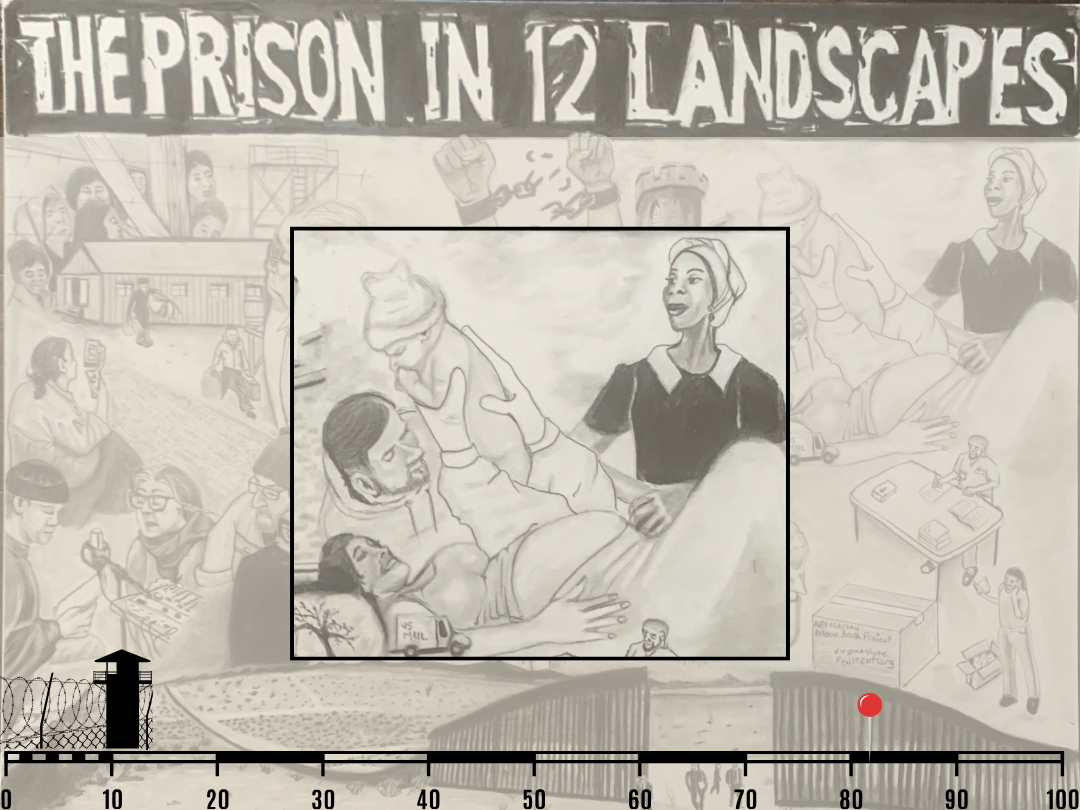
This Q&A is part of a series titled Prison in 12 Landscapes. The series runs through October and is organized to introduce readers to subjects beginning with the most—and easing into the least—proximate to prisons’ material form. You can read through the full series here.
This interview has been edited for brevity and clarity.
Tamar Sarai: I’d love to start by just learning about how REP got started and how you each got involved.
Jason Sole: It started with [theater director and artist] Signe Harriday. Signe reached out after [the police murder of] George Floyd. [We] had collabed a lot of different times and I always admired her work.
Signe knew a lot of the people that came into REP, and I’m just grateful for how it’s softened me and allowed me to grow and develop and try things. In 2020, I had no protest energy. I was done with all of that. I had done so many protests and occupations, my energy wasn’t there—and as a three-time felon, I’ve gotta move very smooth out here. I’ve gotta raise my kids, I gotta stay tempered. REP has been a place where I could just dream up things, sit [with] stuff— even the hard stuff—and I’m grateful to be a part of it.
Yordi Solomone: I think the part of REP that [speaks to me] is that there’s not one way to do things. We don’t have the answers; we’re just experimenting. This is an experiment. We’ve never been free, so how do we imagine and dream up freedom? And I think the ecosystem pods and the hotlines are sort of like an iteration of that. If it is not working, let’s pause and figure out what’s not working
There’s nonprofit trauma that we have all experienced—so much bureaucracy and navigating relationships that don’t even feel like relationships, so how do we daily deprogram the way we function in community and how do we show up as ourselves and actually build something? Even if it’s a failure, we’re still building it and figuring it out. That keeps me excited, and I feel like an ecosystem pod is a big part of that.
Paige Reynolds: I’ll pick up on that because I’m sitting with the “even if we fail” part. [We are] working through breaking down those nonprofit ideas of success, [where] if we create the program and get the grant funds, then we know it’s successful.
Part of what drew me to REP was that my political home at the time—Million Artist Movement—was more among artists, so we have been talking about abolition from the perspective of artists. As [author and activist] Toni Cade Bambara said, it’s the job of the artist to make the revolution irresistible. [We were] doing art stuff combined with teachings: bringing people to see plays, but having childcare and political education before and after; using art to get people thinking and out in the street; making community quilts; talking about what our communities could look like without policing and what’s a different way we could take care of each other. I was drawn to that kind of work within REP.
I remember from the beginning, Signe was talking about [how] we need something different from calling 911 and police. At the same time, we’re not trying to become the direct replacement for 911 and police because we know that’s part of the problem. This is about shifting culture and shifting people out of the mindset that the people around them are dangerous, breaking down our ideas of what is criminal and what is bad, and shifting towards taking care of each other [and] seeing our neighbors as having unmet needs that we actually know how to meet.
That’s part of how I came into REP as an artist, as someone who is interested in long-term revisioning and what arts, imagination, and culture can do for us to shift our storytelling about each other and about what’s possible.
Sarai: I wanted to hone in on the pods. For readers who are unfamiliar with that idea, what is a pod, and what information or resources do you give to community members who are interested in joining one or creating one from scratch?
Reynolds: We take inspiration for the pod concept from the Bay Area Transformative Justice Collective and [organizer] Mia Mingus. I believe when they first started, they were looking at [using pods] to address domestic abuse, child abuse, and finding ways to deal with [these issues] in their community without policing. Pods have since expanded, so when REP talks about pods, we mean a group of people who have come together with an agreed-upon purpose, goals, parameters, maybe even a set amount of time, and maybe set roles to do a specific thing. When the pandemic first hit in 2020, the Million Artists Movement formed pods together to help address COVID. We made little brochures to give to the community. REP was part of that too, and so we naturally carried [pods] into REP. In that case, having a pod looked like: Somebody’s sick. We go to this person’s house to grab some food because we know they have food ready. This person makes herbal tinctures. And then that person is a quilter and has some warm hats so the person can keep warm. We drop off a little care package [with these items]. So that was an example of a pod that had specific parameters; people didn’t have to go through a bunch of bureaucracy to get their care.
With REP, we emphasize breaking down community building into smaller bits and getting used to talking to your neighbor and being like, “Hey, do you need anything? I’m running to the store,” or “Hey, I got kids and I noticed that you got kids too. What if we started something on the block where we help each other take care of our kids?”
Pods don’t have to be permanent. Sometimes we burn ourselves out trying to make a thing last forever. Sometimes your pod may just be for an upcoming emergency, or maybe just for a [limited] time. So that’s how it’s looked so far, like planting a bunch of seeds and watching them grow and checking on the progress. Some people’s pods are flourishing. Some people’s pods are no longer operational, and that’s fine. That’s great. It worked for a time. It did what it needed to do.
Sarai: You mentioned how pods can include something as simple as checking in with someone before you go to the grocery store. How has being in pods changed the way you relate to people within your own neighborhood? Has it brought you new revelations about the spaces where you live?
Sole: Since childhood, I’ve always worked in teams. I’m from Chicago, and I joined a gang as a teenager, and we had a system: We had a treasurer, we knew who the secretary was. The gang that I was in was pretty large in Chicago, like a 500 head count. I saw structure, we had rank, we had people giving prayer. It was super organized. Not only that, but [there was also] the Nation of Islam and other Black organizations where I grew up. If you know about Chicago, the Eastside is half Christian and half Muslim, so it’s churches and mosques battling each other. I [also] played for Dunbar High School, and you’ve got to be a team when you play for Dunbar because other schools are going to be hard on you. So forming camaraderie and being the captain of the team, and then going to prison and having leadership in my gang [has meant] I’ve always had to work in groups of people. I don’t really know a life of being just on an individual basis; it’s always been squads. My family is [also] large as hell, and I don’t want to be out here building pods and not being true to my own family. I always try to make sure I’m not just rushing to be good to my neighbors or the people across the street; I want to make sure I’m doing right at the crib, then making sure my second and third cousins all know I still care, and then spread that further.
My pod usually looks like formerly incarcerated people, survivors, and people who don’t necessarily fit in a box. I got a duality: I teach at a university, but at the same time I still talk the language of the young people who are around me. So I try to make sure my pods—whether on campus or in community—can tap in with me. I ain’t saying I’ve got an answer or a solution. I’m not trying to be a savior, but I do think I could offer something that’ll make it a little lighter.
Yordi: I think [pods] gave me language for a lot of the things that we were already doing, or I that I was already doing. I think about my family, my grandmother, who is always like, “Who has their school fees coming up? Do we need to chip in? Who doesn’t have food?” It’s very basic-level stuff, but REP gives us the language and [helps us remember what] we’re already doing and affirming it.
Sarai: Do you provide ongoing support for people—even after they have started their pods? Are there concerns or questions that frequently come up? I’m thinking about what you said earlier about experimentation and not having all the answers, but kind of like creating things in real time.
Reynolds: Sometimes it is just practical resources a pod might need. One of the things that people often approach us about is [needing] a service provider for housing or food and looking for people doing it with the right values. For example, REP has a resource list that is vetted, so when we share something from that list with folks, we can [tell them that] if you call, they will or will not try to put you in contact with police or they are or are not connected to 911. That’s a consistent ask. Within a pod, there’s the people that you know, who are closest to you, who you like, and already have existing relationships with, like neighbors, coworkers, family. Then there’s a second layer of support that we talk about, like community resources or organizations. For that second layer of support, sometimes people don’t always know where to go.
Interpersonal conflict is always one that’s hard. There’s agreeing not to call the police, and then there’s agreeing not to be cops with each other—and those can be two different things. People are often looking for [help with] that. I think folks are also looking for help with moments when they’re de-escalating or trying to help folks that they may not really know. So the person may be like, “Hey, I have a block pod, but there’s a situation where it seems like there may be active violence, and we really don’t know who to call that handles those things except the police.” Working with REP’s values of radical consent, [means asking if they are] talking to the person who needs support. What do they want? Are you acting outside of that [expressed need]? What assumptions are you making? That’s the kind of thing that comes up a lot. You can have the pod established, but it’s a whole thing to work through how those values actually live in the everyday world.
One of the things we make sure we talk about when we talk about radical consent is that a lot of the time, the choices that we’re presented with are messed up in the first place. So, how do we help people find those alternatives, find what works best, what does the least harm and leaves dignity intact as much as possible?
Sarai: It sounds like a lot of the work is helping people navigate through issues collectively, like a thought partner. Are there specific pods or groups of people you’ve been able to act as a thought partner with?
Reynolds: Healthcare workers often come to us [because they understand] the amount of interaction between healthcare and the carceral system. We worked with a group called Campaign Against Racism, a group of healthcare workers who wanted to see themselves as more of a pod so that they could support each other as healthcare workers. They’re talking about [being] mandated reporters and how to navigate that. We’ve worked with them a few times, and they’ve really gotten clear about their values, and they’re talking regularly about going beyond [healthcare’s mandate to] ‘do no harm.’
I’ve done training with birth workers too, because birth workers are so close to families at such a vulnerable time. I’m a birth worker too, and we see a lot. We know that we have the capacity to put [a family] in harm’s way with the medical system or with the family policing system, and we want to make sure we’re not doing that. So it’s been really encouraging to see people who work in these systems that are [in proximity to] police and who are saying, “I don’t want to do that. I don’t want to perpetuate that. Can REP help me think through another way to do my work?”
Sarai: Another branch of work is the emergency hotline. What is the criteria for calls you respond to, and what are situations that you frequently encounter? How do you manage the needs of the community against the capacity that you have?
Solomone: I do feel like the community wants us to be on seven days, 24 hours a day, and I want that. But right now, we’re [available] Friday and Saturday from 7 p.m. to 12 a.m. We made it very clear that it’s low-level calls, nothing [related to] violence or guns because I think at the end of the day, we have to keep our dispatchers and our responders safe and there’s complications with good Samaritan laws. It was a very strategic and hard move to limit the calls.
Generally, we work in pods, and we never send only one responder out. Responders have their medical kit with them, and they go through over 90 hours of training. But no matter how many trainings you go through, it doesn’t really prepare you for the real thing. We often get calls from people feeling isolated and lonely and who just want to talk to somebody. Sometimes folks see something and [they want] REP to assess the situation, [like] if someone’s roommate is acting in an [unusual] way and they’re not sure if they should call the police. A lot of it is co-watching and being a co-conspirator. One of the things that was very clear to me when I came into REP was we’re not trying to replace 911; we’re not trying to do policing or surveillance. We’re trying to support and love people to the next step so that they feel like they’re not alone in that moment and so they don’t have to call the police for things that are low level or things that we could probably solve together.
Sole: People are understanding that they can do [this work] too. More than what we get right or wrong, people are understanding that whether it fails or does well, it’s an attempt.
When we started REP, we [gave it] a 10-year [expiration date]. We don’t know what it’ll look like after 10 years, but we wanted to hold the sacredness of it. We’re really trying to have a world where you don’t have to call the police [because you can use] Narcan or practice your de-escalation style. I know that I’ve gotta shrink when I de-escalate because I’m kind of tall. I have to get smaller and keep my hands up when I’m de-escalating, and sometimes I gotta take steps back. That might not be the case for other folks.
Sarai: In other cities and towns that have started emergency response programs, it’s a hotline or a text line. Are there models that you looked to when developing your program?
Sole: When we first started, we tried to talk to everybody—including [the anti-police terror project] MH First in Oakland, California, MPD150 and Crisis Assistance Helping Out On The Streets (CAHOOTS) in Eugene, Oregon. Their calls come through the police, but White Bird Clinic [works with] CAHOOTS, so we talked with them. Anybody who was trying something, we tried to get to on a call or a Zoom. The American Indian Movement had their own patrol many years ago, so they are in our training curriculum, and we give them credit. It was definitely a community effort to try and get this thing off the ground, and the community always asked questions and held us accountable.
Sarai: I’m from New York, and there was a lot of buzz around the mental health response program, but in many ways, it’s deeply attached to the NYPD. How do you prevent this type of programming from being subsumed into the police system? How do you resist that?
Solomone: It’s hard. I think it’s hard mostly because of resources and money and how the police are everywhere. I think one of the things that we’re very, very clear on is we don’t take state money. A lot of our funding comes from foundations, donors, and folks that are really interested in a non-state-sanctioned dream of safety. So every time I’m having a one-on-one with someone, and they talk about being really interested in experimenting and collaborating with REP, my first ask is, “Are you working with the state?” There’s also a vetting process.
If I don’t know you or if I can’t find two or three people that say they can vouch for you, it’s gonna be a problem. We’ve seen some folks that were vetted and just didn’t really rock with REP. This was not the experiment for them, and they walked away. So I do feel like resisting is really hard, because I feel like we’re swimming in the waters of state-sanctioned violence all the time. And I think there’s a lot of folks that are invested in wanting experiments like this to fail or [who would] like for us to not be experimenting. There’s also a lot of folks that are associated with the state that I work with personally, that are doing amazing work, but I don’t think it would make sense for REP to collaborate with them because there’s a specific string attached that feels weird and outside of our values. It’s a 10-year experiment.
I keep thinking about what it looks like to resist. To me, it’s disrupting how we have imagined safety and to [instead] think about tending to our people. Do people feel cared for? Are we meeting community needs? I think that’s kind of the bottom line. If we’re not meeting community needs in doing all of this, then something is off.
Sarai: Is there any upcoming work or programming that you’re particularly excited about or want to give our readers a lens into?
Reynolds: We’ve been approached by trans community members, especially [amidst] public violence against trans folks over the past few years. People are asking how we can start thinking about taking care of each other as a collective—whether it’s ride shares or self-defense or organizing our community of trans, nonbinary, and two-spirited folks. We’re responding to that now and hosting a series of trans community meetings.
REP is making the container for folks to come together around some shared values and then seeing where it goes from there. I’m really excited about that. It feels needed. There’s been speculation and tension around upcoming elections, too. Minnesota is a sanctuary kind of state for a lot of queer and trans people, and we have a lot of people coming in from other states now, looking for resources and needing community.
One thing I appreciate about REP’s approach is again: not trying to replicate cops, not trying to replicate the nonprofit industrial complex, not trying to have this work be funneled through an organization where we make the prescription, we create the thing, and that’s all we offer you. Instead, how can we make space and have people come together around their own brilliance and their own needs? We just create the container and then folks decide how they want to continue to engage with us. We also don’t want REP to be the only thing. We want to see a bunch of experiments going on all across the Twin Cities. We want people to form all kinds of food distribution, and childcare collectives, and neighborhood community response, and block pods, and self defense clubs, and all of that.
Author
Tamar Sarai is a writer, journalist, and historian in training. Her work focuses on race, culture, and the criminal legal system. She is currently pursing her PhD in History at Temple University where
Sign up for Prism newsletters.
Stay up to date with curated collection of our top stories.