Miami’s landscapes of gentrification
Clusia guttifera and snake plant tell the story of Miami’s transformation due to rapid development, speculative buying, and outside investment
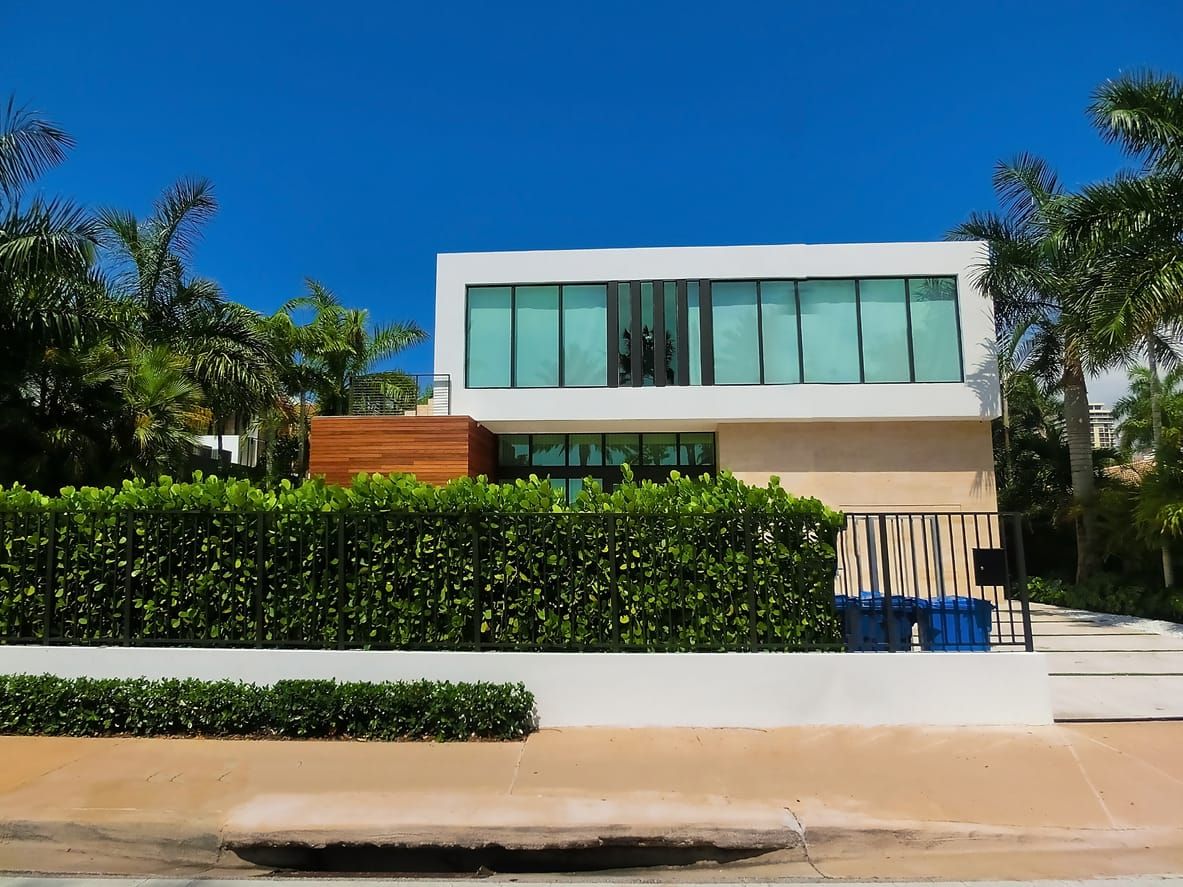
In Miami, plants tell the story of the city’s transformation just as clearly as property records or census data.
Some plants arrive as symbols of permanence and status, their leaves forming living walls around new luxury builds. Others linger quietly on neglected lots, growing in the shadows, overlooked but enduring.
Two species, the Clusia guttifera and Dracaena trifasciata—known more commonly as the snake plant, have become unlikely markers in Miami’s changing neighborhoods. Clusia is favored by developers as a ready-made privacy screen. Snake plants, long dismissed as “invasive,” are being reclaimed by an artist who sees in the plant a different vision for what it means to take root.
The modern white picket fence
Over the past decade, rapid development, speculative buying, and a flood of outside investment transformed Miami, block by block, driving out longtime residents and erasing cultural landmarks. Little Haiti, Overtown, Allapattah, and other historically Black and immigrant neighborhoods face waves of displacement as white, cube-shaped homes replace bungalows and apartment buildings. Clusia guttifera emerges as a modern rendition of the white picket fence, tracking paths of gentrification and home loss.
An April 2024 report from the business and financial services company Moody’s revealed that Miami rent increased by 32.2% between 2020 and 2024, compared with the national growth rate of 19.3%. The skyrocketing rent placed Miami just behind New York City as the second least affordable metro area in the U.S.
The affordability crisis is compounded by climate pressures, with higher-elevation neighborhoods—often communities of color—targeted for redevelopment in a process some call “climate gentrification.” As sea levels rise, these communities face shifting property values and encroaching development as oceanside dwellers scramble to relocate. Miami, built along miles of coastland, has become ground zero for climate gentrification. In this reshaping of the city, plants tell the story: Clusia guttifera hedges rise as living walls of exclusion around new builds, while the snake plant, thriving on vacant lots and in overlooked corners, offers a vision of rootedness that strengthens community rather than displacing it.
Many of Miami’s changing neighborhoods are newly laced with Clusia hedges, and many a Publix grocery store has lined its curbs with the shiny shrub. Its stiff, waxy pads stand out against the more intricate philodendrons, cascading pothos, and prickly palms that form the backdrop in Miami’s green spaces. For some residents and horticulturists, the succulent has become a symbol of unwanted change.
“I’d say I started noticing Clusia in my neighborhood maybe six years ago as the neighborhood went through the 17th wave of gentrification,” Miami resident Amanda Rose said. “Now it’s become so aesthetically redundant that it feels visually invasive, it feels energetically invasive.”
Using native plants, there are so many beautiful textures, and colors, and shapes that can decorate their homes and raise the value of our homes too.
Natalia Manrique
Rose’s house, bought in 2003, is located in what is now known as Miami’s Design District. However, when she moved in, the neighborhood was still considered part of Little Haiti. This was before the area underwent a striking transformation when Craig Robins, CEO of real estate company Dacra, poured $1.4 billion into constructing high-end art galleries and luxury shopping plazas. The shift rippled out into the surrounding neighborhoods. Many of the original bungalows and brightly painted homes were replaced by cube-style houses painted white and lined with Clusia hedges, often planted in tandem with “sold” signs.
“I don’t inherently have any beef with any plant. I’m not a purist as far as native species only,” Rose said. “For me, it’s this ideology, what it represents, that is so problematic. It’s just this way that it’s been weaponized as a tool of separation, as a tool of colonization, and as a tool of this corporate land grab from developers is really the issue.”
The rise of Clusia
A decade ago, Florida native Clusia rosea was only found along the coast of southernmost Florida. Unlike the guttifera variety that now dots the Miami landscape and is native to the Caribbean, Clusia rosea flowers and fruits, providing sustenance for wildlife. But even Clusia rosea is only native to the rocky seashores of Florida’s Keys. Thanks to rising sea levels and heat-stripped soil, the preferred climate of both varieties is encroaching north.
“The Clusia that is around is not native. In my understanding, it’s not dangerous in itself, but our local animals don’t get nectar or food from it,” said Robert Colòn, landscape architect and resilience coordinator with Miami-Dade County’s Office of Environmental Risk and Resilience. “It’s not invasive, but the risk is whenever you have a massive planting of one species, our community might be more vulnerable to disease and pests.”
Clusia’s sudden rise in Miami is partly thanks to the plight of Florida Ficus, which was plagued with gnat-like whiteflies in the late 2010s. Clusia’s no-nonsense, rather sterile qualities provided the perfect solution for the Ficus mess. The plant neither flowers nor fruits, attracting little to no pests.
“Clusia is also being overused on the consumer side because they see it as a ‘clean’ plant—a certain aesthetic,” said Natalia Manrique, owner of NaMa Native Landscapes and Flora of Miami garden center. “I don’t know if it’s some sort of Miami issue that makes it look a little plastic, but you could translate that to many different things that happen in Miami. It’s like the white house with the green Clusia hedge, over and over and over.”
Agricultural experts fear that Clusia cultivation might follow the same path as Ficus. Both species are grown as privacy hedges, with dozens of plants placed in close contact—potentially facilitating infection. Clusia guttifera is commonly grown from cuttings, which is part of what makes it affordable for consumers and so lucrative for landscapers. But this technique replicates a single DNA across the crop, depleting genetic diversity that would otherwise strengthen the plant against disease.
Still, as the demand for the plant grew across Miami, large landscaping companies swiftly answered the call for Clusia. Ring a Bell Farms, Mr. Clusia, and Oasis Landscape are among half a dozen nurseries in South Dade alone that specialize in Clusia. Even the website URL for Oasis uses the phrase “we sell clusia.” Mr. Clusia’s inventory includes Clusia rosea, but only as a tree. The company confirmed that only Clusia guttifera is available for hedge installation.
Ring a Bell Farms in Miami’s Redlands sells Clusia for $20 a plant. Despite being the largest nursery for miles, the farm only sells the guttifera variety. The company’s website emphasizes sales to real estate developers, harping on “curb appeal” and “first impressions.”
Not everyone in the Magic City is on the Clusia train, however. Manrique often encounters clients who have just moved into new homes and want their Clusia removed.
“I wish more developers and landscapers could understand it is also a selling point to use native plants. Using native plants, there are so many beautiful textures, and colors, and shapes that can decorate their homes and raise the value of our homes too,” Manrique said. She recommends Simpson’s stopper, Crabwood, and Jamaican caper as native hedge alternatives to Clusia that also provide sustenance to wildlife.
Extractive or collaborative
In Little Havana, artist and organizer Ọmọlará Williams McCallister sees another plant telling a very different kind of story about Florida.
The snake plant, formerly known as Sansevieria, can be found across Miami’s many vacant lots, often owned by absentee landlords waiting to cash in when the time is right. To many, the plant is just another “invasive” species. To Williams McCallister, it’s a lesson in how to live in a place without taking it over.
“When we say invasive versus native, what we’re saying is this space is for people who are from here, not people who are not from here,” Williams McCallister said. “But the issue is not that people are not from here; the issue is how people are interacting with the ecosystem, and how they’re either extracting, contributing, [or] collaborating within the ecosystem.”
Snake plants became popular in Florida decades ago because of their ornamental appeal, and they were once studied for fiber production. Now, the plant is recognized as a category two invasive plant in parts of South Florida, hardy enough to tolerate shaded understories and spread through rhizomes, helping to bind the soil. Williams McCallister said this likely helps with moisture retention during Miami’s heavy rains, although there are no ecological studies to substantiate the claim. Williams McCallister harvests snake plants to make fiber and paper, serving as a direct connection to African and Caribbean traditions of working with what’s locally abundant.
Like the snake plant’s roots, Williams McCallister’s work often happens out of sight, building stability beneath the surface. The snake plant’s slow, underground spread also mirrored Williams McCallister’s own “relational network building” when creating Blaq, open studio hours that enable queer and trans Black artists and practitioners to access materials at Miami’s Paper and Printing Museum, allowing them to learn new skills in a predominantly and historically white space. “I think affordability is definitely an issue within Miami,” Williams McCallister said. “And on top of affordability, there’s issues of lack of model and mentorship for people. How have people made this shit work?”
Affordability and simplicity are also driving the Clusia craze, but it turns out that Clusia guttifera is more high-maintenance than many bargained for. Without maintenance, the plant quickly becomes a towering wall, upward of 20 feet tall, and its pruning requires a lot more than just chopping dead plant material to prevent the hedge from turning brown with rot and mold.
“The issue with Clusia is the leaves are very thick and meaty, and they’re not meant to be trimmed with hedgers; they need to be clipped with pruners,” explained Veronica Charpentier, horticulture program specialist at University of Florida Extension Office. “Is it overused? Yes. But it’s really that people don’t choose the right plants.”
Clusia and the snake plant are both transplants to Miami. But there is sharp contrast in the way the community uses each within its surroundings: one used as a barrier to keep out the outside world, the other used to protect and give back.
In a city where the pace of development threatens to uproot entire communities, these plants become mirrors, reflecting the kind of presence residents want to have in their environment: extractive or collaborative, walled-off or woven-in.
As Miami continues to change, the question for both plants and people is the same: Will you take root as fortresses or as networks?
Editorial Team:
Tina Vasquez, Lead Editor
Carolyn Copeland, Top Editor
Stephanie Harris, Copy Editor
Authors

Kat Grimmett is a writer, educator and herbalist. As a South Florida native, her work explores community-based solutions to issues regarding the food system, environment and urban development.

Alexandra is a Cuban-American writer based in Miami, with an interest in immigration, the economy, gender justice, and the environment. Her work has appeared in CNN, Vice, and Catapult Magazine, among
Sign up for Prism newsletters.
Stay up to date with curated collection of our top stories.