Filed Under:
Democratic Miami mayor should end agreement with ICE, advocates urge
A coalition of immigration rights advocates urged City Commissioners to end Miami’s 287(g) agreement between local police and federal immigration agents, citing community fear and public safety

Alexandra Martinez
Real journalists wrote and edited this (not AI). Independent, community-driven journalism survives because you back it. Donate to sustain Prism’s mission and the humans behind it.
Real journalists wrote and edited this (not AI)—independent, community-driven journalism survives because you back it. Donate to sustain Prism’s mission and the humans behind it.
Many Miami voters rejoiced in December when they elected their first Democrat mayor since 1997—a potential halt to the conservative political shift seen in the last presidential election. But advocates and voters say Mayor Eileen Higgins, who is six months into her new position, has failed to follow through on one of her key positions: ending the controversial 287(g) agreement between law enforcement and Immigration Customs Enforcement (ICE).
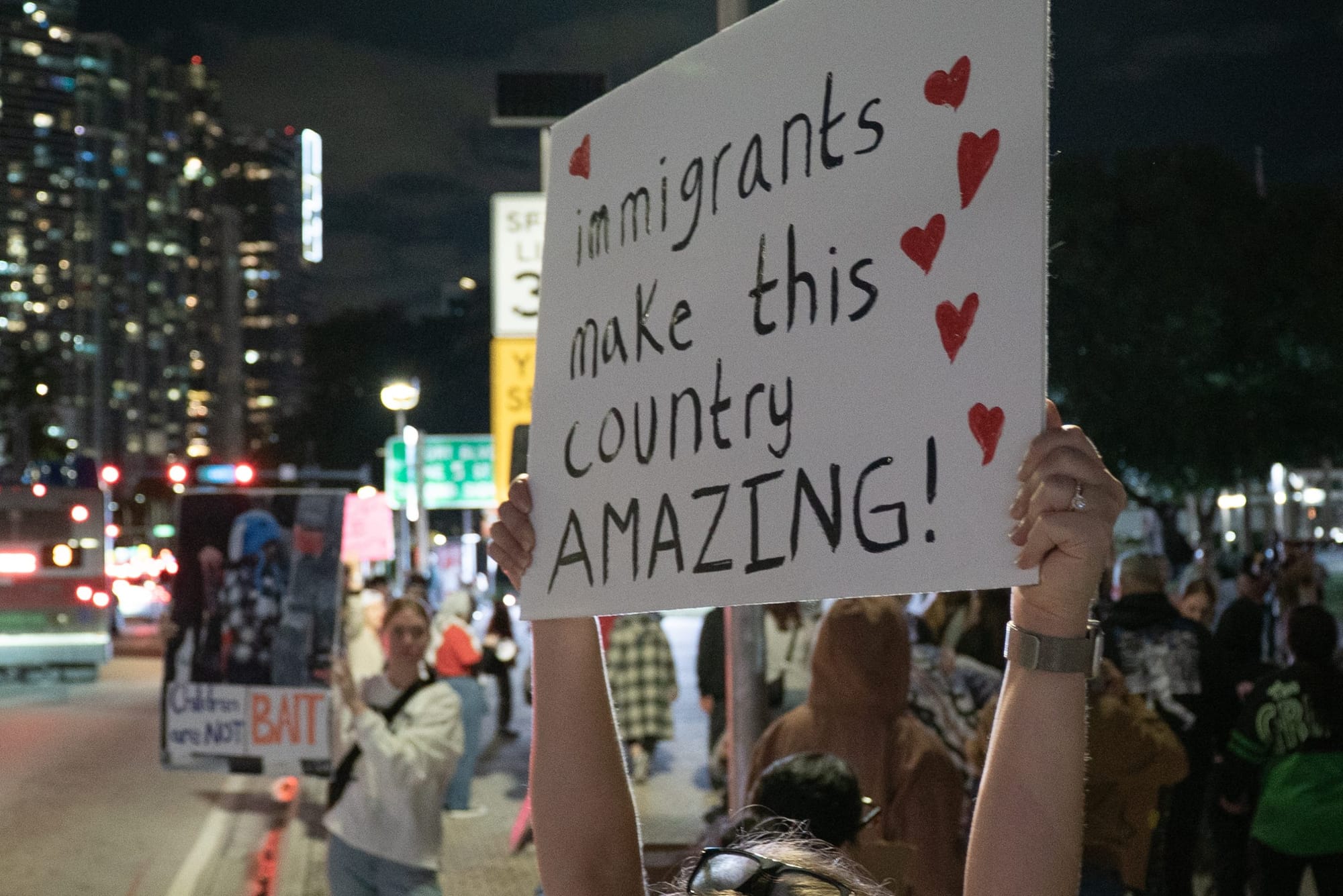
A coalition of immigrant rights advocates, community organizations, and local residents gathered outside Miami City Hall on June 25, before a City Commission meeting to call on Higgins to terminate the city’s 287(g) agreement, arguing that the partnership between local police and ICE, which was enacted last year, has created fear among immigrant communities and undermined public safety. Higgins did not attend the meeting; she did not respond to Prism’s request for comment.
Representatives from organizations, including the Black Liberation Alliance Movement, Miami Democratic Socialists of America, the Florida Immigrant Coalition, Community Justice Project, The Workers Circle, League of Women Voters of Florida, Family Action Network Movement, and Miami Workers Center, held a press conference before addressing city officials.
Speakers said the policy has discouraged immigrants from reporting crimes, seeking emergency assistance, and participating in everyday community life.
“As a coalition of organizations, residents and concerned citizens, we’re calling on Miami-Dade commissioners and our new mayor to rectify the mistake they made a year ago,” said Thomas Kennedy, an organizer with Florida Immigrant Coalition.
Organizers cited state data that shows Miami has recorded the highest number of immigration encounters among Florida municipalities participating in the program.
The city has been part of the 287(g) agreement for the past year, after commissioners voted 3-2 in June 2025 to join the ICE partnership, despite widespread public opposition. The agreement deputizes selected local officers to act as federal immigration agents, enabling them to question, arrest, and process individuals for immigration violations.
Although the commission’s races are officially nonpartisan, the vote split along party lines. But, since then, the city elected Higgins, who has criticized the decision to participate in the 287(g) program. Newly elected Commissioner Rolando Escalona has also said he is open to ending the agreement.
The rally came days after attorneys with the American Civil Liberties Union of Florida, Community Justice Project, and Americans for Immigrant Justice sent a June 22 memorandum to Higgins and the City Commission asserting that neither Florida nor state law requires municipalities to enter into or maintain participation in the federal immigration enforcement program.
The memo argues that, despite statements from Gov. Ron DeSantis and Attorney General James Uthmeier, the governor lacks constitutional authority to remove elected municipal officials solely for voting to terminate such an agreement, unless they have been indicted for a crime.
After hours of public comment opposing the program during the meeting, commissioners took no formal action. Still, three of the five commissioners—Christine King, Rolando Escalona, and Damian Pardo—said on the record that they would support withdrawing from the agreement if doing so is legally permissible.
Residents and activists told Prism, as well as commissioners at the meeting, about the harm the ICE partnership inflicted throughout the community.
“The agreements make it very hard for people in different immigrant communities to feel safe,” Kendra Howard, a lifelong Miami-Dade County resident and member of the Black Liberation Alliance Movement, said in an interview with Prism. “Many times, those same individuals will be aware of crime, and they won’t report it because they feel unsafe. They feel like if they call the police, then there’s a chance that they can get deported. So we’re not keeping our community safe by doing that.”
Howard said the climate of fear extends beyond interactions with police, referencing a community member who did not go to work out of fear of getting deported.
“That’s someone who’s helping the community, because she’s working at a local food bank, but she’s also in fear of her status,” Howard said. “Someone finally decided to go by her home to find out what was going on. That’s not appropriate for someone to be in that much fear that they can’t even do things that would allow them to make a living, even to help the community. ”
Howard said she believes the city’s relatively new mayor is still in a position to reconsider the policy.
“She may not have been aware of the totality of how it impacts the entire city,” Howard said.
At the rally, Ariane Betancourt of the Workers Center shared her family’s experience after her father was detained, arguing that the agreement contributes to family separation and discourages people from calling 911 during emergencies.
Marcello Balladares, 26, who attended the rally with the Miami chapter of Democratic Socialists of America, said the agreement has eroded trust between immigrant communities and law enforcement.
Seeing a cop on the street and not even knowing if they could report you to immigration, I think that really damages the trust that people are supposed to have in the ones that are supposed to be watching out for them.
Marcello Balladares, miami chapter of the democratic socialists of America
“[There’s been] a feeling of fear for a lot of folks, regardless of their own documentation status, being worried for their neighbor, worried for their family, for their friends,” Balladares said. “Seeing a cop on the street and not even knowing if they could report you to immigration, I think that really damages the trust that people are supposed to have in the ones that are supposed to be watching out for them.”
Renata Oceto, deputy director of the Florida Immigrant Coalition, said the organization receives roughly 1,000 hotline calls each month from people affected by immigration enforcement. She described cases involving traffic stops, family separations, and residents who are afraid to seek help.
Attorney Miriam Haskell of the Community Justice Project said local officials have legal options to end the agreement. The legal memorandum sent to lawmakers also outlines what attorneys describe as a legal pathway for municipalities to terminate existing agreements by following the termination provisions contained in their memoranda of agreement with ICE.
City Attorney George Wysong cautioned commissioners that withdrawing from the 287(g) agreement could expose Miami to retaliation from state leaders, including the possible loss of state funding. He said the city receives roughly $7.5 million annually from the state.
Commissioner Christine King dismissed the financial argument.
“$7.5 million is worth saving a life, a family,” King said. “We’ll make it up some kind of way. … We will figure it out.”
Organizers are continuing to talk to commissioners to encourage them to put the issue to a formal vote.
Balladares told Prism, “While it’s OK to be excited about [political change] … it’s also important to hold the politicians that we elect into office accountable to what they promise.”
Editorial Team:
Sahar Fatima, Lead Editor
Lara Witt, Top Editor
Stephanie Harris, Copy Editor