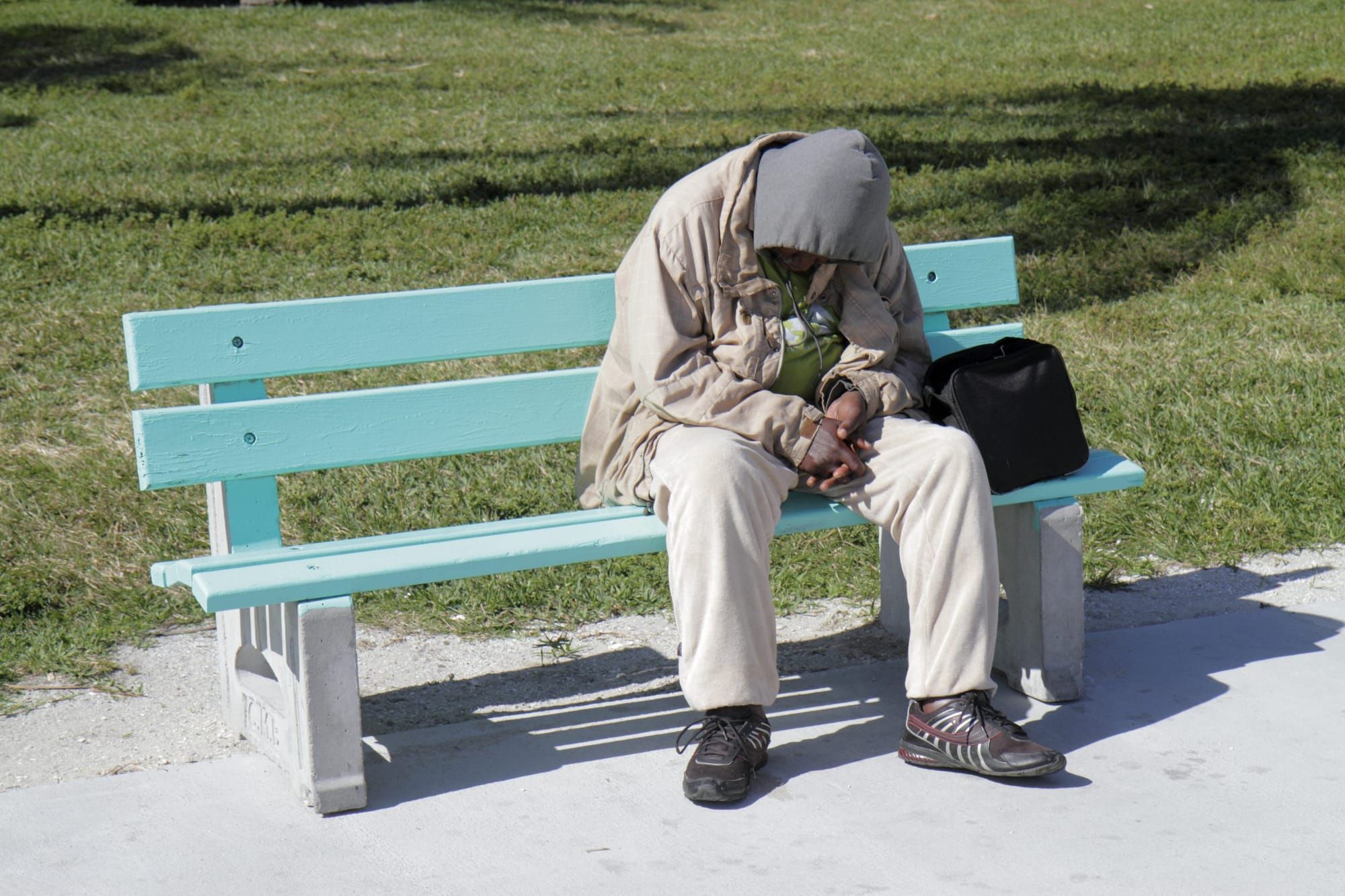
Organizers held a “Homeless Solidarity Sleepover” on Aug. 3 at a public park in Miami Beach to challenge city laws that criminalize homelessness. Members of the Miami Coalition to Advance Racial Equity (MCARE) and the National Coalition for the Homeless held the sleepover at Lummus Park, directly across from the iconic former Versace Mansion. The groups said they intended to protest the city’s practice of arresting and deporting homeless people, which critics argue is both discriminatory and inhumane.
According to MCARE founder David Peery, who has been unhoused in the past, the sleepover was part of a local commemoration of National Solidarity Week, an initiative of the National Coalition for the Homeless.
“What the city of Miami Beach is doing is, quite frankly, a violation of human rights,” said Peery, accusing the city of systematically removing homeless residents and either arresting them or relocating them to varying neighborhoods as far as Richmond Heights, 30 miles south of Miami Beach. “It’s creating a humanitarian crisis.”
Miami Beach’s enforcement of an ordinance that bans sleeping outdoors on public property, which began in October 2023, has led to a sharp increase in arrests among individuals experiencing homelessness. According to data obtained through a public records request by MCARE, nearly 50% of all arrests in the city since then involve homeless individuals. Violations of this law can result in a prison term of up to 60 days and a $500 fine, with the potential cost to taxpayers for one arrest reaching up to $17,580. In contrast, the annual cost of a studio apartment in Miami Beach averages more than $16,000.
The solidarity sleepover comes after a June Supreme Court ruling allowed cities to arrest individuals for sleeping in public spaces and follows Gov. Ron DeSantis’ recent legislation promoting the creation of sanctioned encampment sites, which critics argue are essentially internment camps.
While Miami Beach has not yet established any sanctioned encampment sites, Peery expressed concern that political and financial factors could eventually lead to such developments, particularly in less populated areas of Florida.
In Miami, where 60% of the homeless population is Black, Peery said these tactics are particularly racist.
“The city of Miami Beach is returning to its ugly, racist roots as a sundown town,” Peery said. “That’s effectively what they’re telling the homeless with this ordinance that bans sleeping on public property. Because the homeless have no other place to sleep. They have no alternative but to sleep on public property.”
The sleepover event saw a substantial police presence, which Peery described as excessive and intimidating. He said the Miami Beach Police Department set up in two areas surrounding the park, with flashing lights surrounding the protestors.
“It felt like an overwhelming show of force for a peaceful protest,” he said.
Despite the heavy police monitoring, Peery said it appeared the police had no intention of arresting the participants, indicating that their presence was more about intimidation.
The event faced additional challenges from the weather, as the outer bands of Hurricane Debby made landfall on South Florida, with heavy rain and thunderstorms cutting the sleepover short. Peery estimated that about 100 people attended the rally, with around a dozen staying until 1:30 a.m. to demonstrate solidarity with the homeless community before lightning strikes cut the event short due to safety concerns.
“We’re all a lot closer to being homeless than being owners of Century or Lennar real estate,” said a member of Planting Resistance Collective during the event. “We’re here in solidarity; all of us together have power.”
Dr. Armen Henderson, founder of Dade County Street Response, spoke during the rally about the severity of the conditions the unhoused community faces.
“We see them losing weight, getting cancer, getting hit by cars,” Henderson said. “We see their sandals melting into the ground because it’s so hot outside. We see people with feces on themselves because they have to walk a mile to use a bathroom or they’re denied access to a bathroom altogether. Housing is a human right.”
Peery was encouraged by the solidarity shown by both participants and passersby, including unsolicited donations and expressions of concern from international visitors. But he acknowledges the difficulty of fully replicating the experience of homelessness for just one night, emphasizing the need for ongoing advocacy and systemic change.
“These [events] help create empathy and understanding and compassion,” Peery said.
Author
Alexandra is a Cuban-American writer based in Miami, with an interest in immigration, the economy, gender justice, and the environment. Her work has appeared in CNN, Vice, and Catapult Magazine, among
Sign up for Prism newsletters.
Stay up to date with curated collection of our top stories.