Smaller cut in revised Miami-Dade arts budget still harms struggling community, artists say
New county budget proposal restores most of the $12.8 million initially planned for cuts to arts and cultural grants. But artists say Miami’s arts need more support, not less

This project is supported by The Andy Warhol Foundation Arts Writers Grant.
After months of pushback from artists and community members, Miami-Dade County Mayor Daniella Levine Cava is canceling most of the proposed cuts to arts and cultural grants in the upcoming budget. While the updated budget now meets some of the community’s demands, activists say partial restoration is not enough as other lingering problems remain.
On Aug. 19, the night before a County Commission meeting that artists, students, and cultural workers planned to flood, Levine Cava unveiled an updated fiscal year 2025-2026 budget that no longer slashes $12.8 million from the grants. Instead, the new plan leverages nearly $66 million in newly identified and recovered funds to restore community priorities, including $11.5 million to partially restore cultural arts programming grants. The updated budget also keeps the Department of Cultural Affairs (DCA) as an independent agency.
But Levine Cava’s plan still cuts cultural funding while boosting the sheriff’s department and reducing funding to programs such as eviction diversion and small business support. The arts funding also isn’t recurring, meaning that even if this budget is approved when commissioners vote on Sept. 18, cuts could be back on the table next year.
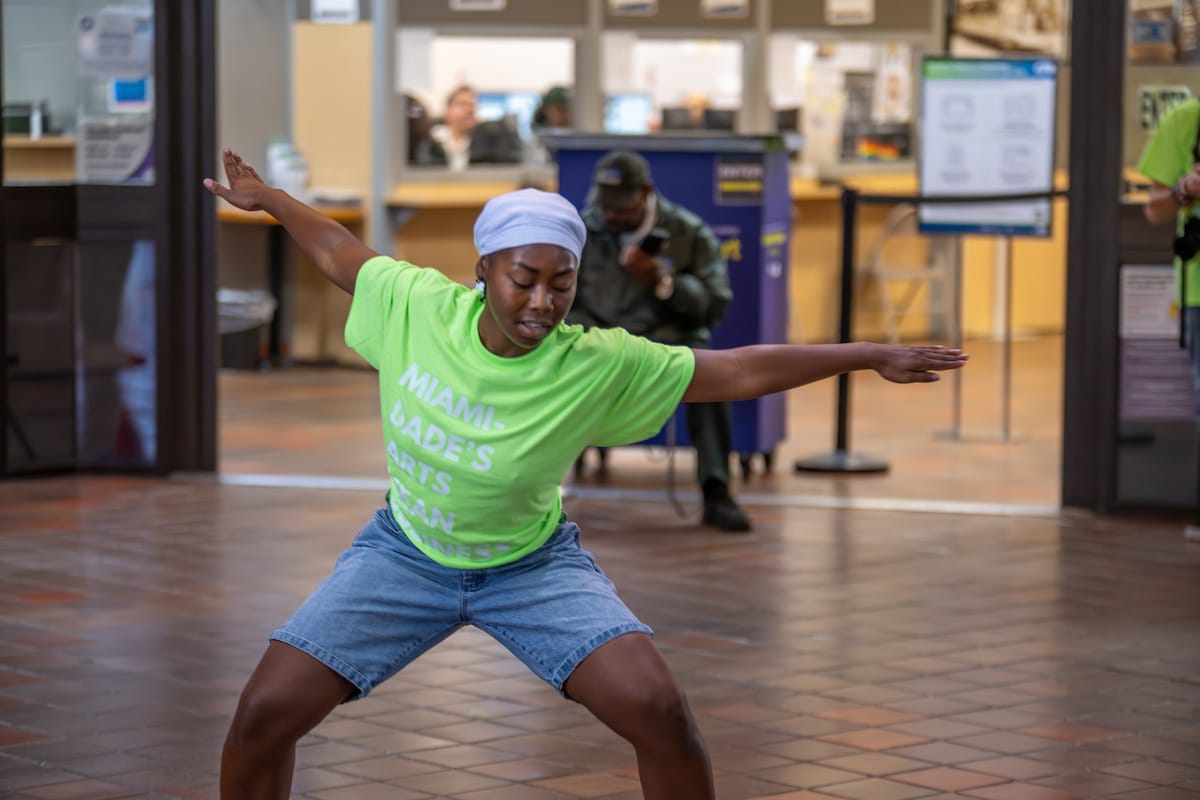
“It’s a half-baked commitment to a very important lifeline in Miami,” local artist Pamela Largaespada said at a community rally on Aug. 20 at the Stephen P. Clark Government Center. Seven hundred artists and advocates, clad in neon green shirts emblazoned with economic impact numbers, packed the commission meeting room and spilled into overflow areas.
“Miami arts is like an artery; to do a partial reinstatement is not a commitment that we deserve,” Largaespada said. “We deserve a full reinstatement. If anything, I would ask for more support.”
Levine Cava’s office did not respond to Prism’s request for comment but shared some thoughts during an Aug. 19 virtual town hall meeting held after she announced the new budget.
“I will only tell you what a terrible burden this has been for me, finding $402 million to keep this county going, because we can’t print money,” Levine Cava said. “I’m very happy that we’ve been able to find some stopgap measures. It’s not really a long-term solution, but we want to work together to make sure that we stay strong and accept our destiny as the most dynamic and diverse place on the planet, so much animated by our arts and culture.”
The data doesn’t lie
Largaespada, a self-described “Miami art kid” who works at O Cinema and conducts outreach for the Miami Artist Census, still remembers when her alma mater, an arts high school, was defunded in 2018. She said she feels that the Miami Artist Census is similarly underappreciated.
“Just because we’re not a plot of land that they can build a building on doesn’t mean we’re not valued,” Largaespada said. “I feel like [the Miami Artist Census is] doing a lot of the heavy lifting; the county’s not surveying our needs as artists. The county is not considering that we need health care, we need child care, we need basic human rights, and it’s being overlooked.”
The Miami Artist Census, the first artist-run data project of its kind in Florida, provides a window into the realities of the creative workforce. Adapted from a Los Angeles model, it collected responses from 443 artists across disciplines between October 2024 and January 2025.
The findings reveal widespread precarity: 88% of employed artists lack benefits, 75% have no paid sick days, and 73% have no paid time off. Three out of four reported considering leaving Miami-Dade altogether.
“I’ve been a bartender, I’ve been a freelancer, and I’m tired of traveling to other cities to make an actual living wage and coming back when I have a 5-year-old to parent,” Largaespada said. “A lot of magic in the city would cease to exist, and I want to see my peers excel and thrive in this city that is our home.”
Taken together, the survey results reveal a community that contributes enormously to the region’s cultural identity, yet struggles to access basic protections and stability. Organizers with the open artist collective Artists for Artists: Miami (A4A: MIA) framed the mayor’s budget pivot as proof of the power of collective action. But the group also called for further action.
“Considering this a win would fail to recognize how the county budget continues to make devastating cuts to eviction diversion and small business support, [while] raising funding for the Sheriff’s Department, all while people are illegally detained at the county’s Everglades Concentration Camp,” the group said.
The sheriff’s office’s proposed budget stands at $1.1 billion, an 8.5% increase from last year. This comes as Miami-Dade confronted a $400 million shortfall, which Levine Cava attributed to the expiration of federal pandemic relief funds and the added costs of newly created constitutional offices, including the sheriff’s department.
In her Aug. 19 memo, Levine Cava reported uncovering $65.8 million in newly available funds, including $33.2 million in unspent constitutional office money, $6.6 million from additional departmental adjustments, and $26 million from the County Office of the Tax Collector.
The community reacts
The mayor’s reversal followed an extraordinary mobilization by the arts community. Groups under the umbrella campaign Arts Action Alliance of Miami-Dade County organized rallies, petition drives, and a visible presence at county meetings. More than 6,000 residents signed a petition urging full restoration of funding and preservation of the DCA as an independent department.
The DCA, established more than 50 years ago, is nationally recognized as a model for equitable funding. Its elimination would dismantle institutional expertise and advocacy that have helped build Miami into a cultural capital, according to Renee Pesci, executive director of the Arts and Business Council of Miami.
Pesci noted that the arts generate more than $2.1 billion annually in Miami-Dade’s economy and support over 32,000 jobs. Every county dollar invested, she said, returns $42 in economic activity.
“Although we’re encouraged by [the mayor’s announcement], it still is not done until the final vote on Sept. 18,” Pesci told Prism. “We have to just keep until then, so that they hear our voices.”
Pesci came to advocacy after raising her daughter in dance and theater. Inspired by the transformative power of the arts, she returned to school for a degree in performing arts administration and has spent 14 years in cultural advocacy. Art, she said, has kept her daughter out of “so much trouble.”
“It helped me raise her. It gave her so much confidence, and she ended up going into that field,” Pesci said. “I just found how much the arts need our help and need support.”
A flawed system
In an email interview, A4A:MIA organizers argued that the initially proposed cuts exposed how governments intentionally reduce art to a financial instrument while ignoring its layered social value and, in turn, treat artists and cultural workers as nonessential.
“Art is a tool of empowerment, and it is evident that governments will do anything to sustain imbalanced power dynamics where this potential is compromised,” A4A:MIA organizers wrote.
They noted how Miami Art Week brings in millions of dollars, yet remains inaccessible to most local artists. This year, general admission tickets to the prestigious annual art fair Art Basel are $85, even as state support for the arts faces steep rollbacks. Just weeks before the 2024–2025 fiscal year began, Gov. Ron DeSantis vetoed over $32 million in arts grants—an early signal of the deeper cultural funding cuts proposed in Miami-Dade before they were pulled back. Meanwhile, censorship has intensified: Diversity, equity, and inclusion initiatives are restricted, and as of July, Senate Bill 1678 further limits access to state funding for organizations deemed in violation of Florida’s anti-boycott divest sanctions law.
The artists acknowledge that their practices are tied to systems that reinforce the forms of exploitation and injustice they seek to challenge. For example, percent-for-art ordinances, which fund programs such as the lauded Art in Public Places, simultaneously fuel gentrification. These ordinances typically require a percentage of public construction budgets to be spent on art installations, which can beautify neighborhoods but also drive up property values and attract development that displaces long-term residents.
“To survive, artists are making work for institutions that generate their own displacement and the desecration of sacred land,” A4A:MIA organizers wrote. “There is a fundamental lack of care and protection for Miami’s culture, community, and land.”
Displacement and mass exodus
For artists already stretched thin, the threat of eviction looms. According to the budget proposal, the budget halves eviction diversion funding from $2 million to $1 million, even though the Office of Housing Advocacy fielded more than 7,000 requests last year. Amy Morales, policy and advocacy director at civic engagement group Engage Miami, warned that reducing resources during a housing crisis endangers the very communities—such as artists—who are most vulnerable.
“To fully meet the needs of artists who are living paycheck to paycheck, the restoration of the full $12.8 million is needed,” Morales said in a text message.
Naomi Fisher, co-founder of art presentation organization Bas Fisher Invitational (BFI), said she has already lost multiple studio spaces to gentrification and has worked from her home studio since 2015. BFI, once a fixture in downtown Miami, has shifted to a nomadic model, staging site-specific exhibitions across the county.
“After being very much a part of the rise of both the Design District and downtown Miami, and then being priced out of both, and watching that it wasn’t just artists being displaced, but other kinds of residents, we made the intentional choice to become nomadic,” she said. “[It] is an experiment to try to be less of a gentrifying force.”
Yet without stable county funding, Fisher said programming remains precarious. This fall, BFI is still trying to reschedule “Little Islands,” a show meant to unite Black queer femme artists of Caribbean descent. The show was originally postponed after last year’s state funding cuts. But with the fiscal year starting on Oct. 1, just a few weeks after the official budget vote, “we can’t even properly plan for Art Basel,” she added.
“We are a city that is at risk of losing our artists and our arts organizations due to the high cost of real estate and other inflation,” Fisher said. “In Miami, they should be upping the culture money. They should not even be considering lowering it.”
For small and mid-sized organizations, the risk is destabilizing. Gladys Ramirez, executive director of City Theatre, said the state and federal cuts have already hurt. County dollars, unlike many restricted grants, cover essentials, including salaries and rent. Without them, Ramirez warned, programs such as the Shortcuts Tour, which brings actors into public schools, would end.
“When you cut [the county funding], there’s no fat left to trim,” Ramirez explained. “It’s got huge implications, and at the end of the day, the result is people will lose their jobs.”
The ripple effect is significant: Many grants require matching funds, so any county pullback jeopardizes additional support.
The stakes ahead
While efforts now focus on securing the Sept. 18 vote, Pesci of the Arts and Business Council acknowledged the need for structural change.
“We can’t keep doing this every year,” Pesci said.
She pointed to the role of local foundations such as the Knight Foundation, the Pérez Family Foundation, and the Miami Foundation, as well as the importance of diversifying revenue streams through philanthropy and seeking renewed state and federal support.
In the meantime, the Arts and Business Council has launched survival programs, including its “Art Smart Financial Success” workshop series, to help groups evaluate budgets and adapt.
“The mighty oak stays standing because it is rooted in rich soil,” said Beth Boone, founder of The Miami Light Project. “If the rich soil runs dry of nutrients, how long does the mighty oak stand? I think the immediate impact is going to be on small and medium-sized organizations being able to keep their doors open.”
The stakes are high: Miami’s global reputation, thousands of jobs, and the survival of grassroots organizations. Arts Action Miami is calling on residents to flood Government Center for hearings on Sept. 4 and 18.
Dancer Brianna Pierre Georges, a Haitian American student at Miami Dade College who performed at the Aug. 20 rally, told Prism that her performance was about more than choreography.
“It’s very important for us to make sure that we come together and let them know we’re standing strong,” Pierre Georges said. “This is for the generations [of] educators for the arts, the children that want to explore their creativity and their passion, explore their own individuality.”
Editorial Team:
Sahar Fatima, Lead Editor
Carolyn Copeland, Top Editor
Stephanie Harris, Copy Editor
Author
Alexandra is a Cuban-American writer based in Miami, with an interest in immigration, the economy, gender justice, and the environment. Her work has appeared in CNN, Vice, and Catapult Magazine, among
Sign up for Prism newsletters.
Stay up to date with curated collection of our top stories.