Miami artists and activists calling for Gaza ceasefire protest International Art Week
During the annual International Art Week, South Florida activists led peaceful protests Dec. 8 and 9 in support of a free Palestine
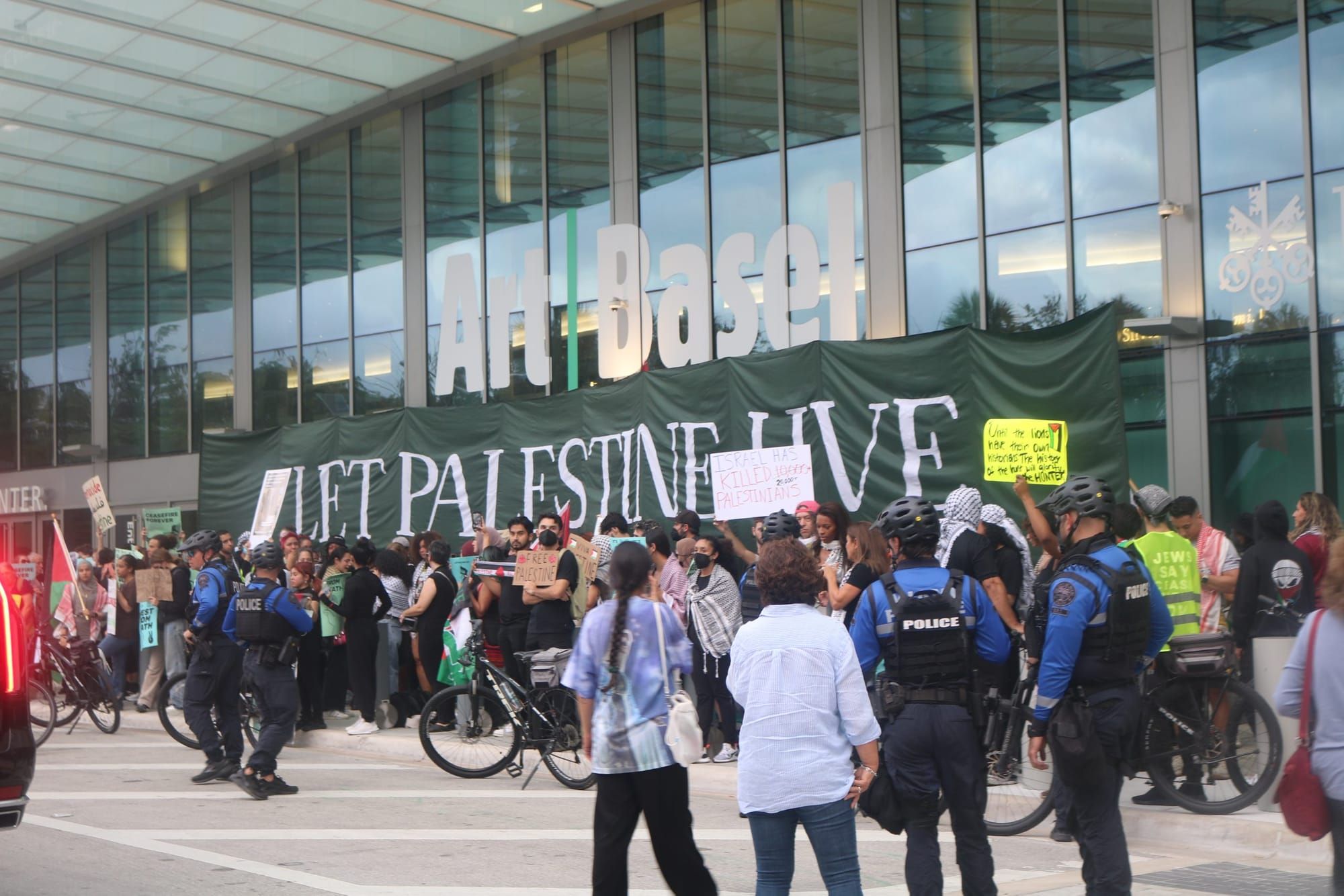
During the annual International Art Week in Florida, the collectives South Florida Coalition for Palestine and The People for Palestine led protests Dec. 8 and 9 in front of the seminal art fair Art Basel that attracts thousands of artists, collectors, and community members.
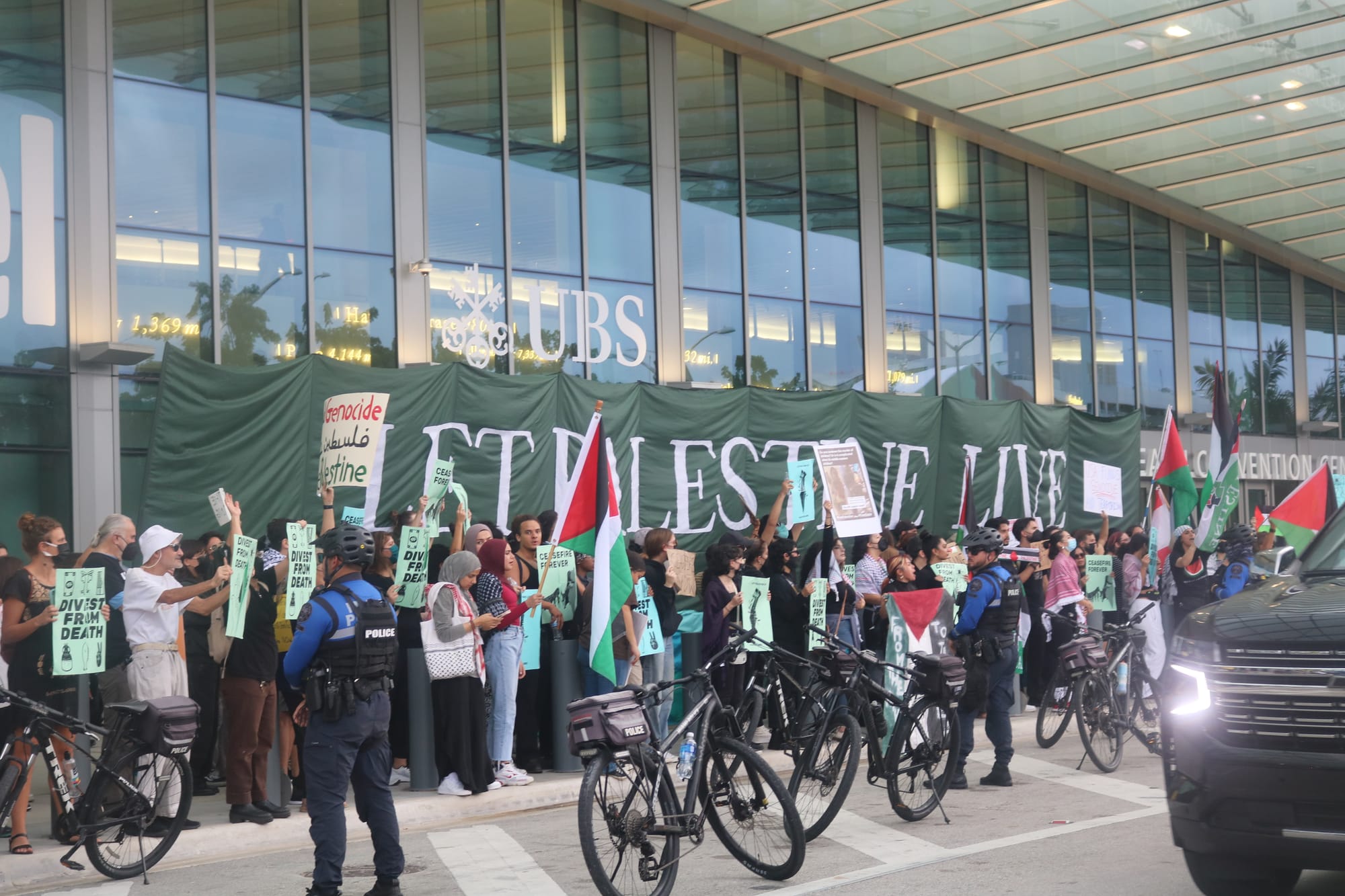
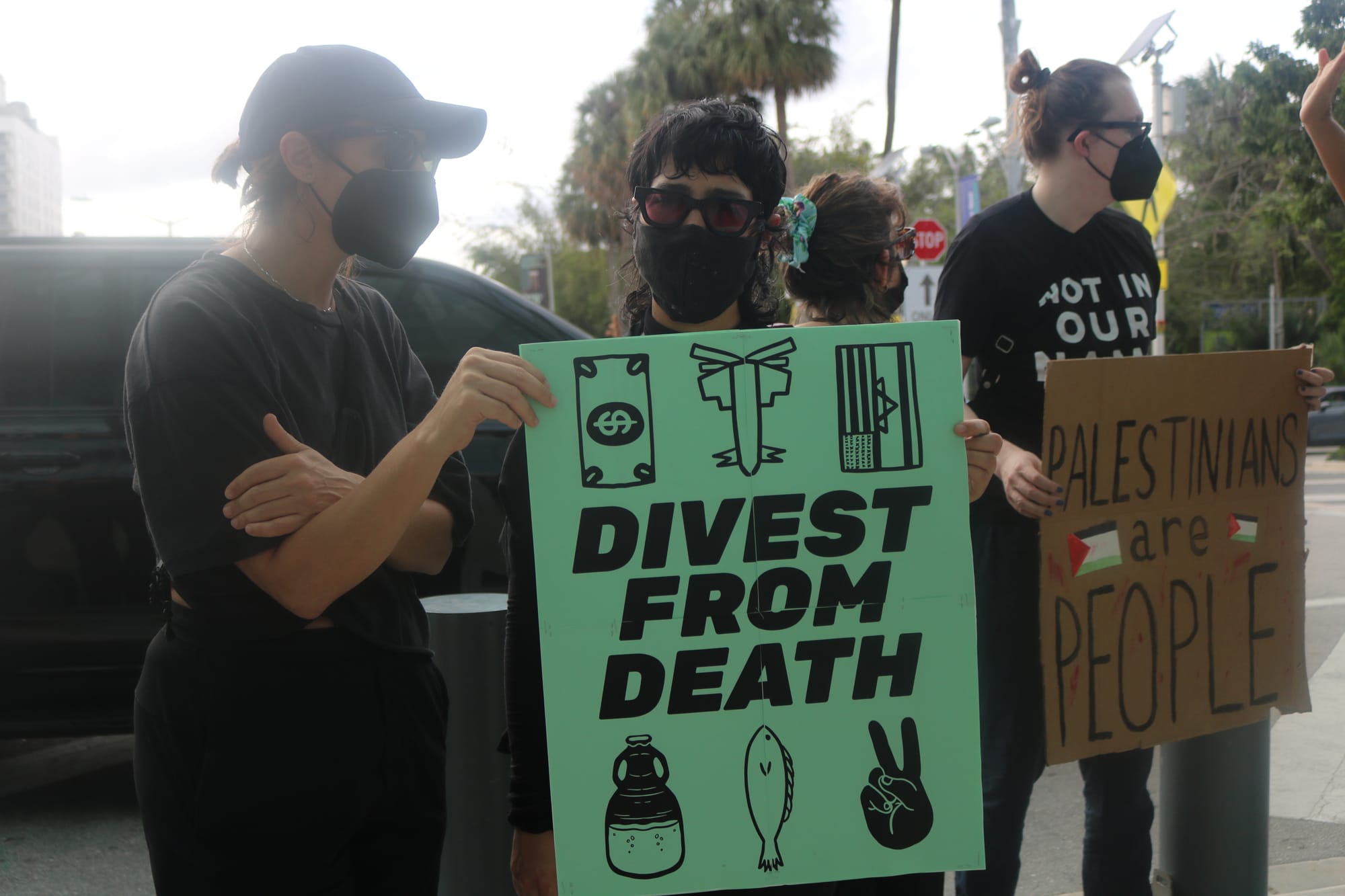
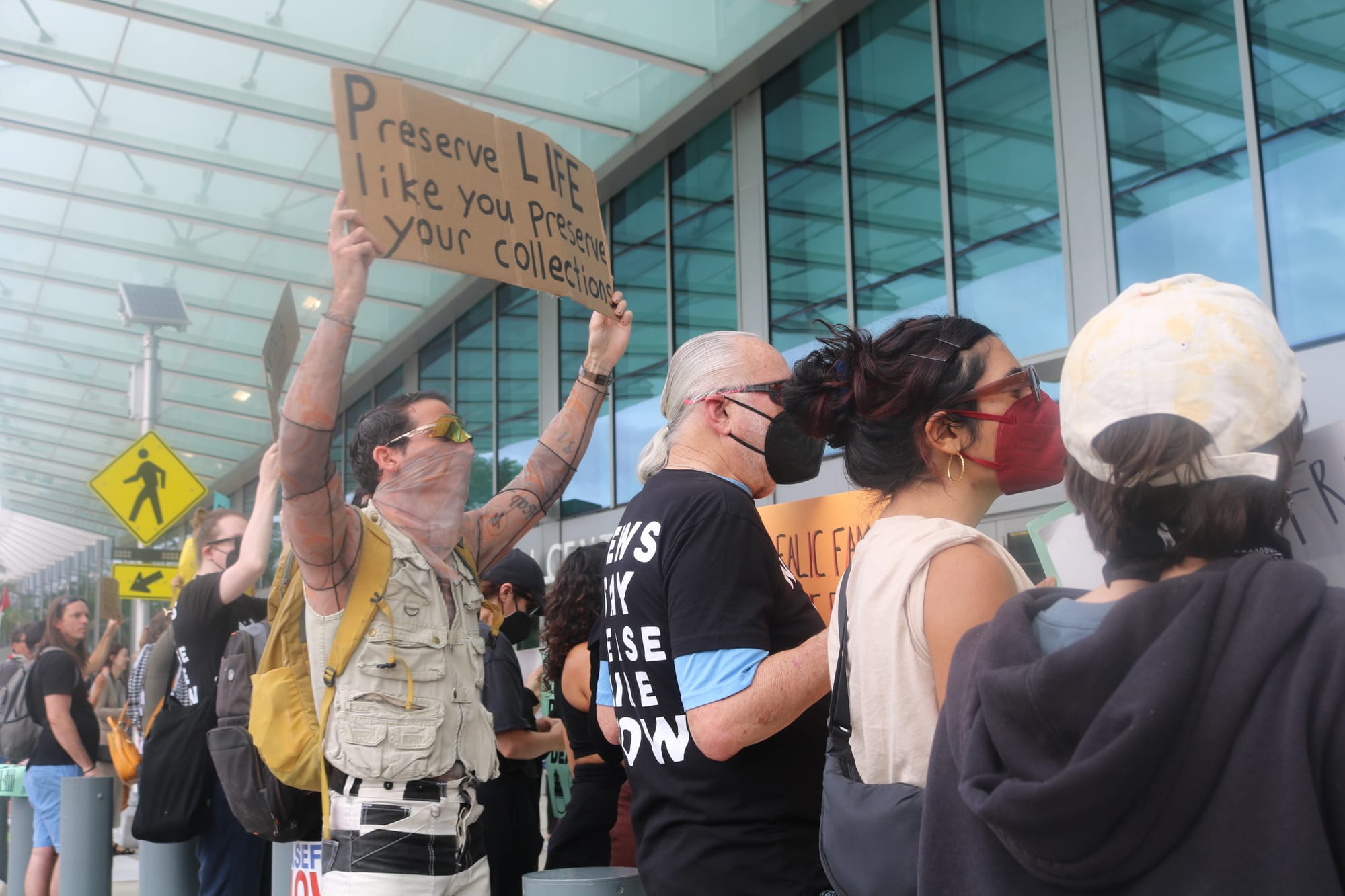
The protests were in part, a response to Miami-Dade County Mayor Daniella Levine Cava’s October pledge to invest a total of $76 million in Israeli bonds. On Dec. 8, organizers and allies rallied outside of the Miami Beach Convention Center that hosts Art Basel. Beginning at 3 p.m., more than 100 activists gathered, demanding a ceasefire in Gaza and calling on Miami-Dade County officials to divest support from Israel.
“The least we can do is help bring awareness,” said Alyssa Hidalgo, a visual artist who traveled from West Palm Beach to attend the protest. “A lot of people have this idea that they shouldn’t do anything; it’s all happening ‘over there,’ what can we do? But they’re wrong. Even if I wasn’t an artist, it is important that we all come together and echo the voices of people who are being silenced.”
Tensions flared during the beginning of the three-hour protest when a Zionist passerby filmed and antagonized the activists. Police officers moved the woman aside, but other anti-Palestinian onlookers continued to shout derogatory messages, including, “Get a fucking life.”
“I have young children, and I think it’s important to see that little voices can be heard,” said Dania Beatrice, an Indigenous Brazilian activist based in Miami. “There are a lot of children dying, and we need to stand up for them.”
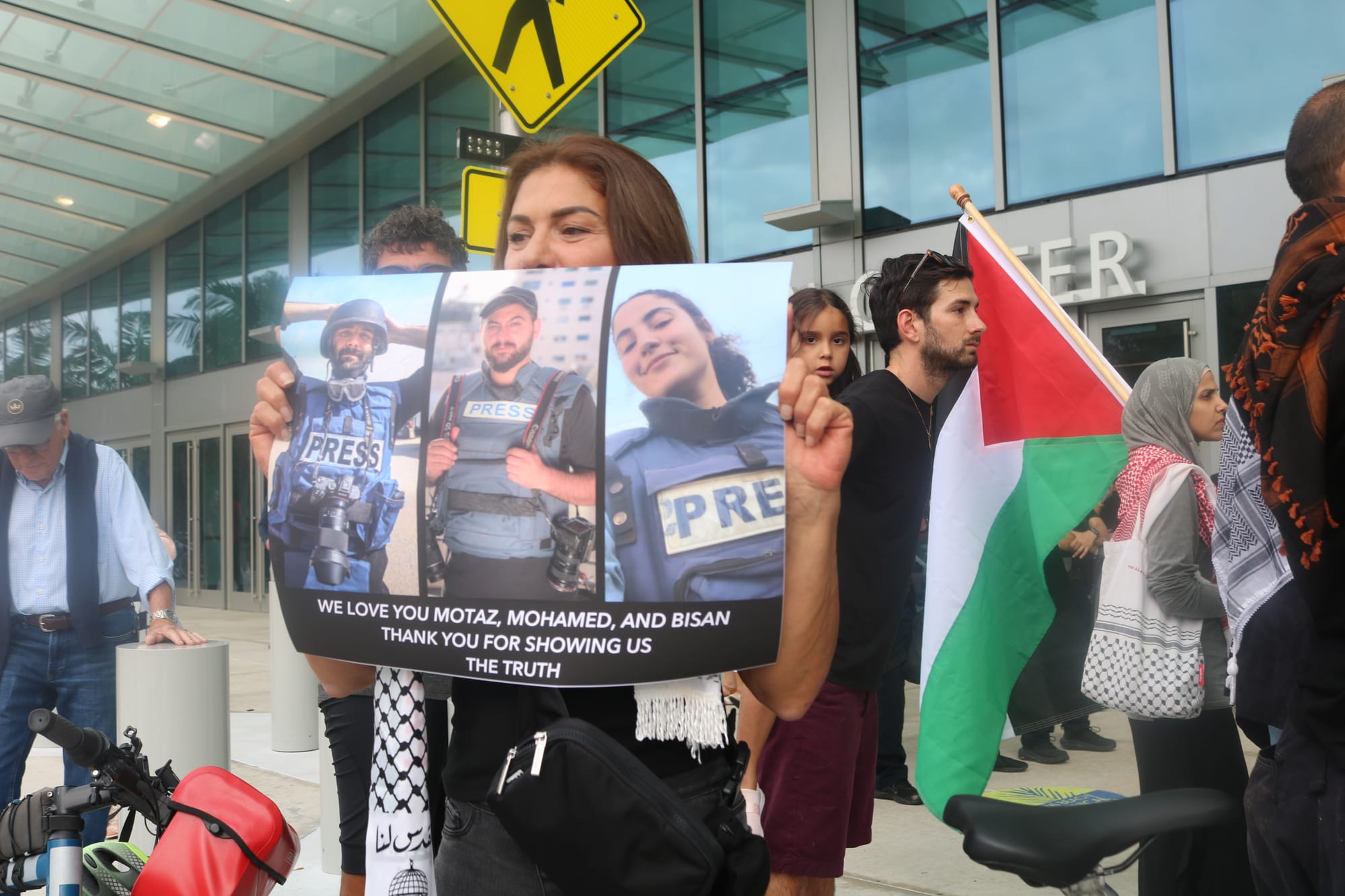
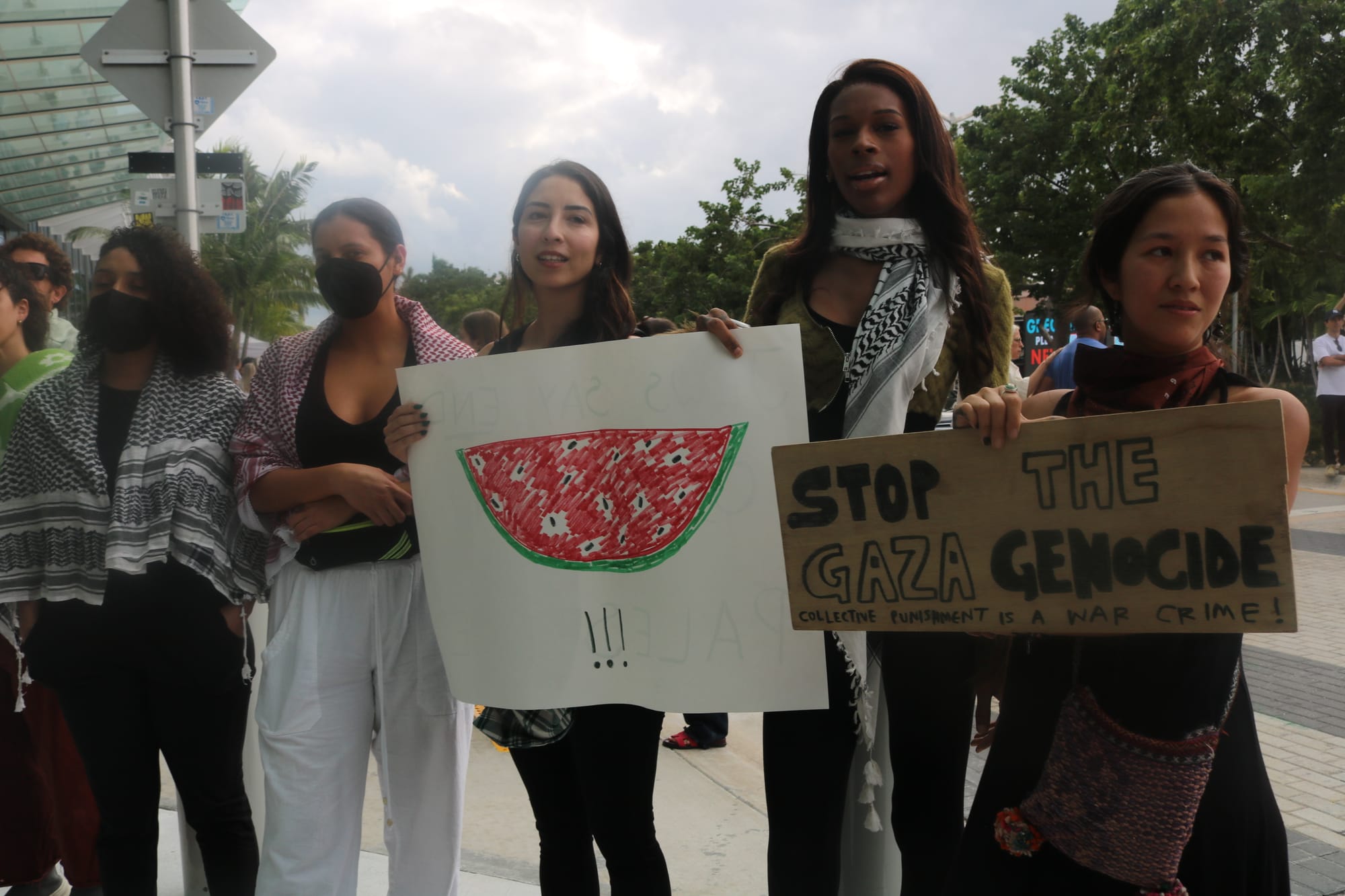
Along the entrance of the convention center, the collective chanted, “Free Palestine,” as well as “Netanyahu, what do you say? How many kids did you kill today?” One poster, held by Miami Artists for Ceasefire organizer (an open letter signed by Miami artists calling for a ceasefire) and Miami-based artist misael soto, said, “Protect Palestine like you protect your collections.”
An hour into the Dec. 8 action, dozens of police officers surrounded the protesters when they revealed a large green banner that in all capital letters said, “Let Palestine live.” Shortly after, two pro-Palestine activists were arrested after one was not allowed into the protesting area.
Mohammad Alajarmeh, who was present, said the incident occurred after an exchange escalated with counter-protesters. According to Alajarmeh, an officer pushed him during the scuffle. Video footage shows the two activists, who are siblings, walking past a Miami Beach Police officer seconds before the officer grabs the 17-year-old male activist in a chokehold and forcibly arrests him. Shortly after, the 19-year-old female activist can be heard shouting for her brother before she too is arrested.
The Miami Beach Police Department reported that one activist was arrested on charges of disorderly conduct and resisting without violence, and the second was arrested for resisting without violence. The two activists have been released.
In a statement, a spokesperson from Art Basel Miami Beach confirmed the details of the arrests.
“This afternoon, there was a protest organized by local Miami activist groups which took place outside the Miami Beach Convention Center,” the statement said. “The exterior of the Convention Center is in the public domain and falls within the purview of the City of Miami Beach. We are in close contact with the local authorities who are responsible for ensuring any protest taking place is in adherence with local laws and does not interrupt visitor access to the halls. Art Basel respects the rights of individuals to engage in peaceful protest and assembly.”
Art as a conduit
Additionally, two more activists were arrested during “March for the Martyrs,” a Dec. 9 performance art protest organized by the grassroots collective the People for Palestine to honor Palestinians killed by the Israeli military. The procession began outside of Art Basel at the Miami Beach Convention Center and ended at the ocean, where attendees built a memorial. Participants were encouraged to wear mourning veils and keffiyehs and bring flowers, candles, and other items to place on the memorial. In video footage of the arrests, Miami Beach Police are seen outside the Art Basel venue deploying chemical substances on peaceful protestors, including children.
On the other side of Miami, away from the mayhem of Art Basel, Palestinian-American artists gathered at a community event organized by the Flower Shop Collective, founded by Palestinian-American artist Nadia Tahoun, who also curated the exhibit. “An archive as a space for gathering” urged artists to consider how they can archive oral histories. The exhibition was created in partnership with Tunnel Projects, a Miami artist co-op that hosted the event and that provides affordable studio space in Little Havana. The show also featured poetry from Mosab Abu Toha, a Palestinian poet who was recently seized and “terrorized” by Israeli forces before his release.
“What the world is collectively talking about right now is what has been consistently spoken about at home, at the dinner table,” Tahoun said. “We always try to galvanize on moments where the masses are paying attention.”
Miami Artists for a Ceasefire, an open letter signed by local artists, formed as Israel’s genocide of Palestinians unfolded in Gaza. As Art Basel approached, soto recalled scrolling through Instagram and swiping through jarringly contradictory content: jubilant and colorful Art Basel event flyers intermixed with gruesome images of Palestinian death in Gaza.
“The juxtaposition was unbearable,” soto wrote in an emailed statement to Prism. “All of our local leaders and institution heads were seemingly completely fine with the eyes of the art world landing on Miami without a single mention of the atrocities taking place. Most of them still are.”
Art is innately political and a powerful conduit for discussing and channeling attention to current events. This is what led soto to reach out to members of the artist collective they helped organize, Artists 4 Artists: Miami, to write an open letter for artists to sign that called for solidarity with Palestinian people and a ceasefire in Gaza. As of Dec. 6, MA4C’s efforts garnered 225 signatures. The letter was also sent to local institutional leaders.
“The longer it goes unacknowledged, the more we’ll do to get folks in our community to take notice,” soto wrote.
MA4C organizer and writer Monica Uszerowicz told Prism they have received some retaliation for their participation in the letter, though they have not received a response from any of the institutions they contacted.
“[The lack of a response] is far more disappointing than any backlash,” Uszerowicz said. “I understand that it’s Art Week and people are busy, and I would like to give them the benefit of the doubt. But this is an urgent matter.”
Uszerowicz hopes to utilize the international attention on Miami during Art Basel to bring awareness to Palestinians’ suffering. Uszerowicz, who is Jewish and Afro-Puerto Rican, says she feels particularly called to organize for Palestinian liberation because her paternal grandmother survived Auschwitz and her paternal grandfather escaped transfer to a death camp during the Holocaust. She has no interest in perpetuating the same harm inflicted upon them.
“It’s the values of my family and ancestors that teach me to oppose state-sanctioned injustice, displacement, and second-class citizenship,” Uszerowicz said. “Having witnessed the traumatic effects of one genocide, I feel horrified to witness another genocidal campaign. Jewish safety and Palestinian liberation and safety are, for me, forever intertwined.”
As South Floridians, Uscerowicz explains that they “live in a prognostic microcosm for much of the country and even the world.” They find it crucial to speak from the perspective of the diaspora. In Florida, which is ground zero for climate change, immigration policy, and political censorship, soto and Uscerowicz say their diasporic struggles are intrinsically tied to those of Palestinians. Miami also has strong political and economic ties to Israel.
“We’re a city of many diasporas, and diasporic struggles are linked. Pretending that nothing is happening in Gaza and the West Bank feels particularly irresponsible and naïve here,” Uszerowicz said. “We also live in a state whose leaders have decided that critiques of the Israeli state and its military are akin to antisemitism. I find it frankly heartbreaking that, one, calling for the freedom and safety of the Palestinian people is considered controversial and, two, that the protection of Jewish people is now shored up with the protection of international interests. As a Jewish person, I have never felt protected by [Gov.] Ron DeSantis in the state of Florida; I’d argue that he’s pretending to care about us.”
Tahoun said it was a no-brainer for her to sign the MA4C letter and that she was happy to see so many other Miami artists sign on and organize in support of Palestine. She understands that when artists and cultural workers are vocally pro-Palestine, it does not come without risks. In 2021, the Palestinian-American artist said she received death threats from people on Instagram for posting pro-Palestine content. More recently, her Flower Shop Collective account received backlash on Instagram, with users asking how they could support Hamas.
“We’re not willing to entertain [these questions],” Tahoun said. “We continue to educate our community because at the end of the day, we’re here to speak for artists of color … We create safe spaces for them. So we don’t see ourselves as needing to educate white America, for example. There are other spaces that need to do that, and we’re very much here to cultivate our people. Make sure that we have opportunities in the art world.”
Hosting the show at Tunnel Projects was intentional for Tahoun. She says she was invited by another satellite art fair, but their values did not align. Tahoun, who was born and raised in Miami and is a descendant of the Palestinian diaspora, showed her interactive work “There are many ways to be silent,” which features a poem the artist embroidered onto a piece of fabric. The work hangs from the ceiling, and at the bottom, Tahoun fabricated a makeshift piece of Miami limestone that hides an iPad. The screen prompts the participant to use their phone to respond to a prompt that asks them to “define a wound.” Attendees’ responses are then scattered on the screen, and the program creates new poems that incorporate their answers.
“So you start to see these through lines of how people define means or what their experience with my writing is,” said Tahoun. “It’s collaborative with the people that have entered the space … Your participation requires you to center yourself and go in sort of like a prayer meditation mode into what a wound is, what trauma is, what histories are.”
Tahoun says the decision not to display entire responses was intentional. She wanted participants to have the space to be vulnerable when discussing their wounds, and she wanted them to leave with a sense of healing.
“I think that there is healing when artists of color and artists of persecuted groups can speak to each other,” said Tahoun. “We should be able to build spaces where people feel safe doing that… Our struggles are [not] in silos; they very much are interconnected with fighting white supremacy. We’re fighting imperialism. We’re fighting very violent power structures and dynamics, and we are all involved.”
Author
Alexandra is a Cuban-American writer based in Miami, with an interest in immigration, the economy, gender justice, and the environment. Her work has appeared in CNN, Vice, and Catapult Magazine, among
Sign up for Prism newsletters.
Stay up to date with curated collection of our top stories.