Meet Yamilet Galvan, the trauma-informed voice of a generation
Like many youth across Los Angeles County, the 11-year-old Chicana has plenty to say about Trump, ICE’s racist raids, and the many failures of grown-ups who voted for the mess young people find themselves in
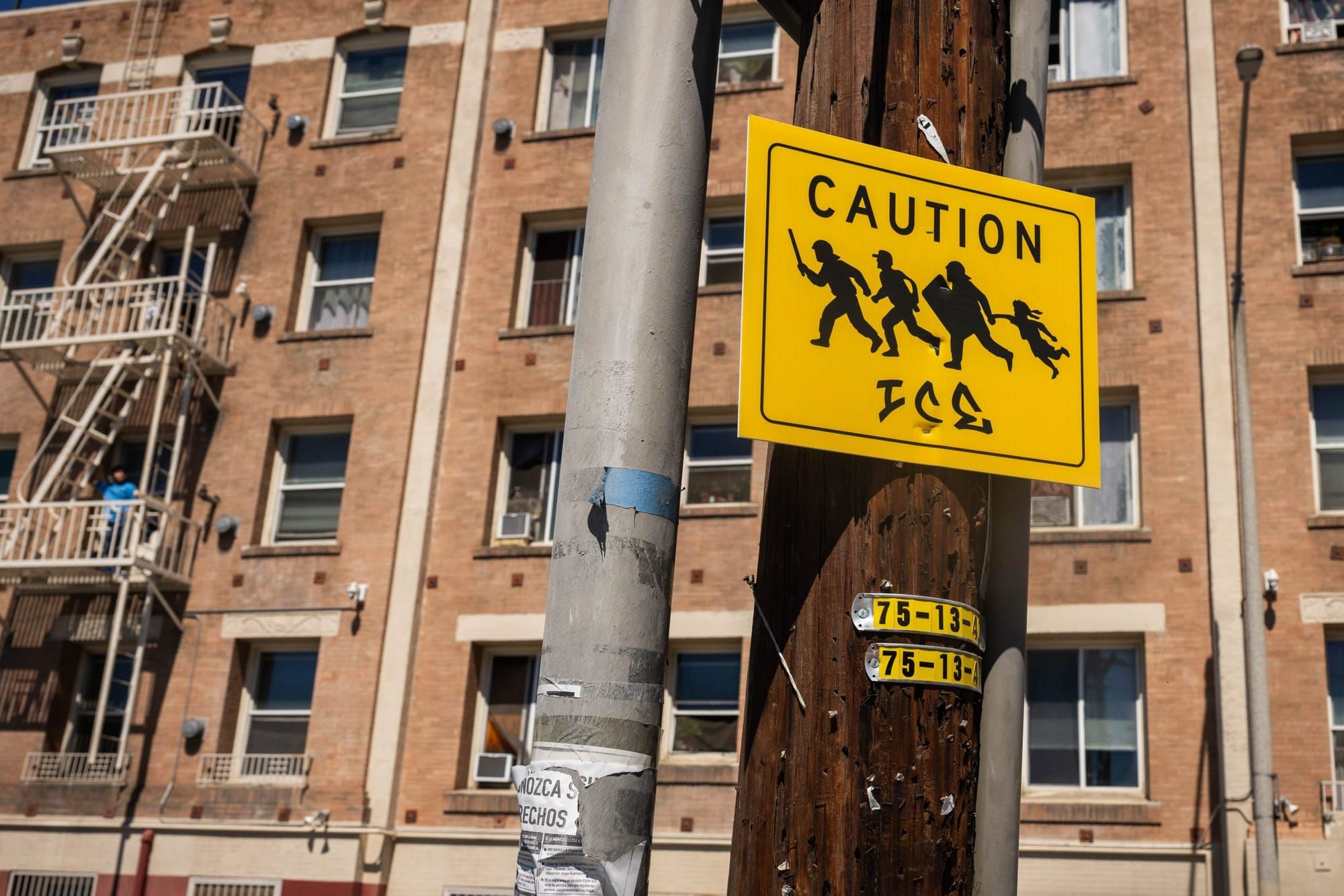
Yamilet Galvan is a kid from Pacoima, California, who, in August, was struggling to enjoy the last days of her summer vacation. The Department of Homeland Security was making that difficult.
Yamilet’s family belongs to Los Angeles County’s immigrant community, and like most girls her age, the 11-year-old Chicana worries a lot about her friends. Some have undocumented parents and grandparents who chose to repatriate rather than take their chances with the roving bands of masked Immigration and Customs Enforcement (ICE) agents that have become familiar sights at car washes, grocery stores, Home Depots, and construction sites.
“It’s so mind-blowing,” she said, “that my friends are able to stay so positive with everything that’s going on.”
When Yamilet hangs out with her friends, they don’t discuss their fears. Instead, they talk about comforting topics, like what they’ve been binge-watching on TV or how cool it would be to adopt a puppy. Yamilet repeated that she doesn’t understand how her friends can stay so upbeat. Her awe is palpable. The strength shown by her friends impresses her, and Yamilet sometimes asks herself, “How are they not broken by now?”
One could ask the same of her.
When Yamilet was 5 years old, her father voluntarily repatriated to Mexico after being served with an order of deportation. That’s why he’s not sitting with Yamilet, her mother, and me at a shaded picnic table in San Fernando Recreation Park. Crystal Diosy Reyes, an activist and organizer who founded Voces Unidas en Pacoima, is Yamilet’s mom. She introduced me to her daughter and urged me to speak with her, emphasizing that the budding creative has insightful things to say and that she demands to be heard. I agree that Yamilet’s vision matters. Hers is the trauma-informed voice of a generation that understands who to hold accountable for the racist terror that so many of us are facing: grown-ups.
We make the world that kids are forced to live in. We’re also the ones with the most power to change it.
“The world would be a better place”
This season of ICE hasn’t dulled Yamilet’s effervescence.
A self-described activist and creator who entered junior high school this fall, Yamilet is as animated as the cheerful Disney tiger printed on her heather gray T-shirt. Still, when I ask her about the grim atmosphere created by the federal government, the tween gives less Tigger and more Eeyore. Rage starts to flicker in her big, carob eyes. Ire mounts, causing Yamilet to wave her hands. She confirms that this summer has been like no other.
It’s scary to think about how people I know could get mistaken for someone who was not born here because they look Mexican.
Yamilet Galvan
“It’s been low. I’m seeing people I love live in fear,” she said. “I’m also worried about people that are ignoring everything and acting like everything’s fine. It’s scary to think about how people I know could get mistaken for someone who was not born here because they look Mexican.”
The junior high school Yamilet attends is also the alma mater of one of Pacoima’s most celebrated Chicanos. Most people wouldn’t recognize the rock and roller by his government name, Richard Valenzuela. To succeed in the music industry, the teenager who popularized “La Bamba” had to Anglicize his name, rebranding himself as Ritchie Valens. The town where Valens honed his musical craft is cradled by the northern San Fernando Valley, and history shows us that the immigration raids affecting this region are part of an ongoing cycle.
About a century ago, during the Great Depression, white politicians accused Mexican immigrants of stealing jobs. Federal agents tore through LA County barrios, hunting for and capturing suspected Mexicans. Los Angeles Times coverage of the raids published in 1932 described an atmosphere identical to today’s: “Federal immigration agents began weeding out aliens here illegally with the weeding conducted in a most energetic manner in Mexican quarters. Police began menacing Mexican congregating spaces. ‘Social experts’ urged immigration agents and police to make a show of their activities that would scare away many legally and rightfully here, this being their idea of one way to go about reducing unemployment numbers.” During the Great Depression, the federal government estimates that between 400,000 and 1 million Mexicans and Mexican Americans were deported or otherwise coerced to leave the United States.
The park where we’re seated has its own racist history.
The swimming pool that glints nearby was segregated during my dad’s childhood. Many Southern California pools were segregated in the 1950s, and racially minoritized residents could only use them on Thursdays. On Fridays, cleaners drained the pool, scrubbing it of what local Chicano activist Jenaro Ayala wryly called “minority germs,” as if purifying it for white use. Today, Mexicans and Mexican Americans are supposed to be able to freely access the county’s parks, baseball diamonds, playgrounds, and pools. However, one summer workshop facilitator employed by LA County, who asked to remain anonymous, said that Latine youth presence at city and county parks has noticeably declined.
Scared parents are keeping their kids at home, hiding them indoors until this danger passes. Cooped-up kids are denied the pleasure of smelling freshly cut park grass as it mingles with the perfume of pine resin and dried willow leaves. Hidden children aren’t out here eating tamarind-flavored popsicles, picking wild daisies, and running from ornery bees. Instead, they’re avoiding masked agents willing to menace anyone they deem to be Mexican—kids included.
A pesky fig beetle hovers in the air, eavesdropping. Reyes waves her hand, shooing the nosy creature away. Too bad we can’t do the same to ICE. Reyes and I listen to Yamilet laugh, complain, rant, theorize, joke, despair, inspire, ask questions, and answer them. She is a living and breathing anti-fascist manifesto, a girl both unafraid of authority and astutely mad at adults.
“My whole generation is probably going to need therapy,” Yamilet said. “I have it pretty good, but it’s still fucked up. I’m still experiencing trauma.”
I empathize with Yamilet’s frustration and political awakening. When I was a little older than her, Mayor George Hobbs, the bigot who governed my hometown of Santa Maria, California, issued a statement that shaped my Chicana consciousness.
In 1990, while campaigning for reelection, Hobbs addressed the local Economic Development Association, declaring that Santa Maria had a “Mexican problem.” He proposed a solution: “U.S.-financed colonies,” otherwise known as concentration camps, for immigrants at the southern border. Activists demanded that Hobbs resign, but voters reelected him. Now, we’re watching Hobbs’ long-ago dream come to rotten fruition.
Anger and fear surged in me when the elected official in charge of my hometown made my family feel unwelcome and unsafe. When I ask Yamilet which is stronger, her anger or fear, she quickly answers, “Anger! I can’t even form a sentence when I’m thinking about it. It’s just—I get so mad! All I can think of is mad. Bad. Bad! Why? Mad! I wrote a poem about it a few weeks ago.”
My Home
my mom says ‘home is where you are loved.’
my stepdad says ‘home is with your loved ones.’
my little brother says ‘home is where you belong.’
my grandma and tías say ‘home is where you feel safe.’
I think home is all of them because homes are
loving, safe, where you belong simply
because you’re you and with your loved ones.
home is all of this and more.
Much of Yamilet’s poetry and artwork express themes of home and community belonging. Her work also echoes a proverb popularized by scholar and activist Ruth Wilson Gilmore, that “freedom is a place.”
Yamilet is aware of the privilege squandered on kids who aren’t living under the threat of xenophobic harassment. She also knows that rather than face the terror head-on, some members of her community choose denial.
“There’s these white kids that are privileged, and they go out, and as soon as they leave their house, they’re like, ‘I’m bored.’ I don’t think they understand their privilege,” Yamilet said. “The funny thing is, they’re not even from here. Their families are from places like England! And some people that are Mexican are trying to be white! They act like they’re not Mexican so that way, they won’t have to deal with everything that’s happening. It’s like, ‘Dang, why are you denying your heritage? Why are you not helping your community?’”
Yamilet also echoes a musical critique made by Snow Tha Product, a San Jose, California-born rapper and singer whose parents are Mexican immigrants. In her music video for “Sabado,” Snow attends a backyard carne asada where she threatens to call out Donald Trump-voting relatives. Yamilet rips into Latines who cast ballots for Trump, whom she repeatedly refers to as “the actor.”
“There’s Mexicans who voted for him. They thought nothing would go wrong, but things immediately went wrong. The last time he was in office, the actor talked about invading Mexico. Come on! Why did they not think about it?”
Yamilet thinks that we’d all be better off if the actor had stuck to television and film. She also told me that it would probably improve his mental health to get a hobby or learn a sport (Yamilet stressed that it shouldn’t be a team sport).
I tell Yamilet that I’ve talked with some public school teachers who said that they’re approaching the upcoming year differently; for example, they’re considering ICE raids as part of their back-to-school planning.
Ahead of her first year in junior high, Yamilet said, “Honestly, I’m excited not to be in the house all day. But then again, I’m not excited because the actor doesn’t want us to learn. If teachers see people from ICE, I think they will protect us. But sometimes I worry. Like, what if there’s someone racist on campus who leads them to where kids are hiding? Someone could hurt us simply because they think that we are the reason that America is no longer great.”
I’m going to start with our president. I would tell him: ‘Imagine if your mom got an abortion. The world would be a better place!’
Yamilet Galvan
Yamilet tells me that art is an ideal tool for processing trauma. She draws and paints and advises others who are struggling emotionally to do the same. She describes her paintings as “blobby” and filled with “different colors” that represent how “everyone could be.” One of her paintings features a red, white, and green star erupting with rainbow tendrils. Above the star is the word “Proud.” Below is the word “Latina.” Another painting features a brown munchkin wearing large, different colored shoes. One is red, the other yellow. The munchkin wears a floral tiara and waves the Mexican flag while the words “peace” and “love” float overhead in bubbles. The phrase “No more ICE” hovers beside the munchkin’s head.
I was curious about what Yamilet would say to the adults who have ruined her summer and childhood if she could confront them directly. When I mention this to her, she says, “I’m going to start with our president. I would tell him: ‘Imagine if your mom got an abortion. The world would be a better place!’ I would tell him that he sucks. I would tell him to his face, ‘Look at the trauma that you’re causing to kids!’” She wags her index finger. “‘Everyone hates you. You’re eventually going to cause your own downfall.’”
“Wow, you’re so racist”
Yamilet was right in her assessment of the Trump administration. The violent enforcement of immigration policy causes serious trauma, and a recent report published in “Psychiatric News” confirms what Yamilet has learned through lived experience: “Children in immigrant families—whether they are immigrants themselves or born in the United States to immigrant parents—face a constellation of mental health risks shaped by the migration experience and the sociopolitical conditions of resettlement.”
The report also identified “real or threatened parental separation, deportation or detention” and “perceived threats to a parent’s life” as situations that qualify as traumatic events according to the criteria established by the Diagnostic and Statistical Manual of Mental Disorders. Put more plainly: The experiences that Yamilet and her peers are suffering may provoke the onset of post-traumatic stress disorder. This condition is characterized by chronic hypervigilance, insomnia, depression, and suicidal ideation.
Yamilet argues that “all generations need therapy for different reasons.” I couldn’t agree more, and my generation needs a therapeutic intervention that will encourage us to stop being such cowards and fight.
My generation needs a therapeutic intervention that will help us detach from our phones and get us into the streets so that we might flood them with healthy rage. My generation needs a therapeutic intervention that will remind us of the importance of community care. Yamilet asked me if I had ever considered how boomers think they don’t need therapy. Her question made me laugh. She laughed too.
“If some of them would go, some of them might heal,” Yamilet said. “I want that for old people. I want them to be able to heal. But at the same time, some of them are so far gone that you can’t even go near them without being like, ‘Wow, you’re so racist.’”
Editorial Team:
Tina Vasquez, Lead Editor
Carolyn Copeland, Top Editor
Stephanie Harris, Copy Editor
Author
Myriam Gurba is the author of several books. Her essay collection Creep: Accusations and Confessions, was a finalist for a National Book Critics Circle award in Criticism. Her next book, Poppy State:
Sign up for Prism newsletters.
Stay up to date with curated collection of our top stories.