May Day march in Chicago brings together anti-Trump coalition
Thousands marched in a day of action that brought together disparate groups alarmed by the Trump administration’s actions and attacks on immigrants
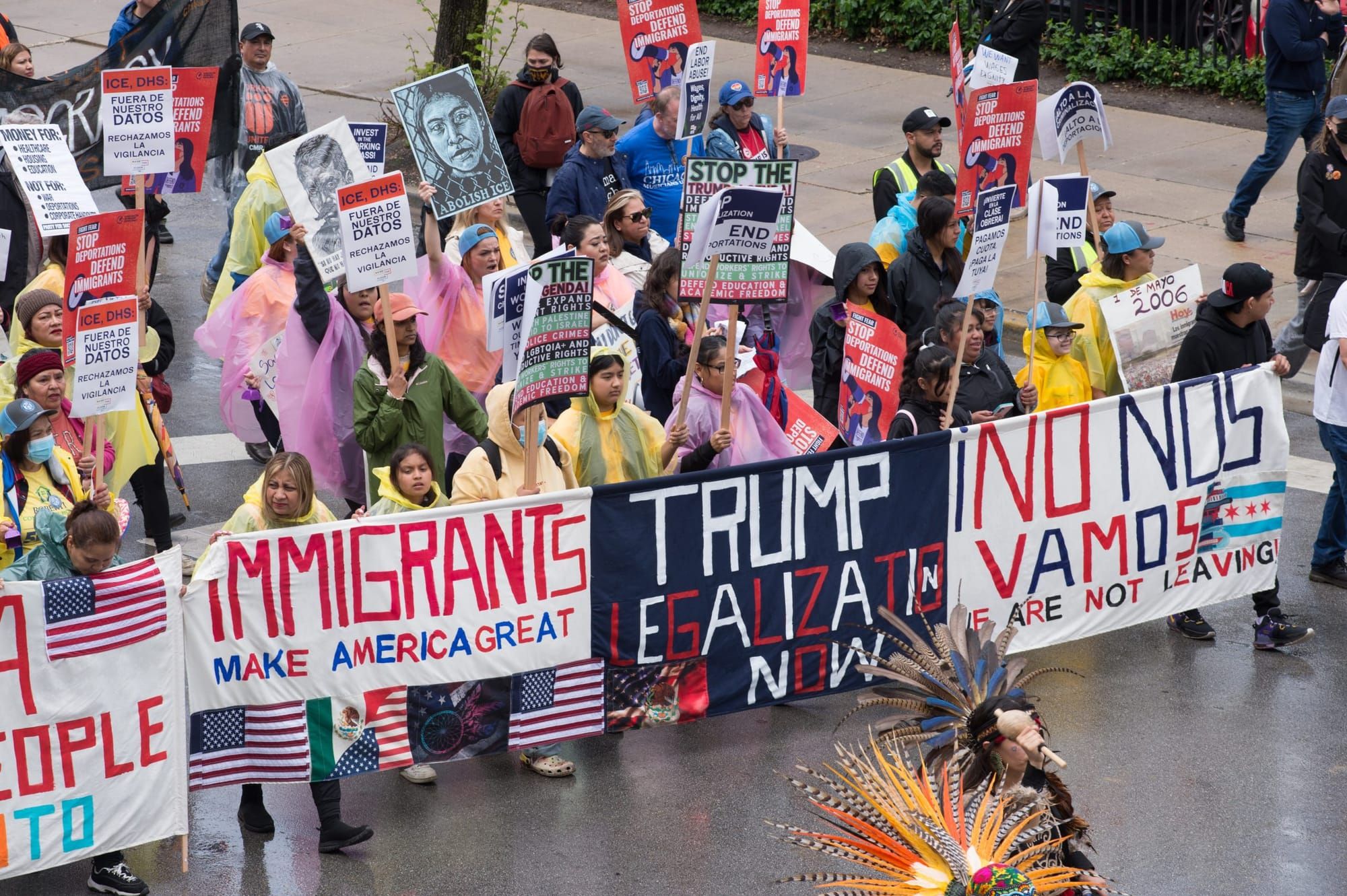
Thousands marched through Chicago’s streets on May 1, in a day of action that in many ways mirrored mass protests in the city months earlier. But in contrast to the march on the Democratic National Convention in August, the May protests were focused on President Donald Trump—and underlined the ways in which the broad antipathy to the current Republican administration has helped unify the left and build bridges to parts of the Democratic Party.
“Chicago is doing everything right,” said Jorge Mújica Murias, an organizer with the immigrant rights movement Consejo de Resistencia en Defensa del Inmigrante. His positive assessment of the city’s approach to immigrant and workers’ rights was reflected in the speakers, banners, and focus of the march led by the Coalition Against the Trump Agenda (CATA).
The rally was a national May Day action among 1,000 marches and demonstrations in every state and abroad. Murias emphasized that May Day is an international holiday. “Everybody’s used to celebrating May Day in their own country,” he said. “It’s International Workers’ Day, not only because it’s celebrated worldwide, but because immigrants are basically international workers: workers looking for jobs in other countries.”
It was a damp spring day, with temperatures in the upper 60s. Many wore rain gear and keffiyehs and waded gamely through the mud to hear speakers in Union Park call for solidarity and resistance.
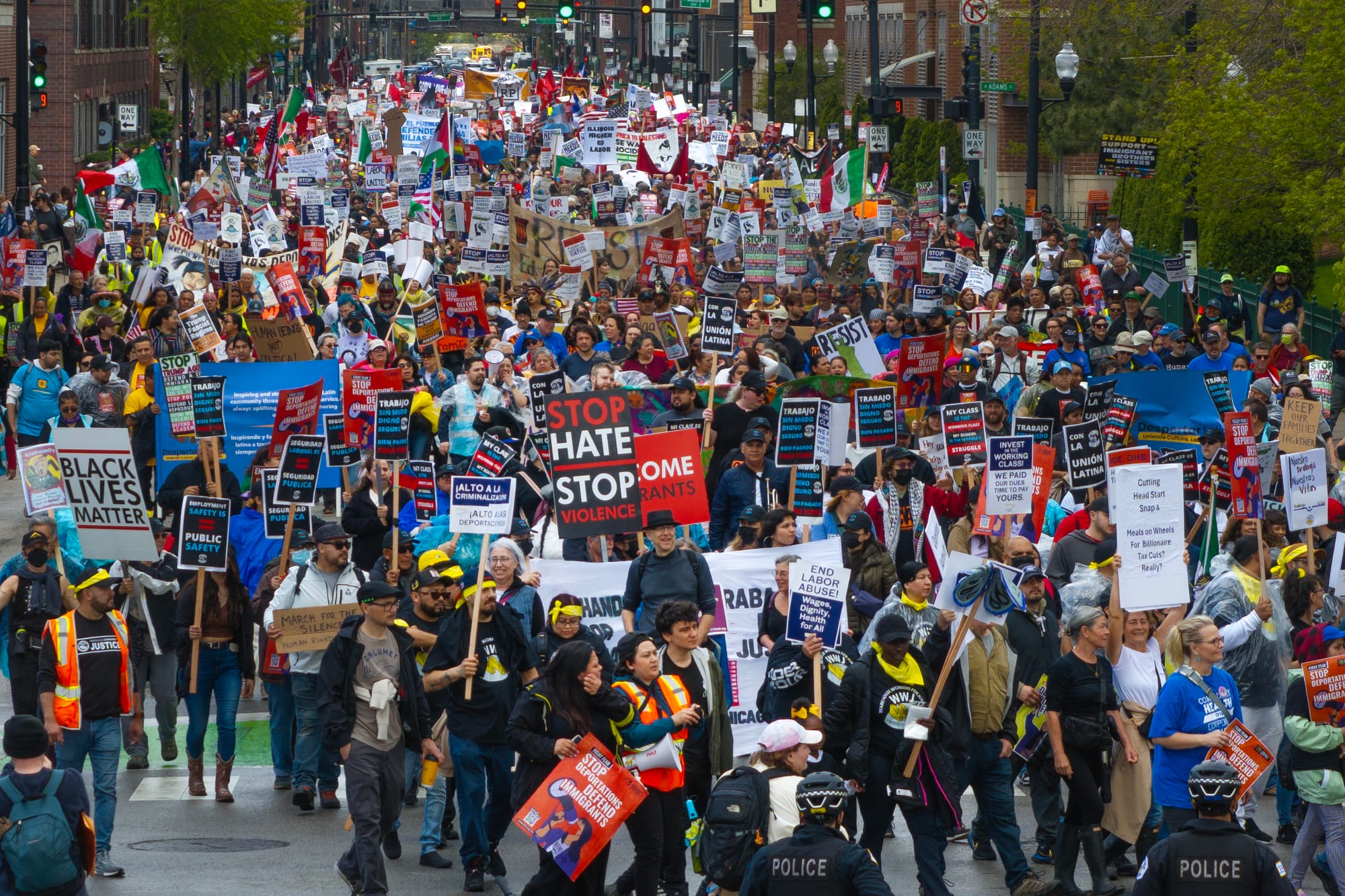
The speakers and topics were similar to those at the DNC protests when the convention was held in Chicago last year. Many speakers addressed Palestinian liberation and denounced the attacks on and arrests of student protesters. Some speakers noted that Democrats had set the stage for Trump with anti-immigrant policies and attacks on student free speech.
The new context of the Trump administration was also central, however. Sheila Bedi, a Northwestern University law professor targeted by the U.S. House in March for her work defending Palestinian activists, spoke about her successful defense. A representative for airline unions denounced Trump’s attack on collective bargaining for Transportation Security Administration workers, a call for solidarity with security personnel that would have been noticeably out of place in August.
Illinois Rep. Chuy Garcia also spoke, evoking the legacy of Mayor Harold Washington, who first declared Chicago a “sanctuary city” in the 1980s. Garcia did not speak at the DNC protests, where Democratic speeches and positive references to Democratic politicians were thin on the ground.
Many of the attendees at the protest were also very focused on the Trump administration and on the desperate, growing need for opposition. Karen Suarez-Flint, secretary-treasurer of the Chicago Federation of Musicians, noted that the Trump administration was “stripping away workplace safety … all those protections we’ve worked so hard to get seem to be negotiable suddenly.” She said that the administration had frozen National Endowment for the Arts grants, which could have a devastating impact on musicians, and that the anti-diversity, equity, and inclusion (DEI) policies were an assault on music in the city.
“If you look at the history of American music, if you take out Black people, I’m not sure what we have,” Suarez-Flint told Prism. “We have Sousa marches. But there’s no blues, there’s no jazz, there’s no rock and roll, there’s no hip hop. Everything that’s American music is DEI.”
Rochelle Ross, the recording secretary of BCTGM Local 1, representing the bakery, confectionery, tobacco, and grain industries, told Prism, “We’ve got to get Trump out of there. He’s destroying us.” She said that Trump’s tariffs have already made it difficult for businesses to get their usual ingredients. Ross added that she hoped the rally would generate support “from all over the world, all over the country.”
Eileen, a 26-year-old hospital administrator who did not want her last name published to protect herself, attended the rally with her mother, who, along with her father, came to the U.S. from Mexico as an undocumented immigrant. They were given a path to amnesty and citizenship, and she is concerned that others are not being offered the same opportunity.
“I understand that there are people here that aren’t doing what they’re supposed to be doing,” she said. “But the fact that [Trump’s] going against everyone—it’s just not right. I don’t get why he’s discriminating, why people are discriminating against us, basically just because of what we look like.”
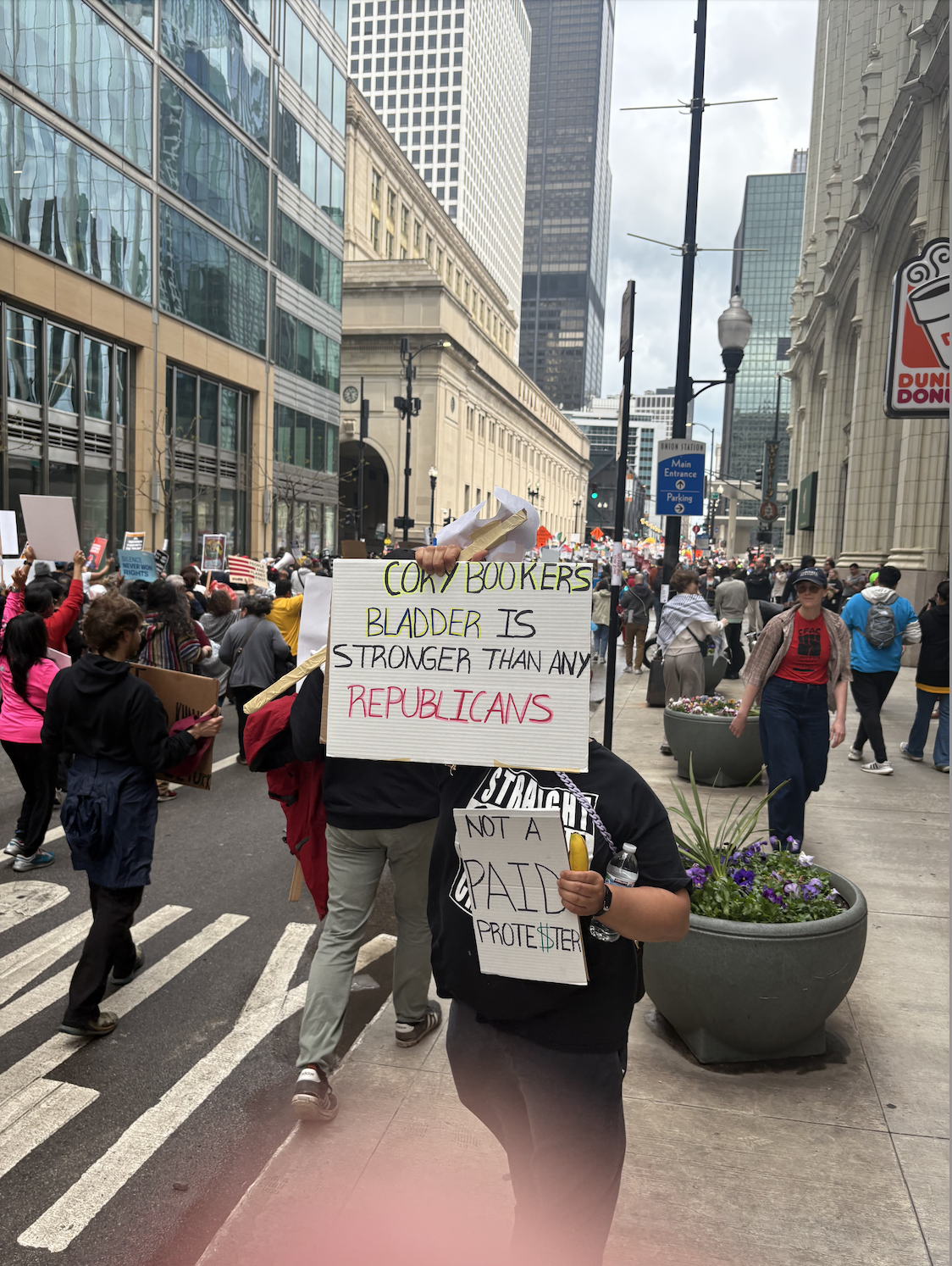
The way Trump has galvanized and crystalized resistance was evident during the march itself. Some marchers carried Communist flags denouncing the Democratic Party. But other marchers carried American flags and signs calling for the defense of NATO, generally considered an imperialist military alliance by those on the left. One man sported an “SEIU for Harris” jacket, representing the Service Employees International Union; another woman carried a poster praising Cory Booker’s bladder—a reference to the New Jersey senator’s 25-hour filibuster against the Trump administration.
There were many indications that the Democratic-led city administration was less antagonistic to this march than the anti-DNC protests. Police presence was much more muted; officers stood at cross streets to block traffic, but they did not line the entire route or prevent the press from taking pictures at the front of the march, as they did in August. The march also was not diverted to side streets; instead, protesters thronged arteries like Washington and Jackson streets as the march wended its way from Union Park to Grant Park.
“This time around,” Murias said, “the administration in Washington is not only attacking immigrants, but it’s attacking everyone at the same time.” That’s extremely dangerous, organizers warned. But they also showed that it was also an opportunity to create a broader coalition, drawing in people who might not necessarily have come out a year ago.
Organizers are very aware of the increased potential for resistance. CATA organized other actions for the first week of May, including a student walkout on May 2 and a Black and brown unity march on May 3. Looking further to the future, Shawn Fain, president of the United Auto Workers, urged unions around the country to negotiate contracts expiring in May 2028, creating the possibility of mass labor demonstrations, strikes, and protests before the next general election.
“As soon as we knew the election results in November,” Murias told Prism, “we realized that we had to be very well organized to resist and defend the community. And now, over time, many more nonimmigrant organizations joined because we have a common agenda.”
Editorial Team:
Sahar Fatima, Lead Editor
Carolyn Copeland, Top Editor
Rashmee Kumar, Copy Editor
Author

Noah Berlatsky is a freelance writer in Chicago. You can follow his writing at Everything Is Horrible (noahberlatsky.substack.com).
Sign up for Prism newsletters.
Stay up to date with curated collection of our top stories.