‘Manifesting a great life for myself’
Louisiana Green Corps equips young workers with the tools needed to improve their lives and their communities
By People over Plastic Staff with files from Alexis Young
This piece originally appeared in People over Plastic.
As the world shifts away from its reliance on the fossil fuel industry, a number of green industries, including clean energy and green infrastructure, are experiencing major growth. Some predictions even suggest jobs in green infrastructure could add millions of jobs to the U.S. economy.
An organization in Louisiana is hoping to equip the next generation of young people with the skills they need to work and build careers in these emerging fields. Louisiana Green Corps trains participants ages 18 and up who live in the Greater New Orleans area with job skills and assistance securing employment through youth and adult programs.
Louisiana Green Corps Executive Director Ryan Mattingly acknowledged in the 2022 annual report the different ways people of color in the region have been marginalized, disinvested in, and disempowered. Mattingly also pointed out that while the green economy is growing in the U.S., it’s not as gender or racially diverse as other sectors. The organization sees its work as part of a much larger movement that seeks to advance racial and environmental justice.
—
Established in the wake of Hurricane Katrina, Louisiana Green Corps was launched to connect New Orleans residents with opportunities that could help make the city more sustainable and more resilient. Its founders also wanted to provide career growth opportunities that are high wage and high demand within the community.
Maria Andrade, programs manager at Louisiana Green Corps, said the organization is unique in that it is both an economic and environmental change agent.
“To date, we have served 1,200 young people,” she said. “Currently, we offer construction training, green infrastructure training. We expose students to coastal restoration, energy efficiency, and solar, but we are really gearing up to more solar training that can lead up to certifications that help folks enter that solar job market.”
Federal funding has meant green industries are creating an unprecedented number of jobs, and New Orleans is seeing a lot of that growth. Due to persistent struggles with flooding, aging drainage infrastructure, and soil subsidence, the city is turning to green infrastructure, spending as much as $260 million on new projects, according to a 2021 report from the Greater New Orleans Foundation. Louisiana Green Corps wants to see those jobs go to young people who have previously not been able to access these types of opportunities but would stand to benefit from jobs in these areas. Jobs that include restorative projects, which, in Louisiana’s case, means projects that help the region recover and rebuild after the devastation caused by Hurricanes Katrina and Rita in 2005. Participants can also train in weatherization or weatherproofing buildings, wetland restoration, and residential and commercial green infrastructure.
—
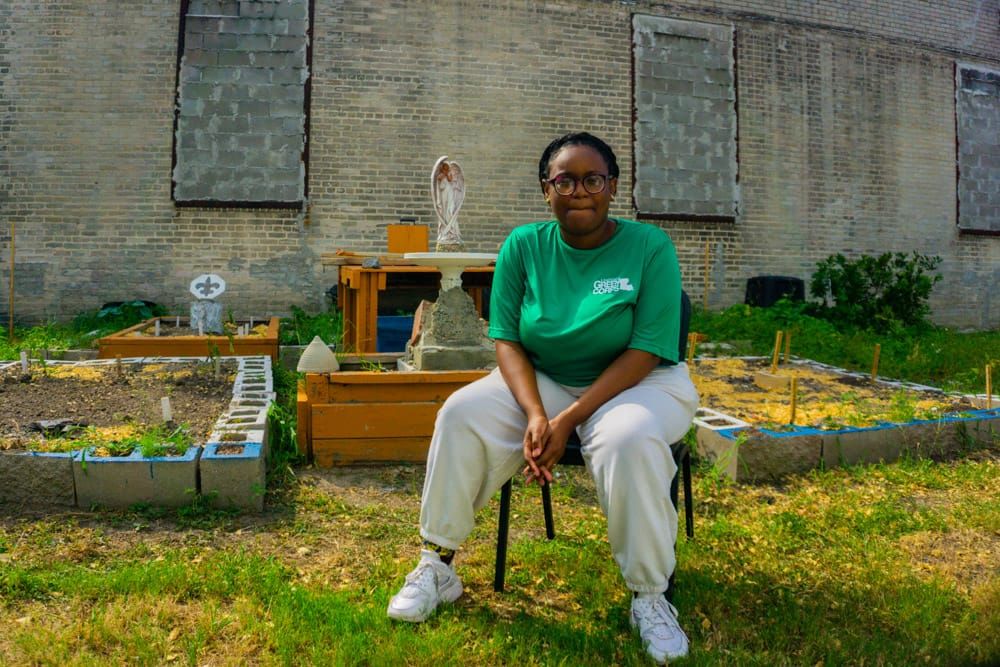
Destiny Barnes is a 22-year-old newly married mother of one who came to Green Corps because she said she was looking for a new lease on life.
“I am pushing and manifesting a great life for myself. I am. I really wanted to do great things for my family. I want to be just as successful as my mom. She is my role model,” Barnes told People over Plastic.
At Green Corps, Barnes is earning her certification in a number of green infrastructure programs. She’s earned her certificate in Occupational Safety and Health Administration as well as her fork-lift certification.
Skill sets like these appear to be the most in demand. According to 2012 figures by the United Nations, at least 80% of global green jobs are expected to be in secondary sectors such as construction, manufacturing, and energy production. However, women are vastly underrepresented in these green industries. For example, women only account for 9% of the workforce in construction. It’s a reality not lost on Barnes.
“We need women. We need women,” she said. “I feel like in certain aspects of green infrastructure, women are comfortable with gardening. That part, that aspect, like hands in the dirt, in the mud, that’s cool with them because, you know, as women, you’re natural nurturers.”
But Barnes said she was motivated to pursue training beyond this, even if it meant overcoming some of her own insecurities.
“I was very hesitant, very scared about doing some things,” she admitted. “I used a lot of big hand tools that I would have never thought I would touch a day in my life. We have that support, and we have a great class. The men are very supportive, and the women are just as supportive. We supported each other, and we overcame a lot of things.”
Eventually, Barnes said she aspires to eventually move into either a management position or one day own her own business.
“I really see myself as a boss. Who doesn’t?” she laughed. “Like I see myself as the head of a company. I see myself looking at those blueprints, being able to read them. I see myself on the field too. I think that there’s nothing but possibilities for me.”
Turning away from jobs in fossil fuels
Barnes is not the only young person attracted to jobs in the green sector. Dymond Martin is another Louisiana Green Corps participant who came close to working in oil and gas after his father, an electrician on an offshore oil rig, told him about the prospects of making good money there.
“He always explained to me all the different guys out there and positions and stuff, and it intrigued me,” Martin said.
Ultimately, Martin gave oil and gas a pass and decided to work in green infrastructure instead. He said he noticed that the fossil fuel industry is trying to attract younger workers like him, hoping to replace its aging workforce. That sentiment is backed by reports in recent years that suggest teens and recent college graduates are avoiding jobs in fossil fuels. An international survey from 2011, which garnered opinions from more than 4,000 graduates, found that more than half of millennials (58%) said they would avoid working in a particular sector solely because they believe it had a negative image. Oil and gas topped the list of industries deemed to have the poorest image, with 14% of respondents saying they would not want to work in the sector due to its problematic image.
“From what I see, they definitely are aiming to get more [young employees],” said Martin. “It looks like there’s an expansion being done, like they’re trying to broaden their employee base.”
—
As governments around the world commit to cutting greenhouse gas emissions to as close to zero as possible, major investments are being made in green infrastructure. In 2021 alone, it’s estimated $627 billion was allocated to sustainable and green infrastructure projects globally.
That’s good news for young workers like Martin in terms of employment opportunities. However, he said, along with that growth, he hopes the industry will work toward improving its own employee base so it is more inclusive.
“It would be awesome to see more people who don’t have some of the resources other people in this field have or don’t have some of the privileges,” he pointed out. “Or maybe coming home from prison or from out of town or starting over in life. It could be a variety of things.”
According to a participant survey that the organization conducted back in 2022, 95% of Louisiana Green Corps participants were Black, and 24% identified as women. Some of the biggest barriers that participants reported experiencing included legal issues, housing insecurity, parenting issues, and lack of transportation.
A new lease on life
After coming home himself after being incarcerated, Rahkeem Durio said he found Louisiana Green Corps to be a supportive place that helped him relaunch his life in many ways.
“They help me with my situation cause, you know, I just came home,” he said. “I really hated what I was going through.”

It hasn’t been an easy journey, Durio admitted, and even today he said it can still feel like an uphill battle to reconcile the past.
“I just have to treat people the way I want to be treated, and just, you know, just continue to strive and be better than what I was yesterday,” said Durio.
It’s clear 32-year-old Durio’s life today has shifted for the better. He credits Louisiana Green Corps for supporting him as he works on improving himself and his life. In addition to providing skills training, the organization also supports participants with services like child care, meals, transportation to job interviews, necessary clothing like work boots, and even equipment.
“They have case managers that you know that you can talk to,” Durio said. “You feel comfortable. You trust them. But I feel like you can build that relationship, build a foundation so you can earn their trust.”
That supportive environment is helping Durio develop his interest in solar energy.
“I like how they use the panels to get the energy from the sun and things like that,” Durio said. “I really want to learn more and just put my all into it.”

Watch the video report of this story by People over Plastic Reporter Alexis Young here:
PoP is the only multicultural media platform of its kind, publishing stories by BIPOC for BIPOC. We focus on uplifting our people’s environmental justice stories, and we do so in a way that is both nuanced, sensitive, and in depth. Our approach is to build community relationships first.
Author
PoP is the only multicultural media platform of its kind, publishing stories by BIPOC for BIPOC. We focus on uplifting our people’s environmental justice stories and we do so in a way that is both nua
Sign up for Prism newsletters.
Stay up to date with curated collection of our top stories.