Mahmoud Khalil’s detainment is a reproductive justice issue
Immigration officers detained and disappeared Khalil in front of his pregnant wife, who was also threatened with arrest

“U.S. immigration ripped my soul from me when they handcuffed my husband and forced him into an unmarked vehicle,” Noor Abdalla said in a statement about Department of Homeland Security agents detaining her husband, Mahmoud Khalil, a Columbia University graduate student, and the lead student negotiator during the pro-Palestinian student encampments last year.
Abdalla is eight months pregnant. She should be preparing to give birth with her partner by her side. Instead, she sleeps alone—if at all—wondering whether Khalil will be there to meet their child. Instead, she pleads with the world to secure her husband’s release.
“Forty years after my parents immigrated to the U.S. from Syria seeking safety, I feel more unsafe and unstable than I ever have in my life,” Abdalla stated.
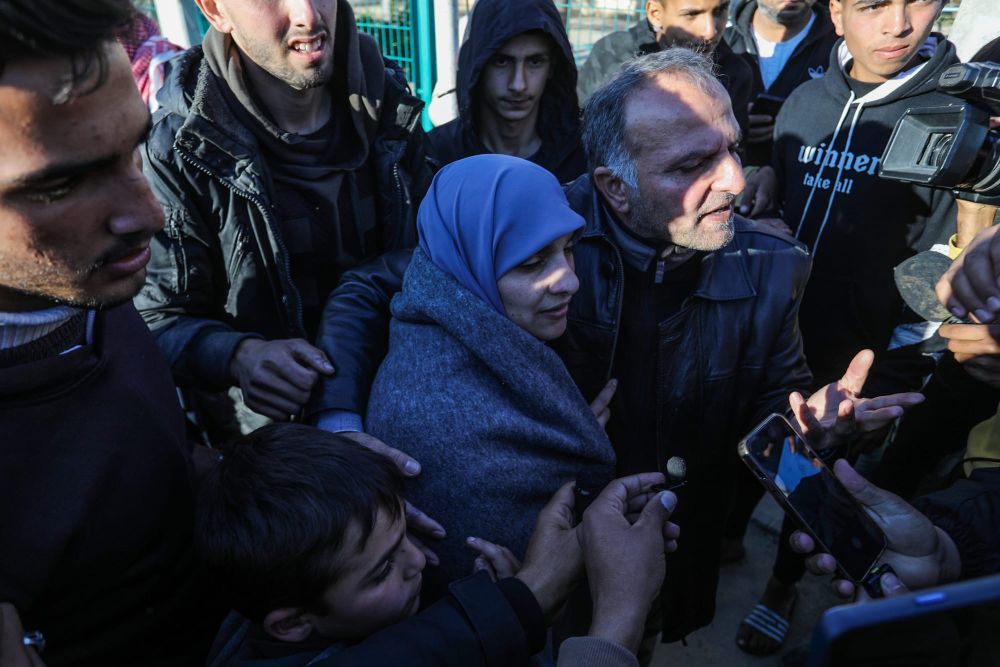
On March 8, DHS agents followed the couple into their apartment building after returning home from an iftar dinner. They stopped Khalil, a green card holder, telling him, “We are with the police, you have to come with us,” according to Abdalla. When Abdalla refused to leave his side, an agent threatened her: “I will arrest you too.” Moments later, they barricaded her away from him. Khalil was handcuffed, forced into an unmarked vehicle, and disappeared into Immigration and Customs Enforcement’s detention system—first New York, then New Jersey, then Louisiana, where he remains.
Khalil’s abduction is not just a First Amendment issue—this is family separation. This is reproductive injustice. It’s happening in full view of reproductive rights organizations and the reproductive justice movement’s legal arm. Organizations like Pregnancy Justice, the Lawyering Project, and Center for Reproductive Rights have so far said and done nothing. As has been extensively covered, many reproductive health care organizations have largely stayed silent or been complicit throughout the genocide in Gaza, despite the Israeli military waging the majority of its violence against children and pregnant women.
In the U.S., migrant families, families of color, and poor families are torn apart by the state every day. Immigration enforcement disappears parents, and children are left behind. Communities are devastated. For Palestinians in the U.S. who are already displaced, already exiled, this is an extension of the same disappearance and dispossession they’ve faced for generations.
Yet, it is only now that organizations once unified against state violence are now unified by their silence in the face of it. How can they be silent as a Palestinian family is torn apart by the same carceral logic that has always targeted Black, brown, Indigenous, and migrant families? Some organizers have dubbed people and organizations who follow this pattern “PEPs” — progressive except for Palestine.
But this isn’t a clumsy, unintentional oversight. It is, as coined by Spelman College professor M. Bahati Kuumba, reproductive imperialism: the global export of family policing, reproductive control, and population management through militarism and incarceration. It’s what tore families apart during chattel slavery and in Indigenous “boarding schools.” It’s what sterilizes people in psychiatric incarceration, prisons, jails, and immigration detention centers. It’s the same logic behind family separations at the U.S.-Mexico border—and now, Khalil’s arrest.
Khalil’s abduction is not just a First Amendment issue—this is family separation.
This is also the long arm of Zionist repression. President Donald Trump said Khalil’s arrest is “the first of many to come,” under the pretext of “national security.” One day before his detainment, Khalil communicated his fears to the Columbia administration about being targeted, doxxed, harassed, and threatened by Zionists and suspended professor Shai Davidai, and was met with silence. Mint Press recently published an investigation revealing that the dean of Khalil’s school is a former Israeli spy who played a significant role in the university’s response to protests. This is not a matter of bad policy—it’s about collaboration between U.S. imperialism and Israeli settler colonialism. Khalil’s detainment is about surveillance, repression, and family destruction, whether at a checkpoint in the West Bank or on the doorstep of university housing in New York City.
Reproductive Justice (RJ) was coined in 1994 as an answer to the problems of mainstream “choice” politics that failed to address the realities of racist reproductive oppression. RJ emerged alongside the formal end of South African apartheid, a moment when much of the Black world was grappling with apartheid as reproductive violence. Controlling where Black families could live, who could have and raise children, and whose lives were valuable.
Third World women had long said it: Body sovereignty is impossible without dismantling imperialism, white supremacy, and patriarchy.
So where is the U.S. reproductive justice movement now? If RJ organizations can’t fight the disappearing of a Palestinian father as his wife prepares to give birth, what is their commitment to reproductive freedom worth? What good is a movement that demands “freedom to parent” but looks away when families of color are systematically denied the ability to raise their children in safety and dignity?
If you claim to fight family separation but are silent as the state disappears Khalil, you are enabling reproductive fascism—the control of who gets to parent, who gets to reproduce, and who gets to exist. Reproductive justice that refuses to confront imperialism is not justice. Reproductive rights that abandon Palestine are not rights. And a movement that cannot hold this line was never about liberation.
It is about reproductive nationalism. Reproductive nationalism is when the language of reproductive freedom is weaponized in service of the nation-state, normalizing rights and protections being granted to some families while justifying the destruction of others. It selectively extends reproductive rights to populations deemed valuable to the state, while subjecting racialized, colonized, and migrant families to control, surveillance, and elimination. This is not reproductive justice—it is window-dressing forced family separation and reproductive oppression.
This is a moment of reckoning. If you choose silence now, you, too, will be destroyed by the machine you refuse to confront. This is not just about one family—it’s about every family.
Editorial Team:
Lara Witt, Lead Editor
Sahar Fatima, Top Editor
Rashmee Kumar, Copy Editor
Author
Ja’Loni is the Director of Movement Power at Avow, a reproductive justice organization building a Texas where every person is trusted, thriving, and free. They are a Queer, Muslim, Black-Latine writer
Sign up for Prism newsletters.
Stay up to date with curated collection of our top stories.