Why are Los Angeles activists organizing against the 2028 Summer Olympics?
NOlympics LA is organizing Los Angeles Olympics protests, highlighting the lasting impact the Games have on local residents
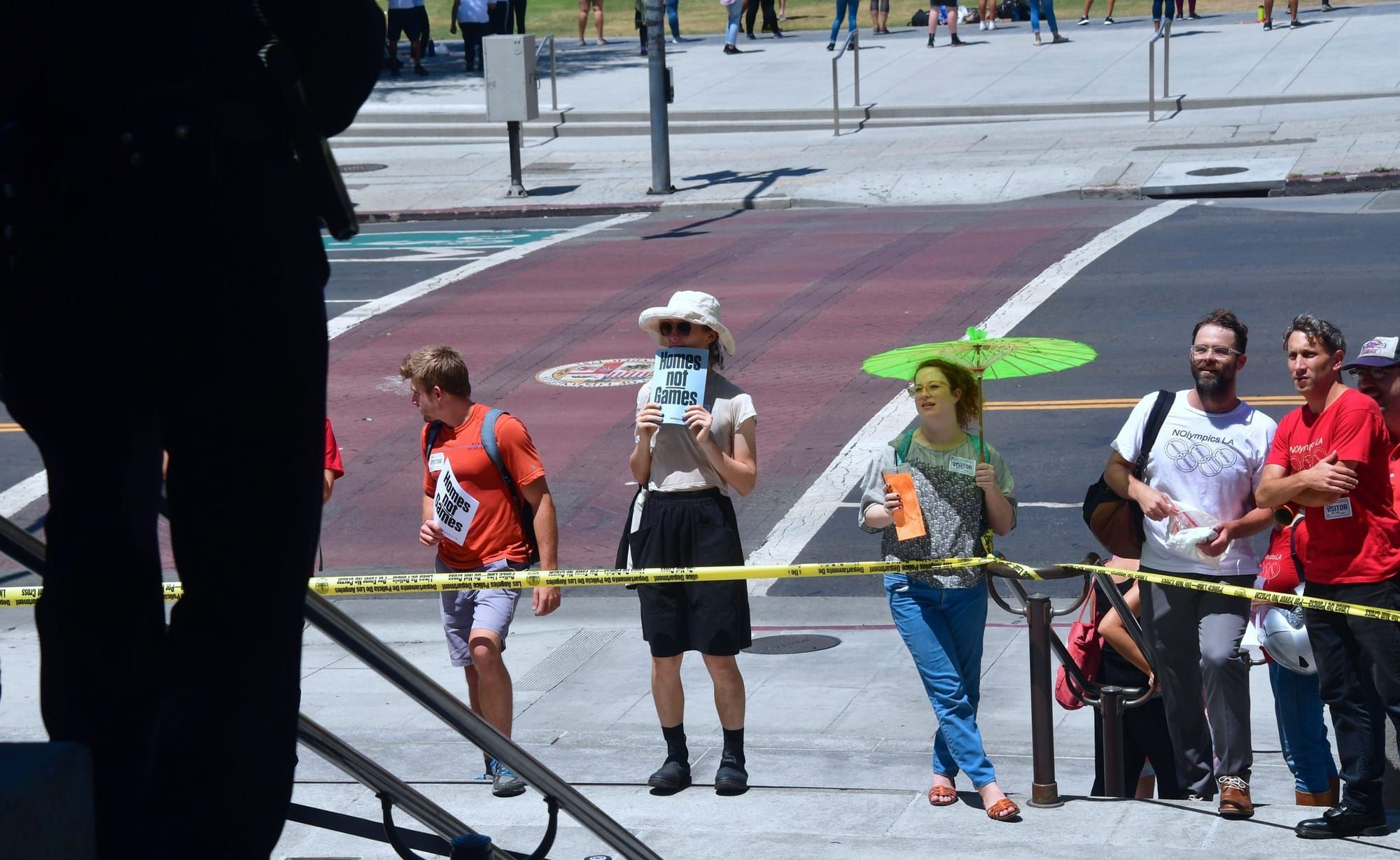
It was rush hour in Los Angeles, and a small but dedicated group of about 10 people gathered on July 23 outside of the Memorial Coliseum. It wasn’t a game day, so there were no crowds to navigate. Still, members of the group were cautious not to attract too much attention as they held banners and posed for photos and video against the backdrop of the stadium’s unlit Olympic torch. At one point, a police helicopter buzzed by in the distance.
A camera on a tripod rolled as they held their fists in the air and chanted, “No Olympics here! No Olympics anywhere! No evictions here! No evictions anywhere!”
The people behind the action were members of NOlympics LA, a coalition of groups and activists organizing against the 2028 Summer Olympics in Los Angeles. They gathered at the Coliseum, the site of previous Olympics in 1932 and 1984, to send a message of solidarity to their counterparts in France, who organized against the Paris Games held over the course of July and August.
NOlympics LA is just one group of many in a loosely affiliated network of anti-Olympic activists in host cities of the recent past, present, and future. These groups aim to highlight how hosting such mega events, like the Olympics, has a lasting impact on host city residents—especially as it relates to housing, homelessness, policing, and the inevitable cost overruns that fall to the public to cover.
The Olympics has come to represent an opportunity for a host city to modernize and revitalize itself, the way that someone might finally put up curtains or paint an accent wall before inviting everyone over for a party. Instead of curtains and paint, it’s the promise of urban renewal and long-overdue infrastructure upgrades that organizers have increasingly used to make a case to officials and residents for hosting the Olympics. In Los Angeles, for instance, that means projects to bolster the region’s rail system, renovate the convention center, and revamp the airport, among others.
But for anti-Olympics activists around the world, these promises elicit more questions than they answer, namely, who are these projects for? Which residents will truly benefit after the Olympics have come and gone? And which residents will be forced to make sacrifices?
“Nothing is inevitable,” NOlympics LA member Eric Sheehan told Prism about the Games coming to Los Angeles. “We can, in fact, say no.”
That’s exactly what Denver said to the Olympics in 1972, when pressure from environmental activists led that city to back out of hosting the 1976 Winter Games. Public outcry is also what led Boston to drop its bid for the 2024 Summer Olympics, just six months after the city beat Los Angeles to represent the United States in the worldwide bid process to host the Games. LA later picked up the bid from Boston, and the International Olympic Committee (IOC) awarded the 2024 and 2028 Summer Games to Paris and Los Angeles at the same time, lest anyone else dropped out.
“It’s not like a natural disaster or a hurricane or an earthquake,” NOlympics LA member Gigi Droesch said. “This is something that has been brought to our cities by politicians and by businesses and by the IOC. And so what it would take to get rid of the Olympics is political will.”
An international movement
In 2019, anti-Olympic organizers worldwide traveled to Tokyo, Japan, for a multi-day summit. People came from LA, Paris, Rio de Janeiro, Pyeongchang (host of the 2018 Winter Olympics), and Indonesia (where an Olympic bid was being considered). The summit included lectures, information-sharing among organizers, a field trip, and a protest as a show of solidarity.
“That was the moment that it actually became an international movement,” Japanese sports scholar Satoko Itani said. “Because up until that point, each city struggled in its own way, and there were just too few people to call it a movement.”
For some activists, the 2016 Rio Olympics marked a turning point. Leading up to it, 700 families in the favela of Vila Autódromo organized to fight eviction—the lower-income neighborhood was adjacent to then-new Olympic Park in a part of Rio that city officials had long been eager to redevelop. Homeownership and land use in Rio’s favelas have a fraught history, so if the Olympics were not quite the reason to evict residents, the Games certainly appeared to be the excuse. In the end, only 20 families were able to hold out against eviction, resettling on the same land in homes provided by the city, in time for Rio 2016—a product of their collective action.
According to Itani, the organizing of Vila Autódromo was an inspiration for members of Hangorin No Kai, an anti-Olympics group in Tokyo. One of its founders, Michiko Ichimura, is a long-time homelessness activist who visited the favela and made connections with organizers on the ground in Rio.
Itani credits Hangorin No Kai with exposing developers’ plans to demolish and replace the Kasumigaoka public housing complex, ultimately displacing 200 families in order to build a new stadium for the 2020 Olympics. “That’s where Hangorin No Kai really worked hard,” Itani said.
Following the success of the first summit in Tokyo, anti-Olympics organizers converged on Paris for another summit in 2022, keeping the movement rolling.
‘They do not have any reason to lose their power’
Natsuko Sasaki has been involved with Paris-based anti-Olympics group Saccage 2024 (meaning “rampage” or “pillage” 2024) since 2016. When she joined, she was already familiar with Hangorin No Kai’s work from friends who were involved back home in Japan.
Leading up to this summer’s Olympics, Saccage focused their organizing efforts on opposing the privatization of public goods, highlighting what Sasaki calls residents’ “right to the city”—to live in affordable housing, to play and socialize in public spaces, and to move freely in the city they call home.
However, generating broader public interest in their cause and forging coalitions with natural allies like trade unions and nongovernmental organizations was a struggle. When she spoke to Prism before the Olympics, Sasaki chalked it up, in part, to being mistaken as antisports intellectuals turning their noses up at anyone who likes sports.
“[Whether] the sport is good or bad, I’m not interested in this debate,” Sasaki said. “But the way the [International Olympic Committee] organized their sporting event is really, really problematic. That is my point.”
For instance, the French government bused unhoused immigrants out of Paris in the months leading up to this year’s Games, promising housing but instead putting many in danger of deportation by entering them unknowingly into a government program to screen them for asylum, for which many unhoused immigrants are not eligible. The Olympics also granted French officials unprecedented and broad use of discretionary powers under an anti-terror law, which allowed them to restrict the movement for people of color flagged as “terror threats.”
But the entrenchment of sports in France—or rather, the entrenchment of France among the international sporting elite—complicated Saccage’s work the most. “The [IOC] was born in France,” she pointed out. Hence the use of French and English at the Olympics.
“French is the first language of the Olympics, and English is the second. And it is not symbolic,” Sasaki said, noting France’s power and influence behind the scenes at the Olympics. “And they do not have any reason to lose their power.”
If the power to shape culture makes the anti-Olympics cause a hard sell in France, it’s the power of nostalgia that does it for Los Angeles.
“The Olympics is a massive machine that has layered itself in good vibes over the years,” Sheehan says. The sports, the athletes, the merch, the heartbreak, and the triumph—he knows the Olympics are alluring. “So just getting through that layer to people is tough.”
Those good vibes are particularly thick in Los Angeles, where it often seems like everyone has a feel-good story about the 1984 Olympics. Whereas Paris last hosted the Olympics 100 years ago, it’s only been 40 years for LA—well within the lifetimes of many Angelenos. And it’s not just that people still remember a festive atmosphere and shockingly little freeway traffic, it’s also the way these memories have been further shaped by lore that LA tells itself about those Games—namely, that it was the first Olympics to make money.
But a lot has changed in LA in 40 years—and the conditions that made the 1984 Games so profitable are not quite the same.
“It’s supposedly a private-run Games, but there’s a [public] backstop for unlimited money,” Sheehan said.
Whereas city leaders could place strict limits on public spending for the 1984 Games, the IOC now locks host cities and governments into covering all overruns for nonsecurity costs. And with cost overruns only increasing for each Olympics—about 185% for the last three Summer Games—it’s not a matter of if those costs will fall on Angelenos for the 2028 Olympics, but how much and how hard.
And for all the talk of Los Angeles 2028 being a “no-build” Olympics—Los Angeles won the 2028 Games in part by pledging to use only existing venues for events—Droesch points out that “no-build” only really applies to venues, not the adjacent developments like hotels, shopping, and luxury apartments. This is already having an impact on low-income renters near major venues like the Coliseum and SoFi Stadium, who face eviction. And for a county where almost 55% of residents are renters, this puts a lot of people at risk.
“People don’t like the Olympics; they like watching television,” Droesch said. “And they don’t like what the Olympics actually does to their cities.”
LA28, the privately run organizing committee behind the 2028 Olympics, may have unwittingly given away the game during the closing ceremony in Paris on Aug. 11. During the handoff of the Olympics from Paris to Los Angeles, the closing spectacular at the Stade de France cut away from a live, in-stadium stunt by Tom Cruise to a preproduced video—not unheard of for recent host cities, as Tokyo also showed a Nintendo-themed video during the closing ceremony of Rio 2016.
But no one expected—least of all the athletes in the stadium, who saw Snoop Dogg all over Paris and who were looking forward to in-person performances by the Red Hot Chili Peppers and Billie Eilish—the performances to be pre-recorded, taped the day before on a sunny Southern California beach.
The athletes and the adoring fans in the stands, who paid anywhere from $50 to $1,791 to be there, watched it the same as the rest of us—squinting at a screen with terrible sound. Some in Paris took to social media to express their disappointment.
However, the message that LA28 sent, intended or not, was: It doesn’t matter what the experience is in person, but rather, does it look good on TV?
‘No city deserves to have this happen to them’
Several anti-Olympics groups from around the world cosigned a declaration of solidarity at the start of the Paris Olympics in July, pledging to continue their work. “Your struggle is our struggle,” it reads.
The Olympic flame will next make its journey to Italy for the Winter Olympics in 2026. Anti-Olympics group Comitato Insostenibili Olimpiadi (or “Unsustainable Olympic Committee,” CIO for short, a play on the Italian for “IOC”) is already at work and communicating with other groups—especially those in Paris, a spokesperson said.
But Sasaki is disappointed that she and Saccage didn’t manage to shut down the Paris Olympics altogether. And it’s not just this year’s Games that have her feeling down. France just won the bid for the 2030 Winter Olympics as well.
“This was a huge failure for us,” she said. “I cannot be proud of anything.”
Sasaki was not always so glum. “She was the one member of Saccage that was like, ‘We need to actually try to stop the Olympics,’” Sheehan said. He learned a lot from her and other anti-Olympics activists in the early days of NOlympics LA, but he admitted he’s doing more teaching now as they connect with groups in cities where the Olympics are headed next.
“[We] make sure they understand the threat and that they know all that they can do to try to stop it from happening in their town,” he said.
Droesch said she’s in constant communication with groups around the world. “I think, like, every day I get a text on my phone from somebody,” she said. In addition to people from LA, Paris, and Tokyo, there’s also others from Oklahoma City (where canoe slalom and softball will take place during the 2028 games); Salt Lake City (recently named host of the 2034 Winter Olympics); and even folks from way back in Rio and London.
“It’s not something where once the Olympics is held in your city, you’re like, all right, bye,” Droesch said. “We believe that the Olympics should be abolished because no city deserves to have this happen to them.”
As the clock ticks down to 2028, NOlympics LA knows they have their work cut out for them. No one else, save for Denver in 1976, has managed to run the Olympics out of town. But that doesn’t mean they won’t try as they continue to collaborate with the local groups and activists in their coalition.
Because a lot can happen in four years.
Author

Andrea Gutierrez (she/her) is an award-winning writer and audio producer in Los Angeles. She’s drawn to stories at the intersection of culture, identity, and power. Her work has been featured in NPR,
Sign up for Prism newsletters.
Stay up to date with curated collection of our top stories.