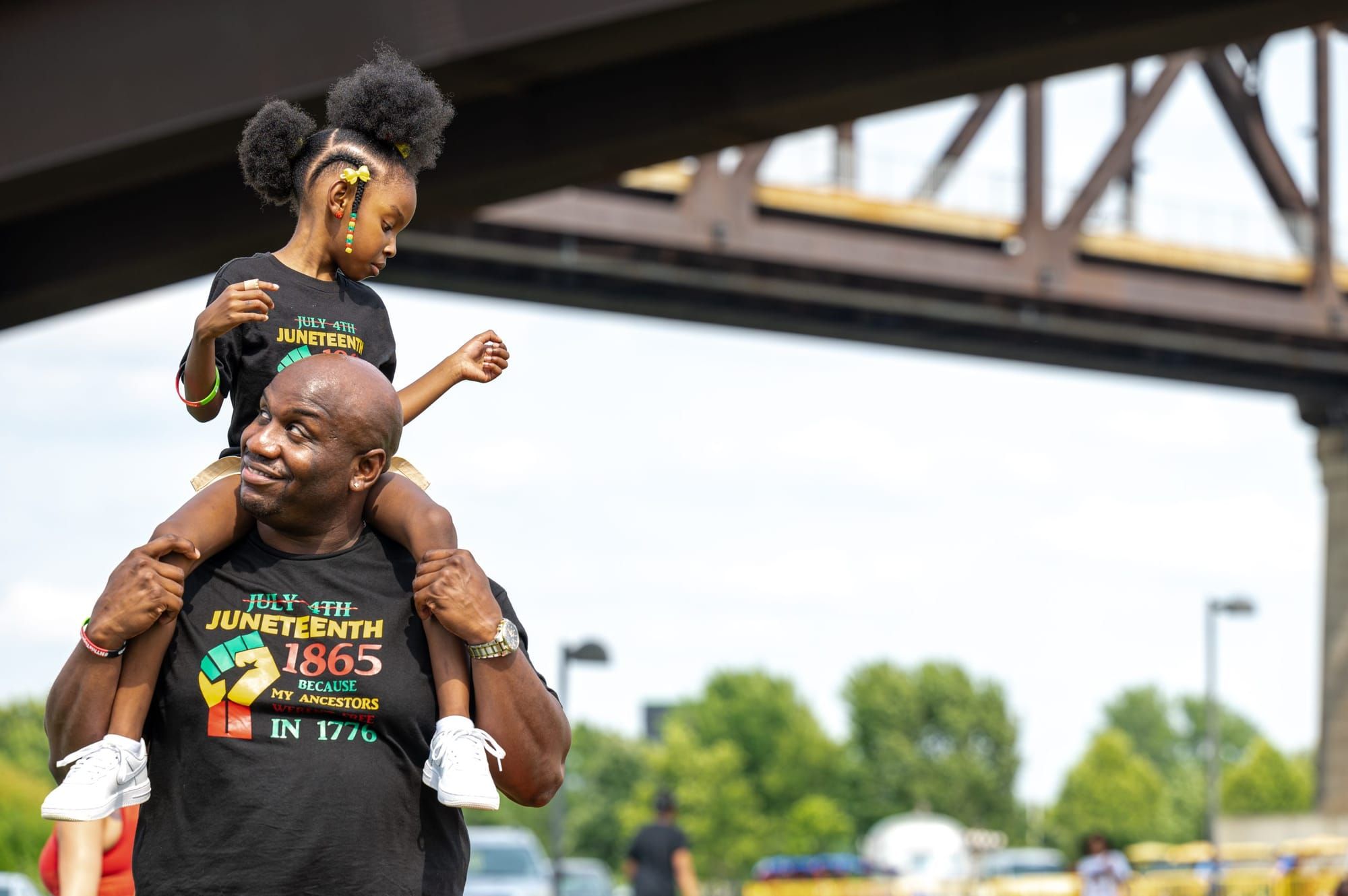
Juneteenth memorializes the day when Union troops arrived in Galveston, Texas, on June 19, 1865, to announce all enslaved peoples were free upon the surrender of the last Confederate stronghold. More than 150 years later, in 2021, President Joe Biden made Juneteenth a national holiday.
Holidays and memorials remind us of who we are as a country—our past and who we hope to become in the future. Juneteenth celebrations provide the opportunity to remember the real national Independence Day.
As Frederick Douglass said, the Fourth of July was an Independence Day for white people and one that was cloaked in hypocrisy:
“What, to the American slave, is your Fourth of July?” Douglass said during a keynote on July 5, 1852. “I answer: A day that reveals to him, more than all other days in the year, the gross injustice and cruelty to which he is the constant victim. To him, your celebration is a sham; your boasted liberty, an unholy license; your national greatness, swelling vanity; your sounds of rejoicing are empty and heartless; your denunciations of tyrants, brass-fronted impudence; your shouts of liberty and equality, hollow mockery; your prayers and hymns, your sermons and thanksgivings, with all your religious parade, and solemnity, are, to him, mere bombast, fraud, deception, impiety, and hypocrisy—a thin veil to cover up crimes which would disgrace a nation of savages. There is not a nation on the earth guilty of practices, more shocking and bloody, than are the people of these United States, at this very hour.”
In my 10th-grade classroom in Camden, New Jersey, Juneteenth is discussed during our unit on the Civil War. But as part of our lessons on the American Revolution, students juxtapose the meaning of Juneteenth with that of the surrender at Yorktown, when, in 1781, the British army surrendered in Virginia, ending the Revolutionary War. By the time June 19 arrives on the calendar, my students are well versed on Juneteenth’s significance, which is important because by then, school is out for the summer.
Most young people nationwide aren’t in school on Juneteenth, including those in Los Angeles, Chicago, Houston, and Philadelphia—the nation’s largest cities with large Black populations. Schools closing earlier in June presents districts unwilling or unable to adequately teach or observe Juneteenth with a loophole to avoid the holiday altogether.
Despite its illegitimacy as an Independence Day for all, the Fourth of July is still overwhelmingly embraced as a national holiday. Juneteenth, however, is not.
The Fourth of July is memorialized in the norms and folkways of the U.S. Parades take place. Entertainers are hired to perform concerts nationwide for cities big and small. Families gather for food and festivities. Most of these events culminate with a fireworks show, often paid for with money from city coffers made possible by taxpayers. Many of these celebrations even take place on empty school campuses.
While Juneteenth is now a federal holiday with events scheduled nationwide (often due to Black community leaders), these celebrations are a new phenomenon. To be clear, celebrating Juneteenth is not new for African Americans. We’ve celebrated Juneteenth in some capacity since 1866, using the color red to remember those who died along the Middle Passage because red is associated with ancestral reverence in West African traditions. This means plenty of red rice, red velvet cake, and red drink.
After the police murder of George Floyd in 2020, Juneteenth celebrations across the U.S. became more common, cementing June 19 more broadly as a day of reverence and celebration. But as recent as this is, Juneteenth is already threatened by the current political climate in which teaching Black history is under attack by Republican lawmakers, conservative groups, and other right-wing movements. While most people of all backgrounds across the U.S. believe that Black history should be taught in the classroom, states like Florida, Georgia, and Mississippi continue to limit what can be taught because of Republican state lawmakers’ fear of critical race theory.
In places where Black history instruction is subject to white surveillance and hysteria, the subject of Juneteenth likely amounts to nothing more than a footnote in the self-congratulatory framing of Civil War instruction. It’s likely also very common that Juneteenth is improperly glossed over in educational settings where history faculty aren’t familiar with the date and its meaning and are not mandated by their school district to learn and teach this history.
What does all of this mean for students? In most cases, Juneteenth isn’t properly acknowledged—if it’s acknowledged at all. In these educational spaces, June 19 is just another date on the calendar, just as the Fourth of July is not acknowledged by some African Americans as Independence Day. The difference is that the Fourth of July did not, in fact, change the conditions of the enslaved.
It is too convenient that because of where Juneteenth falls in the academic calendar, many schools avoid the date altogether or defer to teachers to discuss it as they see fit, which often means not discussing it at all.
This is a loophole that must be closed.
Understanding how the Fourth of July is marked nationally in ways Juneteenth is not, school districts must intentionally set out to memorialize and celebrate Juneteenth and prioritize teaching students its importance. Shifting Juneteenth’s day-off observance from its current place to an instructional day during the school year—as some schools do—doesn’t accomplish these goals. But there are simple steps school and district leaders can take to prioritize Juneteenth for students.
First, schools can decorate for the occasion. Schools can erect red posters, banners, and bulletin boards to mark the date. Second, schools can work with their food servicer to provide red foods and drinks for students to consume during their lunch periods, with posters explaining the historical significance of the items. Lastly—and most importantly—teachers can incorporate age-appropriate historical texts throughout the school year for reading and discussion within broader U.S. history instruction. Resources already exist to make this possible, including this reading list from the National Museum of African American History and Culture.
Why is this a responsibility of schools? Because schools, in addition to providing young people with skills and competencies for the future, socialize young people to understand why specific norms and folkways are important in our society. Students who understand Juneteenth and its importance grow into voters and community stakeholders. They become the guardians of what’s important to our society.
When we plant seeds in classrooms, they sprout in the public sphere. If there is to be reverence for Juneteenth that sprouts in the public sphere, educators must plant instructional seeds in classrooms today—that is, unless a loophole that allows for the erasure of Black history and resistance isn’t a big deal.
Author

Rann Miller is an educator and freelance writer based in Southern New Jersey. His Urban Education Mixtape blog supports urban educators and parents of children attending urban schools. Miller is the a
Sign up for Prism newsletters.
Stay up to date with curated collection of our top stories.